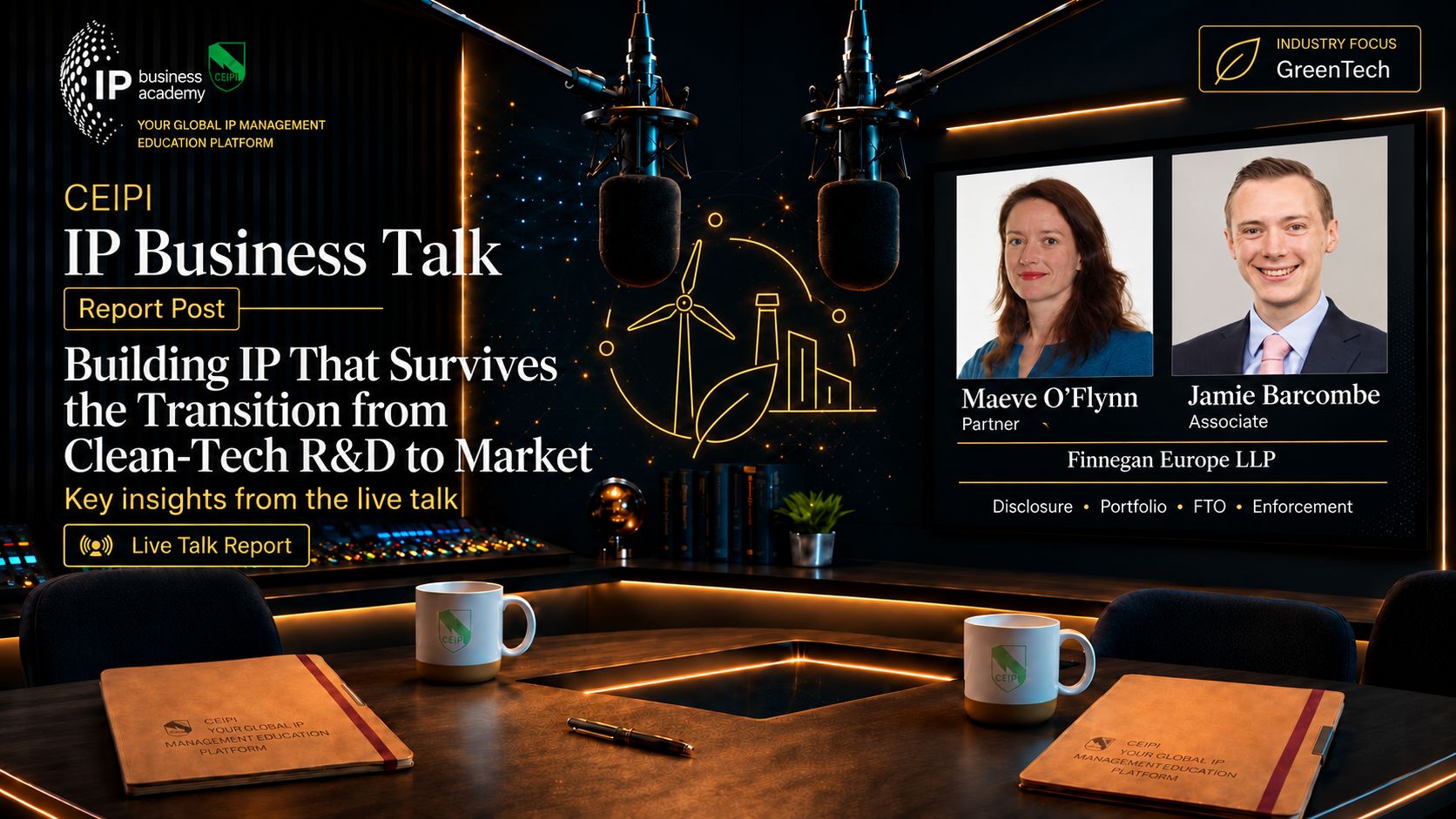
Building IP That Survives the Transition from Clean-Tech R&D to Market with Maeve O’Flynn and Jamie Barcombe

A successful cleantech pilot changes the decisions a company has to make. Commercial partners need technical information, engineers adapt the process for industrial use, and customers reveal requirements that were difficult to anticipate in the laboratory. The IP position built around the original invention needs to remain useful as those changes accumulate.
In the CEIPI IP Business Talk on 29 October 2026, Maeve O’Flynn and Jamie Barcombe from Finnegan Europe LLP joined Prof. Dr. Alexander J. Wurzer to discuss this transition. The conversation connected disclosure, collaboration agreements, invention capture, trade secrets, freedom to operate and enforcement. A recurring theme was the need to bring IP into the technical and commercial decisions through which the business develops.
Disclosure requires coordination with the commercial timetable
Moving towards the market creates pressure to demonstrate what a technology can do. Presentations, pilot installations and discussions with potential partners can all require the company to reveal information before its protection strategy has caught up.
O’Flynn emphasised early communication between the people preparing those interactions and the IP team. Commercial progress and a sound protection position can support each other when the relevant decisions are made deliberately. The difficulty often begins when colleagues fail to recognise that an apparently routine business activity has IP consequences.
The discussion extended beyond academic publications and conferences. Press releases and information shared in financial reporting can also deserve attention. Advisers need to know what is about to be disclosed early enough to assess the implications and available options. Once information has been released, the room for action may be much smaller.
Confidentiality agreements need to be understood in practice
An NDA can create confidence that a discussion is protected, while the agreement’s actual scope receives little further attention. O’Flynn highlighted the need to check its duration, the subjects it covers and whether it still applies to the interaction being planned.
This becomes demanding as a relationship develops. The initial agreement may concern a limited set of topics, while subsequent discussions move into a pilot project or a different technical application. People working on the project need to understand those boundaries and recognise when the agreement requires review.
Wurzer connected this with the broader problem of awareness. A colleague may see a technical presentation or customer meeting without recognising the protection decision embedded in it. Training and a clearly assigned coordination role help make the contractual framework usable in everyday work. They also help address the practical risk that confidential information is handled less carefully than the parties intended.
Pilot projects can generate a new layer of IP
A pilot may start as a test of existing technology and still produce valuable improvements. O’Flynn and Barcombe therefore encouraged attention to the agreements governing collaboration before the work begins. The parties need a shared understanding of how resulting IP will be handled, even when they expect the project to involve implementation rather than invention.
The same discipline applies to the company’s existing filings. As development progresses, the team needs to compare the original disclosure with what it is doing now. Some developments may be supported by that disclosure; others may require a further application. The available options depend on what was originally disclosed and when subsequent developments and disclosures occurred.
The management implication is to keep portfolio review connected with the project. Filing an initial application creates a starting position. Further engineering, customer learning and collaboration can change which capabilities require protection.
Commercial relevance helps prioritise what to protect
Barcombe placed invention identification within a broader process of recognising IP across the business. R&D teams need suitable channels for bringing developments forward, while colleagues in other functions, including marketing, may identify different assets. Regular discussions or disclosure forms can support that process, provided they fit how the company works.
Capturing developments broadly gives the company a basis for deciding which ones deserve investment. Barcombe suggested considering whether preventing a main competitor from using a development would create a meaningful advantage. This links the protection decision with a competitive situation that management can assess.
Incremental improvements can perform well under that test. A process change that improves efficiency or lowers costs may support a better price, a stronger margin or both. Its commercial significance can be substantial even when the development appears modest to the engineers who produced it.
Trade secrets require resources and a realistic risk assessment
Process innovation featured prominently in the discussion of patents and secrecy. Where valuable information remains internal and is difficult to discover from the marketed product, trade secret protection may be worth considering. Detecting a competitor’s use of an internal process can also be difficult, which affects the practical value of a patent intended for enforcement.
Wurzer challenged the assumption that secrecy offers a cheap solution simply because there are no patent filing fees. Barcombe pointed to the systems, access restrictions and working practices needed to maintain confidentiality. These measures require resources and continuing attention.
The company also needs to consider the consequences of losing secrecy. Independent development or reverse engineering may erode the advantage on which the business relies. The choice therefore involves the expected commercial benefit, the feasibility of maintaining confidentiality and the risks associated with each protection route.
An agreed strategy gives coordination a commercial purpose
Responsibility for keeping these issues connected became a central organisational question. O’Flynn described the value of someone within the business driving coordination, potentially from product development, with an understanding of the difference the technology makes commercially.
An agreed IP strategy provides the reference point for that work. Relevant colleagues need to understand what the company is trying to achieve and how its IP decisions support those objectives. The strategy can be concise, provided the people involved have contributed to it and share its direction.
This turns alignment into a practical management task. A filing, a confidentiality decision or an agreement needs a reason connected to the business. The coordinator helps ensure that those reasons remain visible as different teams make decisions under different pressures.
Freedom to operate must follow technical change
An FTO assessment rests on assumptions about the product or process being evaluated. O’Flynn illustrated how later engineering decisions can change that basis: a process temperature may be adjusted, a component replaced or a different supplier selected.
The assessment therefore needs to be revisited as development proceeds. Defined milestones can provide opportunities to check the assumptions and update the analysis. Wurzer raised the challenge of doing this within agile development, where changes may occur continuously rather than at a few formal gates.
The discussion pointed towards integrating IP expertise with technical and commercial teams. Training helps people recognise when a design decision should trigger a conversation with an IP specialist. The appropriate process depends on the organisation’s working methods and needs to make relevant changes visible while the company can still respond.
Enforcement considerations belong in portfolio development
Barcombe connected the intended use of a patent with the way it is drafted and prosecuted. If the commercial objective includes keeping competitors out of a market, the company needs to consider how it would identify and demonstrate infringement.
Process claims can raise particular difficulties when different steps are performed by different parties or in different countries. Such arrangements may complicate enforcement. Thinking about the likely industrial implementation early helps the company assess whether the proposed claims address commercially relevant activities in a practical way.
Design-arounds deserve the same attention. How might a competitor achieve a similar result while avoiding the claims? A portfolio can develop as the technology matures, combining claims directed to established implementations with protection reflecting areas where development continues, within the limits of the supporting disclosure.
Wurzer brought the conversation back to the economic purpose of exclusion: which activities does the company want to prevent others from carrying out, and why would preventing them matter? That question connects drafting and portfolio choices with the position the business hopes to sustain.
Keeping IP useful through the transition to market
Across the talk, the challenge was maintaining the connection between protection and a business that continues to change. New disclosures, technical improvements and partner relationships can alter the company’s options. FTO assumptions and enforcement priorities need to follow that development.
The conversation showed why cleantech IP management requires continuing exchanges between commercial colleagues, engineers and advisers. When those exchanges are part of the company’s working processes, IP can support the decisions that turn a promising technology into a durable competitive position.
Maeve O’Flynn
 Maeve O’Flynn is a Partner and UK and European Patent Attorney at Finnegan. Her experience includes in-house roles at Johnson Matthey and Shell. She advises on chemical technologies, commercially focused IP strategies, trade secrets, collaboration agreements and patent portfolios, bringing a perspective shaped by work inside industrial businesses.
.
Jamie Barcombe
 Jamie Barcombe is an Associate at Finnegan in London whose practice combines patent strategy, prosecution, freedom-to-operate analysis and litigation. With a background in biochemistry, he works across clean technology and life sciences and brings experience connecting portfolio development with the practical demands of disputes.
.
Explore the wider context in our Industry Focus on IP in GreenTech:
👉 https://profwurzer.com/diplex/green-tech/