Pin it

Learning to Manage IP as a Business Function: Enrolment Opened for the MIPLM 2026/27

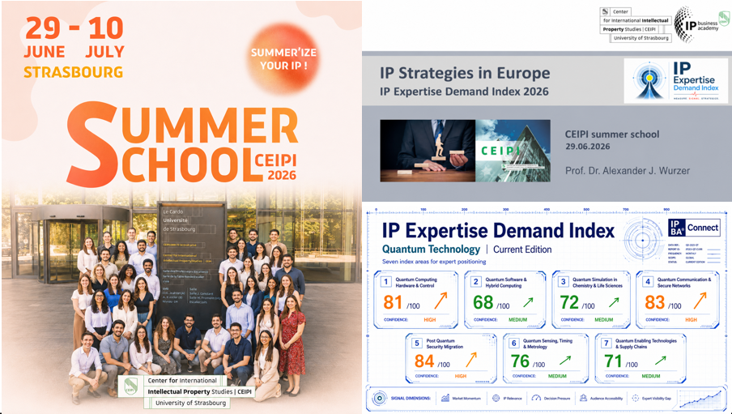
The enrolment for the 2026/27 edition of the Master of Intellectual Property Law and Management (MIPLM) at CEIPI, University of Strasbourg, is now open. The program will run from autumn 2026 into 2027 and is delivered in a modular format, combining on ...

Read More
Pin it

Agile IP Management in Practice: Module 4 of the MIPLM 2025–26 About Organizing Innovation

Agile IP Management is no longer a niche topic for legal specialists. It has become a practical management question for organizations that must innovate under conditions of uncertainty, speed, and constant change. In Module 4 of the Master Programme f ...

Read More
Pin it

Outsourcing in IP Management: What CEIPI’s Module 4 Lecture Reveals About the Future of Legal and Innovation Work

In the fourth module of the Master Program for IP Law and Management at CEIPI, the lecture on outsourcing explored a topic that is often treated as a purely operational issue, but is in fact deeply strategic. Outsourcing in IP and legal work is not si ...

Read More
Pin it

Organizing IP Management: From Legal Function to Strategic Business System – Modul 4 MIPLM 2025-26

Modern companies continuously generate intangible assets such as inventions, software, designs, and brands. These assets often represent the most valuable resources of innovative organizations. However, in many firms intellectual property management s ...

Read More
Pin it

Managing Technological Innovation in Practice: CEIPI MIPLM 2025/26 Module 3

In Module 3 of the CEIPI Master of MIPLM, the lecture on managing technological innovation takes on a problem many organizations feel but rarely name clearly: innovation needs freedom, while management needs reliability. The course does not pretend th ...

Read More
Pin it

The Dynamics of Technological Innovation: CEIPI MIPLM 2025/26 Module 3

Technological innovation is often portrayed as a linear success story: a breakthrough invention, a clever business model, rapid market adoption, and long-term dominance. The reality, as explored in the third module of the Master for IP Law and Managem ...

Read More
Pin it

Pricing the Invisible: How IP Valuation Turns Brands and Patents into Hard Numbers

Intellectual property has become one of the main engines of enterprise value. Global rankings of the “Best Global Brands” show that for companies like Apple, Microsoft or Coca-Cola, branded intangible assets account for a substantial share of market c ...

Read More
Pin it

From Apollo 13 to IP Strategy: How Managers Really Make Decisions

the film Apollo 13, there is a famous scene with Lead Flight Director Gene Kranz in Mission Control. The spacecraft is in trouble, the CO₂ levels are rising, and the engineers are given a brutal brief: “We’ve got to find a way to make this fit into th ...

Read More
Pin it

From Nuclear Standoffs to Patent Races: What Game Theory Teaches Us About IP Strategy

Game theory was born in the context of war, markets and competition – situations where outcomes depend not only on what you do, but also on what others decide at the same time. In modern IP strategy, this is the daily reality: competitors react to you ...

Read More
Pin it

Capability IP at Dangote: How Controlling Complementary Goods Becomes the Real “IP”

How can a company in commodity markets like cement, sugar or fuels build a lasting competitive advantage when products look similar and technological features are easy to copy? The Dangote case makes one point very clear: the real strategic leverage d ...

Read More
Linkedin
×
Cart