
Why Psychology and Strategy Together Determine the Success or Failure of Corporate IP

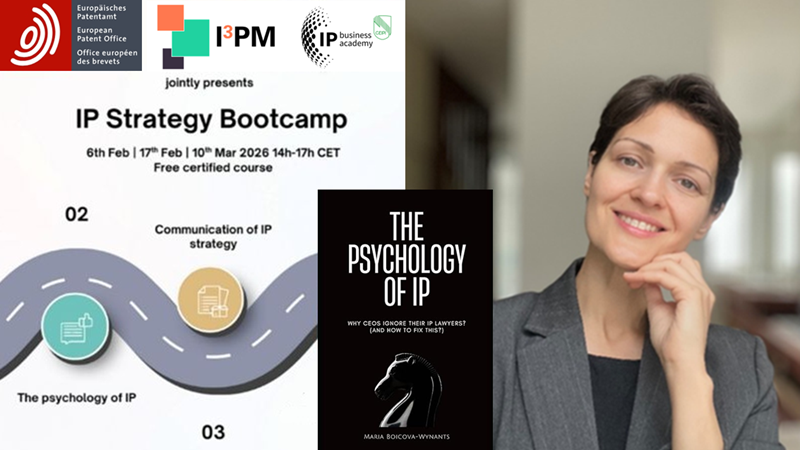
As innovation increasingly drives competitive advantage and corporate valuation, intellectual property (IP) has evolved from a legal checkbox into a strategic business imperative. Yet in many organisations, IP still remains siloed within IP legal teams, undervalued in boardroom discussions, and misunderstood at the operational level. The upcoming EPO – I3PM – CEIPI IP Business Academy IP strategy bootcamp directly addresses this challenge by combining IP strategy trainings with insights into executive decision-making and organisational behaviour.
Why IP Fails in the Boardroom: A Psychological Perspective
A central contribution to the bootcamp comes from Maria Boicova-Wynants, who will present on the psychology of IP strategy. In her recent book “The Psychology of IP: Why CEOs Ignore Their IP Lawyers (and How to Fix This)”, she highlights a critical but often overlooked reality: many IP initiatives fail not because the legal analysis is wrong, but because the message does not resonate with decision-makers.
From a psychological perspective, executives tend to prioritise growth narratives, financial performance, and competitive positioning. IP advice, however, is often framed in abstract legal language. This mismatch leads to predictable outcomes: IP warnings are deprioritised, strategic opportunities are missed, and IP is perceived as a cost centre rather than a value driver. Cognitive biases such as overconfidence, short-termism, and loss aversion further reinforce these patterns.
Understanding these psychological dynamics is essential. IP professionals who want to influence a company’s IP strategy must learn to translate legal insights into business impact. That means framing IP in terms of time-to-market, revenue protection, negotiation power, freedom to operate, and strategic flexibility. Psychology, in this sense, is not a soft add-on, but a prerequisite for making IP visible and actionable at the board level.
Why IP Strategy Is a Matter of Business Survival
At the same time, psychology alone is not sufficient. Companies also need robust IP strategies grounded in hard business realities. An IP strategy defines how IP assets support corporate objectives, whether through protecting core technologies, enabling market entry, supporting partnerships, or strengthening valuation in financing and M&A contexts. Without such a strategy, organisations expose themselves to significant IP and business risks.
These risks include loss of the freedom to operate, weak defensive positions against competitors, missed licensing or collaboration opportunities, and inefficient R&D investments. In extreme cases, the absence of a coherent IP strategy can determine whether a company successfully scales or fails under competitive or legal pressure. IP strategy, therefore, is not about accumulating legal rights, but about aligning IP protection, risk management, and value creation with the company’s long-term goals.
Bridging Psychology and IP Strategy
The IP Strategy Bootcamp is designed to bridge precisely this gap between psychological insights and practical execution of IP strategy. Participants work on concrete frameworks for IP strategy development while simultaneously learning how to communicate IP value in a way that resonates with executive decision-makers. Through practical assignments and guided discussions, the bootcamp focuses on turning IP expertise into a board-level priority.
Turning IP into a Board-Level Topic
Ultimately, the combination of psychology and strategy defines whether IP remains an expert task or becomes a strategic asset. IP experts that understand both dimensions are better positioned to foster informed decisions, explain how to avoid costly missteps, and systematically turn clients’ innovation into sustainable competitive advantage. In an economy dominated by intangible assets, this capability is no longer optional. It is a decisive factor for long-term economic success.