Visible IP – From LinkedIn signals to real client journeys: A new live show format with Giulia Donato and Alexander Wurzer

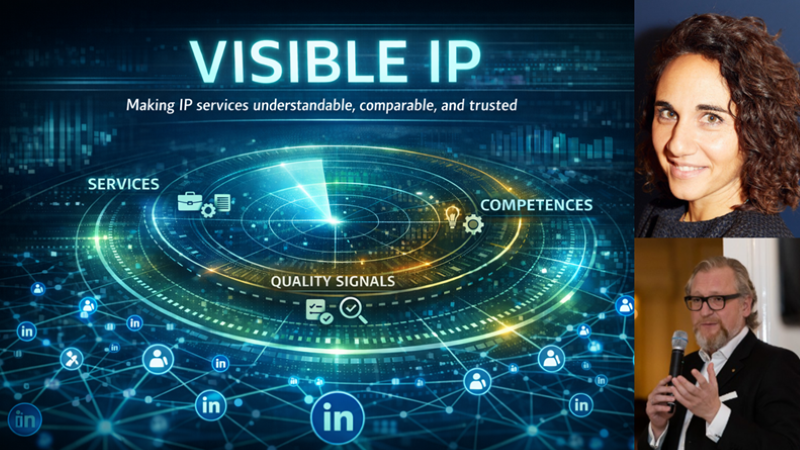
Making IP services understandable, comparable, and trusted
If you ask ten innovation teams what they “need from IP,” you will often hear the same list: a patent filing, a trademark check, maybe an FTO, sometimes “support with licensing.” What you rarely hear is clarity about which IP services exist in the market, what “good” looks like for each one, how to scope them properly, and how to tell real competence from polished wording.
That gap matters, because the market for IP services is not only complex. It is also structurally opaque. Many users of the IP system simply cannot see, in advance, which capabilities are available, in what depth, and with what quality. The result is predictable: projects start too late, scopes are chosen poorly, budgets are misallocated, and trust erodes when expectations and deliverables do not match.
A useful reference point is the Fraunhofer IMW working paper Shortcomings on the Market for Intellectual Property. It highlights “lack of transparency” and also “poor IP service quality” as recurring problem fields, and it treats these issues as connected rather than isolated.
Why this opacity keeps happening
IP services have a specific feature that makes transparency unusually hard: for most buyers, quality is difficult to evaluate even after the service is delivered.
In economics, this is often described through the lens of credence goods: services where the provider typically knows more than the buyer about what is needed, and where the buyer cannot reliably verify whether the chosen scope and the delivered quality were “right.” Think of complex repairs, medical diagnostics, or specialist advice. Legal services are a classic example.
In IP practice, the same mechanism shows up in very concrete ways:
- The “right” depth of an FTO depends on use case, jurisdiction, time horizon, and risk tolerance.
- A “good” claim strategy depends on the product roadmap, competitive design space, and the enforcement narrative, not only on novelty.
- Portfolio management can mean a spreadsheet clean up, or it can mean a governance system that shapes investment and negotiation power.
When diagnosis and delivery sit with the expert, buyers need signals. And when signals are weak, the market becomes noisy.
Research on partner choice in the patent law firm context illustrates this reliance on proxies: clients are more likely to choose firms that also work with competitors because the competitor’s choice acts as an observable expertise signal when direct quality comparison is hard. Here you find the study Competitive overlap as a signal in expert partner choice: Evidence from patent law firm selection.
Why LinkedIn has become part of the solution
At first glance, social media seems like the wrong place to improve a specialist services market. Yet LinkedIn has developed into a surprisingly practical arena for one reason: it exposes how experts think.
When IP professionals share case patterns, decision logic, typical pitfalls, and boundary conditions, they create something the market rarely provides: a public trace of competence. This is not about self-promotion. It is about reducing search costs for users who do not even know which questions to ask.
There is also research that connects credence goods markets with the informational value of new media, including the idea that digital channels can support self-diagnosis and help buyers identify trustworthy providers.
Introducing our new format inside the 🖥️CEIPI IP Business Talks
This is exactly where our new regular live format begins.
Visible IP is designed as a practical response to the intransparency of the IP services market. The starting point is deliberately not “business development tips for patent attorneys.” Instead, we focus on a broader system question: How can visible, high quality communication by IP experts help users of the IP system understand what is available, what quality looks like, and how to make better decisions earlier?
In other words, personal visibility is not treated as an end in itself. It is treated as an instrument for IP awareness building, and as a way to make an otherwise opaque services market more legible.
What we will do in each episode
Each Visible IP session follows a clear two part structure.
Trend watch, how IP experts communicate on LinkedIn
Giulia and I review current developments in IP communication on LinkedIn using real posts from practitioners. We anchor this in two curated sources: the “Whom to follow” section of the 🎯IP Management Pulse newsletter, and our own IP influencer list.
This allows us to bypass three questions that often block professionals before they start:
- Is it legitimate for IP experts to be active on LinkedIn
- Which formats are appropriate
- Are only extreme outliers visible, or is there a peer group reality
When patterns and trends are visible, these questions tend to answer themselves. The discussion becomes concrete: what works, why it works, and for whom it works.
From a single post to a full client journey
We then take one specific example and show how that communication signal can be translated into a coherent customer journey, not only on LinkedIn, but across the full set of touchpoints that lead to trust and engagement.
This includes practical elements such as:
- What the “first meaningful problem statement” looks like
- Which clarifying questions reduce mis scoping
- What a clean boundary between education and advice looks like
- Which deliverables create confidence early, and which do not
- How a service becomes understandable without becoming simplistic
We will use one reference case from our own work to make this tangible, while keeping the discussion focused on method rather than on promotion.
Two perspectives, one purpose
Giulia brings the personal branding and communication psychology perspective: how trust signals form, what feels credible, and how expertise can be expressed in a way that stays accessible for non-specialists.
I bring the market and systems perspective: why intransparency in IP services has real economic consequences, how it affects decisions inside companies, and how a well-designed client journey can turn “unknown services” into understandable options.
This is also why Visible IP is not intended as marketing talk. It is a format that supports CEIPI’s broader mission of IP awareness building, while showing how individual business development and ecosystem clarity can reinforce each other.
What viewers should take away
Across episodes, we want to create a practical set of outputs that make the market easier to navigate:
- A growing “map” of IP service types, typical scopes, and common mis fits
- A set of questions that buyers can use to specify what they actually need
- A set of quality indicators that are observable without confidential access
- Clear examples of how IP work connects to business outcomes, risk, and timing
There is also an emerging research angle here: attempts have been made to operationalize IP service quality and service mode in a structured measurement scale, which shows that “quality” is not only a matter of taste. It can be described and tested. (PubMed)
First live date
The first Visible IP live session will air on 10 March 2026.
We will start with a concrete trend example from LinkedIn and then build a full client journey explanation around it, focused on transparency, trust, and better decision making in IP services.
 Giulia Donato
Branding & Communication Advisor | Executive Coach | Lecturer
people & brand strategies
www.donatostrategies.com
Columnist on the 📝IP business academy blog and in the 🎯IP Management Pulse Newsletter
 Prof. Dr. Alexander Wurzer (Director IP Management Education at CEIPI), is professor at the Center for International Intellectual Property Studies (Centre d’Etudes Internationales de la Propriété Industrielle, CEIPI) at the University of Strasbourg, where he is responsible for all academic IP management training programmes run by the IP Business Academy. On his LinkedIn channel, he offers a newsletter on business development for IP experts and his monthly #reflectandlearn. He also provides fitting BD tools on the 🌱 resource hub.