
MedTech & Digital Health Systems in motion: Why IP Is Becoming a Decision System for Connected Healthcare Innovation

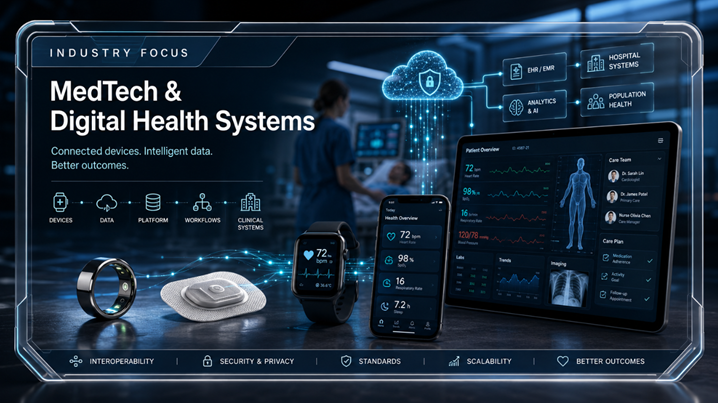
MedTech and digital health are no longer separate innovation fields. Medical devices, software, data processing, connected sensors, digital platforms, clinical workflows and European enforcement structures are beginning to form one strategic environment. This matters for IP management because IP is moving from a narrow protection function into a decision system for control, collaboration, market access, risk management and competitive positioning.
From medical devices to connected health systems
A visible signal comes from the European patent landscape. In their article “Unitary Patents – MedTech leads the way!”, Frank Lee and Thomas Prock of Marks & Clerk observe that “MedTech constantly has a higher uptake rate than the average.” Their analysis links MedTech to the growing use of the Unitary Patent and the Unified Patent Court, showing that medical technology companies are not only innovating, but also adapting their European protection and enforcement architecture.
That signal is important because it points beyond filing statistics. MedTech companies increasingly need broad territorial protection, efficient enforcement options and coordinated portfolio decisions across Europe. Marks & Clerk note that MedTech leads Unitary Patent filings among technical fields with more than 7,200 requests and that the UPC has already become a significant venue for strategic MedTech litigation in Europe.
This is not just a question of where to validate a patent. It reflects a broader shift: medical innovation is becoming more system based. Devices are connected to data flows, software layers, service models, cloud platforms, supply chains, clinical users, reimbursement structures and regulatory pathways. A patent strategy that only protects a physical device may miss the places where value and control are actually moving.
Digital health is becoming practical, not speculative
The practical reality becomes even clearer when looking at health data. In “Patenting the processing of medical data – and lessons of T 1741/22 applicable to other fields”, Dustin Bauer of Reddie & Grose explains that the impact of a recent EPO Board of Appeal decision “may affect patentability of inventions related to health data.” The article is authored by Dustin Bauer, Senior Associate, and sits in the Medical Devices & Digital Healthcare sector.
This is a core issue for digital health systems. Many innovations are no longer only about an improved instrument, implant or diagnostic device. They involve physiological measurements, sensor data, medical images, user generated health data, processing methods and output logic. The strategic question is therefore not simply whether the company has a medical device. It is whether the technical contribution can be framed, protected and defended in a way that matches the business model.
Bauer’s discussion of medical data processing shows why patent strategy must begin early. If the decisive value lies in how data is captured, structured, processed and translated into a medically or operationally relevant output, then the patent position depends on how the invention is technically articulated. This has consequences for research documentation, claim drafting, product design, software architecture and the way technical effects are evidenced.
The IP landscape is moving across biological, digital and data layers
A second signal comes from the life sciences side. In “Digital Life Sciences: Mapping a Shifting IP Landscape”, Laura Johnson, Senior Associate Patent Attorney at Carpmaels & Ransford, describes a changing environment in which IP strategies must reflect “biological, digital and everything in between.”
This is a useful formulation because it captures the convergence problem. Life sciences companies are developing or acquiring digital capabilities, while software and platform companies are entering life sciences innovation. Carpmaels describes a broader innovation base that includes software platforms, data infrastructure, tools for analysing multimodal data, clinical information structuring and lab automation.
For strategic IP management, this means portfolios can no longer be designed around traditional categories alone. A digital health system may include device claims, software related inventions, data infrastructure, user interfaces, design rights, trade secrets, copyright, database related rights and licensing structures. The value may sit in the interaction between these layers rather than in any one layer alone.
The implication is significant. Portfolio architecture must answer where control is needed. Is the defensible position in the sensor? The algorithmic processing step? The training data or calibration dataset? The clinical workflow integration? The user interface? The interoperability layer? The manufacturing know how? The clinical evidence package? The answer changes how IP should be created, documented, protected and commercialised.
Wearables show how consumer devices become medical control points
Smart rings and wearable health devices illustrate this shift particularly well. In “Technology spotlight: Smart rings”, Andrew Pearson, Senior Associate and Patent Attorney at Potter Clarkson, writes that “Patent activity in this area is accelerating.” His article connects smart rings with health, fitness and wellbeing metrics, patent filing trends, leading applicants and examples of sensor based patent filings.
Wearables are strategically interesting because they sit between consumer electronics, medical monitoring, preventive health, digital therapeutics and data based services. They may look like devices, but their strategic value often depends on continuous data capture, signal quality, behavioural feedback, integration with apps, platform access and clinical or quasi clinical interpretation.
This creates new IP questions. A company may need protection for the sensing arrangement, data cleaning method, signal interpretation logic, user guidance workflow and ecosystem integration. It may also need freedom to operate across hardware, communication protocols, software functions and medical use cases. In such an environment, the boundary between product IP and service IP becomes less useful.
The strategic risk is dependency. A digital health company may depend on sensors it does not control, app store rules it cannot influence, cloud infrastructure it does not own, datasets it cannot reuse freely or clinical workflows shaped by third parties. IP management must identify these dependencies before they become bargaining weaknesses.
Protection choices are becoming business model choices
The HGF article “Protecting Digital Health innovation in the AI revolution” provides another important signal. Amy Kelly, identified by HGF as the Patent Attorney who prepared the article, writes that “robust IP protection is not just a legal safeguard.” The article frames protection choices around patents, trade secrets, copyright and the difficulty of protecting software based digital health technologies.
Although the article uses AI as one important context, its broader relevance is digital health strategy. The protection question is not only whether a patent can be obtained. It is which parts of the system should be disclosed, which should remain secret, which can be licensed, which must be controlled for investment, and which create strategic leverage.
For a digital health company, patents may support exclusivity, investment narratives and enforceability. Trade secrets may protect datasets, model parameters, development know how or operational practices. Copyright may protect code and documentation, but not necessarily the functional logic that creates competitive advantage. The IP strategy must therefore match the commercial route: licensing, platform access, device sales, clinical partnerships, reimbursement models or data enabled services.
This is where IP becomes a decision infrastructure. It helps management decide what to reveal, what to keep confidential, what to standardise, what to license, what to enforce and what to avoid building on. These decisions shape the future business architecture.
Why fragmented advice is no longer enough
MedTech and digital health systems create a market problem for advice. Many companies receive fragmented input: a patent filing here, a regulatory assessment there, a data protection review, a contract template, a freedom to operate opinion, perhaps a litigation view at a later stage. Each service may be technically correct. But the company may still lack an integrated answer to the strategic question: where does control actually arise?
This gap matters because digital health combines different logics. The medical device logic asks whether the product is safe, effective and compliant. The software logic asks whether the technical contribution can be protected and whether updates change the system. The data logic asks who can access, reuse and restrict data. The platform logic asks who controls interfaces and distribution channels. The patent logic asks what can be claimed and enforced. The business logic asks where differentiation, leverage and market access will come from.
When these logics are treated separately, companies can become compliant but strategically exposed. They may protect the wrong layer, disclose too much too early, miss a patentable technical contribution, rely on data access they do not control, underestimate UPC enforcement dynamics or build a business model around an unprotected bottleneck.
The role of IP experts as strategic translators
This is why IP experts have a special role in MedTech and digital health systems. Their task is not only to explain legal rules. It is to translate between law, technology and business so that decision makers can see the structure of options.
An IP expert can help identify where the defensible control point lies. In one case, it may be a sensor architecture. In another, a method for processing physiological data. In another, a clinical workflow integration or a platform layer. In another, the strategic value may lie in combining patent protection with trade secrets, data governance and licensing.
The best IP advice in this field therefore creates decision capability. It clarifies which rights support market access, which dependencies require mitigation, which collaborations require careful ownership structures, which claims may support enforcement, which parts of the system should remain confidential and which patent filings can support investment or partnership discussions.
Strategic summary: MedTech and digital health as IP infrastructure
MedTech and digital health systems are no longer peripheral to IP strategy. They show how modern innovation is becoming layered, connected and dependent on decisions across technology, data, regulation, enforcement and business models.
Key implications:
- MedTech patent strategy is becoming European enforcement strategy. The Unitary Patent and UPC matter because medical technologies often require broad territorial protection and credible enforcement options.
- Health data processing is becoming a patent strategy issue. The protectability of medical data related inventions depends on how technical contribution, physical interaction and clinical relevance are framed.
- Digital health portfolios must reflect multiple layers of value. Devices, software, data, interfaces, platforms, trade secrets and contracts need to be coordinated rather than treated as separate files.
- Wearables are turning into ecosystem control points. Sensor based health monitoring can create leverage, but also dependency, especially when devices, data flows and platforms are controlled by different actors.
- IP experts are needed as strategic translators. The central task is to help companies understand where control, risk, freedom to act and competitive positioning arise.
The strategic thesis is clear: MedTech and digital health systems are not just another legal or technological category. They are becoming part of the infrastructure of modern innovation and competition. Companies that understand this early gain room to act. Companies that treat it only reactively risk dependency, loss of control and strategic blindness.
Sources and Authors
Frank Lee and Thomas Prock, Marks & Clerk
Publication: “Unitary Patents – MedTech leads the way!”
Link: https://www.marks-clerk.com/insights/latest-insights/102kfos-unitary-patents-medtech-leads-the-way/
Dustin Bauer, Reddie & Grose
Publication: “Patenting the processing of medical data – and lessons of T 1741/22 applicable to other fields”
Link: https://www.reddie.co.uk/2024/10/14/patenting-the-processing-of-medical-data-and-lessons-of-t-1741-22-applicable-to-other-fields/
Amy Kelly, HGF
Publication: “Protecting Digital Health innovation in the AI revolution”
Link: https://www.hgf.com/knowledge-hub/articles/protecting-digital-health-innovation-in-the-ai-revolution/
Laura Johnson, Carpmaels & Ransford
Publication: “Digital Life Sciences: Mapping a Shifting IP Landscape”
Quote used: “biological, digital and everything in between”
Link: https://www.carpmaels.com/digital-life-sciences-mapping-a-shifting-ip-landscape/
Andrew Pearson, Potter Clarkson
Publication: “Technology spotlight: Smart rings”
Link: https://www.potterclarkson.com/news/technology-spotlight-smart-rings/