
The MedTech Strategy Gap: What Connected Healthcare Companies Need, and What IP Advice Still Often Fails to Integrate

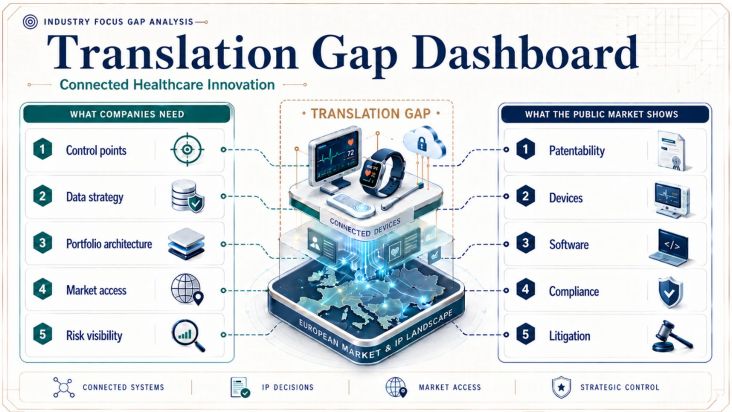
A growing number of signals from the MedTech and digital health market point to a structural mismatch. Companies are no longer developing isolated medical devices. They are building connected health systems: devices linked to software, sensors, health data, AI models, clinical workflows, cloud platforms, and reimbursement structures. Yet much IP advice is still publicly framed as if the central question were only whether a device, software feature or data-processing method can be protected.
This article is not about whether IP matters in MedTech. That debate has largely passed. It is about a gap.
On one side, MedTech companies are facing a layered innovation environment in which patents, data access, trade secrets, software architecture, clinical evidence, regulatory compliance and market access increasingly interact. On the other side, much visible IP communication still separates these questions into individual legal categories: patentability, freedom-to-operate, software protection, trade secrets, designs, contracts or litigation. Each category matters. But companies often need something more integrated.
The issue is not that expertise is missing. In many cases, the opposite is true. The issue is that the way expertise is communicated does not always reflect the strategic decision environment in which digital MedTech companies now operate. The core thesis is this: MedTech and digital health are becoming one strategic environment, and IP is moving from a narrow protection function into a decision system for control, collaboration, market access, risk management and competitive positioning.
The demand side: what connected MedTech companies increasingly need
Many MedTech companies are not primarily asking whether they can obtain “a patent” for “a product”. They are facing more complex operational questions.
A company may be developing a wearable sensor that continuously collects physiological data. It may be building software that interprets this data. It may depend on cloud infrastructure, app stores, third-party algorithms, interoperability standards, clinical validation partners or hospital workflows. It may need to decide which parts of the system should be patented, which parts should remain secret, which data rights are commercially decisive, and which dependencies could later weaken its bargaining position.
This is not an abstract concern. The European Health Data Space Regulation entered into force on 26 March 2025 and is designed to create a common EU framework for the use and exchange of electronic health data. The European Commission states that it supports both primary use of health data for healthcare delivery and secondary use for research, innovation, policy-making and regulatory activities; key parts are scheduled to apply from March 2029 onward.
That changes the context for digital health strategy. Health data is no longer only an internal technical resource. It is becoming part of a regulated European data infrastructure. For innovators, this creates opportunities for access, research and product development. But it also raises strategic IP questions: What can be exclusively controlled? What must be shared? What can be licensed? What remains protectable as a technical contribution? Where does differentiation arise if data access becomes more structured across Europe?
The same pattern is visible in patent statistics. In 2025, the EPO recorded 15,905 European patent applications in medical technology, while computer technology and digital communication were among the largest and fastest-growing technical fields. Computer technology reached 17,844 applications, and digital communication grew by 11.4%. This does not mean that every MedTech company is becoming a software company. It means that medical innovation is increasingly embedded in the same technical layers that drive digital systems more broadly.
What companies therefore need is not only patent drafting. They need orientation in a system where the defensible position may sit in the sensor, the software logic, the data-processing method, the user interface, the clinical workflow, the training dataset, the interoperability layer, or the combination of these elements. That need often arises before the filing decision. It concerns portfolio architecture, dependency analysis and business model design.
The supply side: what IP communication still often emphasizes
When one looks at how MedTech IP expertise is often publicly presented, another picture becomes visible.
The dominant public signals are often technical competence and legal categorization. Communication may focus on patent protection for medical devices, patentability of software-based inventions, trade secret protection for AI, design protection for user interfaces, or regulatory complexity. These are all relevant topics. But they can remain fragmented if they are not connected to the company’s strategic control problem.
The message is often: We can protect MedTech inventions. Much less often, the message becomes: We can help you understand where control, leverage and dependency arise in a connected healthcare system.
This distinction matters. E.g. HGF’s discussion of digital health innovation in the AI revolution frames robust IP protection not only as a legal safeguard but as a foundation for growth and investment. It also highlights the complexity of protecting AI-enabled digital health innovations through patents, trade secrets and copyright. That is already closer to the real decision environment. But many companies still need this logic translated into a practical management question: Which protection route supports which business model?
A second recurring pattern is the focus on protectability. In digital health, protectability is necessary, but not sufficient. A patentable invention may still fail to protect the commercially decisive layer. A trade secret may preserve technical advantage but weaken investment communication. A dataset may be valuable but unusable under the intended collaboration model. A software feature may support differentiation but depend on third-party infrastructure. A claim may be technically elegant but commercially misaligned.
Protection choices are becoming business model choices. In digital health, the question is not only whether protection is available, but which parts of the system should be disclosed, kept confidential, licensed, controlled for investment or used as strategic leverage.
Where the mismatch becomes visible
The gap becomes clearest when comparing the situations companies face with the way IP expertise is often segmented.
A connected MedTech company does not experience its risk in separate legal boxes. It experiences the system as one decision environment. The medical device logic asks whether the product is safe and compliant. The software logic asks whether the technical contribution can be protected. The data logic asks who can access, reuse and restrict data. The platform logic asks who controls interfaces and distribution. The patent logic asks what can be claimed and enforced. The business logic asks where market access, differentiation and bargaining power will come from.
When these logics are treated separately, the company may receive correct advice and still remain strategically exposed.
It may file patents for the device but miss the data-processing layer. It may protect an algorithm but overlook the sensor dependency. It may treat a wearable as a consumer product while its real value lies in medical interpretation. It may rely on trade secrets without considering investor due diligence. It may design a clinical collaboration without securing ownership of product improvements. It may build a platform strategy without understanding whether interoperability creates leverage or dependency.
Wearables show this particularly clearly. E.g. Potter Clarkson’s analysis of smart rings notes accelerating patent activity in this field and connects smart rings to health, fitness and wellbeing metrics. Strategically, such devices sit between consumer electronics, preventive health, digital therapeutics and medical monitoring. Their value may depend less on the ring itself than on signal quality, continuous data capture, user feedback, app integration, and interpretation logic.
Dependency is a central strategic risk: a digital health company may depend on sensors, app stores, cloud infrastructure, datasets or clinical workflows it does not control. IP management must identify these dependencies before they become bargaining weaknesses.
The European enforcement layer
There is another reason why fragmented IP advice is becoming insufficient: European enforcement has changed.
Marks & Clerk’s article on Unitary Patents notes that MedTech leads Unitary Patent filings among technical fields with more than 7,200 applications and shows a higher uptake rate than the average. This is not merely a filing statistic. It suggests that MedTech companies are adapting their European protection architecture to a more centralized enforcement environment.
For connected healthcare companies, this matters because enforcement risk and enforcement opportunity increasingly affect portfolio design. A patent strategy for a connected device, sensor platform or digital diagnostic system cannot be assessed only by asking whether a claim can be granted. It must also consider where the patent could be enforced, where revocation risk would matter, how licensing leverage is created, and how European market access could be affected.
In other words, MedTech patent strategy is affecting European business infrastructure. The Unitary Patent and UPC do not only matter for litigators. They matter for companies deciding how to structure protection across products, software layers and data-enabled services.
A gap in translation
What appears visible, then, is not primarily a gap in legal quality. It is a gap in translation.
Companies increasingly experience MedTech and digital health innovation through questions of control, dependency, interoperability, data access, regulatory timing, investment readiness and European market architecture. Publicly visible IP expertise often still frames the subject through separate legal categories: patents, software, trade secrets, designs, contracts, data, litigation.
Those categories are necessary. But they are not the same as the company’s strategic problems.
The opportunity for IP experts is therefore not only to offer more technical expertise. It is to make existing expertise legible as decision support. Companies need to understand where the defensible control point lies. In one case, it may be a sensor architecture. In another, a method for processing medical data. In another, a clinical workflow integration. In another, the strategic value may lie in combining patents with trade secrets, data governance and licensing.
Carpmaels & Ransford’s discussion of digital life sciences describes an innovation landscape that spans software platforms, data infrastructure, multimodal data analysis and lab automation, and argues that effective patent portfolios must reflect the full complexity of innovation across physical and digital layers. That is the right direction. The next step is to translate this complexity into board-level choices.
The strategic opportunity
The market opportunity is not simply to tell MedTech companies that IP is important. They already know that.
The opportunity is to show them that IP can function as a decision system for connected healthcare innovation. It can help management decide what to protect, what to disclose, what to keep secret, what to license, what to standardize, what to monitor, what to avoid building and where collaboration requires stronger ownership structures.
That is where the next stage of differentiation in MedTech IP advice may begin.
The companies that understand this early gain room to act. They can shape their portfolios around control points instead of assets alone. They can align patent filings with data strategy, collaboration models and European enforcement. They can use IP not only to protect what has been invented, but to clarify how the business should compete.
Companies that treat IP reactively face a different risk. They may become compliant but dependent. Protected but exposed. Innovative but undefended. Visible in the market but weak in negotiation.
The MedTech gap is therefore not a gap between innovation and IP. It is a gap between connected healthcare systems and fragmented advisory narratives. Closing that gap means translating IP expertise into the language of strategic control.