
What Makes Digital Marketing for IP Law Firms Work: VOSSIUS and HOFFMANN EITLE

Digital marketing for IP law firms is not only about attracting attention. It is about helping the market understand what a firm should be chosen for. Expertise becomes commercially relevant when it is visible, structured and connected to a concrete client decision. A law firm is not chosen because it has published something. It is chosen because the market can associate the firm with a specific type of problem, technology, legal development or strategic risk.
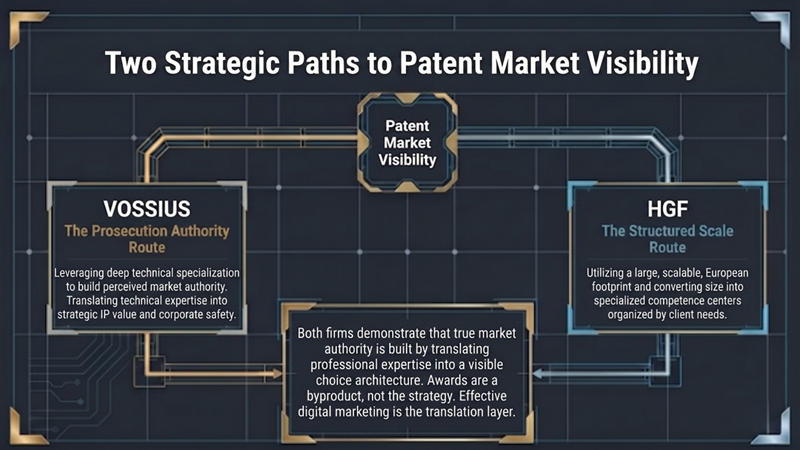
Two examples for this are: VOSSIUS and HOFFMANN EITLE. Both are German-rooted European IP firms with strong patent reputations. But they show two different models of digital marketing. VOSSIUS demonstrates how technical breadth and prosecution excellence can be translated into a visible competence system. HOFFMANN EITLE shows how legal authority can be built through recurring analysis, case-law visibility and structured knowledge formats.
VOSSIUS: Making patent prosecution visible as technical market competence
VOSSIUS was recognised at the Managing IP EMEA Awards 2026 as “Germany Patent Prosecution Firm of the Year”. On its own award page, the firm links the recognition directly to its work in patent prosecution and notes that it followed a previous Managing IP award for cross-border patent litigation work in the Xiaomi and OPPO matter against Panasonic.
This is important because patent prosecution is often difficult to market. Litigation creates visible disputes, judgments and public narratives. Prosecution, by contrast, is usually quieter. It happens over many years and deals with technical details, claim amendments, office actions, examination strategies and portfolio decisions. The client value is substantial, but the work is less visible from the outside.
VOSSIUS addresses this challenge by making prosecution part of a broader technical competence architecture. Its Patent & Utility Model Prosecution page does not present patent filing as a narrow administrative task. It frames prosecution around expertise in mechanical engineering, physics, electrical engineering, information technology, chemistry, pharmacology, biology, biotechnology and interface technologies. It also refers to customised prosecution strategies, EPO and German Patent and Trademark Office proceedings, and the coordination of patent applications outside Europe.
From a digital marketing perspective, this is a strong move. The firm does not simply claim to file patents. It shows that prosecution is connected to technical understanding, international strategy and portfolio management. This turns a formal legal service into a strategic competence signal. For clients, especially technology companies and international patent departments, this matters because prosecution quality is not just about getting a patent granted. It is about obtaining protection that can later support investment, licensing, enforcement, defence and market exclusivity.
The firm’s other marketing campaigns support this same message. In the IAM Patent 1000 2025 communication, VOSSIUS reports that it was ranked Gold for “Prosecution and Nullity”, Silver for “Infringement” and recommended in the Unified Patent Court ranking. The same page also lists numerous recommended lawyers across patent attorney and attorney-at-law profiles. This creates an important bridge between prosecution, validity, infringement and UPC work. The market does not see prosecution as an isolated function. It sees a firm whose patent work spans the lifecycle from application to dispute.
VOSSIUS also uses topical pages to connect classical patent expertise with emerging business questions. Its Artificial Intelligence hot-topic page frames AI-related inventions as a technological and legal development with major implications for industries, innovation and IP law, including references to the EU AI Act and generative AI. Its Unitary Patent and Unified Patent Court page explains that the UPC fundamentally changes how patents are litigated in Europe and presents the VOSSIUS-BRINKHOF cooperation for UPC litigation.
This is the best-practice lesson from VOSSIUS. A prosecution-focused award becomes much more valuable when the firm already has digital assets that explain why prosecution expertise matters in technical, international and strategic contexts. The award is not a stand-alone badge. It confirms a visible system of competence.
What VOSSIUS shows about digital marketing for IP law firms
VOSSIUS represents the technical breadth-to-strategy model. The firm starts from a core patent attorney strength: prosecution across many technologies. But digital marketing turns that strength into something more market-relevant. It connects technical fields, prosecution strategy, international filing coordination, AI, UPC and litigation capability.
This is particularly relevant for patent law firms. Many such firms have strong technical depth, but their digital communication often remains too close to professional categories: patent filing, oppositions, utility models, infringement. Clients, however, do not usually think in those categories first. They think in terms of technologies, markets, risks and business decisions. The task is therefore to translate the professional service into the client’s decision language.
VOSSIUS shows how this can be done without becoming superficial. The firm does not abandon the technical substance. It makes the substance comprehensible.
HOFFMANN EITLE: Turning legal analysis into recurring authority
HOFFMANN EITLE provides a different model. The firm won multiple awards at the Managing IP EMEA Awards 2026, including recognitions connected to Europe Impact Cases of the Year, cross-border patent litigation teams and major European patent matters. The firm’s public positioning is therefore strongly linked to high-impact legal work and complex European patent disputes.
But the digital marketing lesson is not only the award communication. It is the way HOFFMANN EITLE builds authority through recurring analysis. The firm’s HOFFMANN EITLE Quarterly is a central asset. It presents regular updates on current developments in IP law and patent office practice, with topics such as UPC substantive law, EPO case law, AI-generated content as evidence, antibody epitope claims, provisional measures before the UPC, description amendments at the EPO and AI hallucinations in court documents.
This is a different kind of digital marketing. It does not primarily work through campaign-style positioning. It works through accumulated credibility. Each issue of the Quarterly becomes another signal that the firm follows, interprets and explains legally important developments. Over time, this builds a perception of authority.
HOFFMANN EITLE also uses a dedicated UPC Hub. The hub gives users access to information about the UPC, the firm’s UPC expertise, materials, a UPC handbook and a UP cost calculator. This is a particularly strong example of digital marketing for a complex legal environment. The firm does not only publish opinions. It creates tools and structured resources that help clients orient themselves in a changed European patent system.
The firm’s Quarterly Newsletter 06/24 shows exemplary how this works in practice. One year after the UPC entered into force, the newsletter discussed the achievements and direction of the new court. It also linked the UPC discussion with CRISPR, AI patenting in Europe, unfair competition and medical use claims. This combination is important. HOFFMANN EITLE does not present IP developments as isolated news items. It places them in a wider legal and technological context.
From a marketing perspective, this is highly effective for sophisticated IP audiences. Patent departments, in-house counsels and innovation-driven companies do not need simplified explanations. They need reliable interpretation. They need to know which cases matter, which doctrinal shifts are emerging, where the UPC is aligning with or diverging from EPO practice, and how new technologies such as AI or CRISPR affect patent strategy. HOFFMANN EITLE’s digital presence serves exactly this function.
What HOFFMANN EITLE shows about digital marketing for IP law firms
HOFFMANN EITLE represents the authority-through-analysis model. The firm does not rely only on awards, rankings or service descriptions. It builds market trust through repeated, substantive interpretation of legal developments.
This is especially powerful in IP because the market changes through case law, office practice, regulatory developments and technology shifts. A firm that can consistently explain these developments becomes more than a service provider. It becomes a reference point.
The best-practice element is the combination of recurrence and depth. A single article can create attention. A recurring analytical format creates authority. A dedicated hub creates orientation. Together, they help the market associate the firm with legal judgment, not only legal execution.
Two new models for the series
VOSSIUS and HOFFMANN EITLE expand the best-practice set with two additional models of digital marketing for IP law firms.
VOSSIUS shows the technical breadth-to-strategy model. The firm takes a broad prosecution and technical competence base and makes it visible through practice pages, technology topics, AI content, UPC positioning and ranking validation. The award for patent prosecution becomes stronger because the market can see what prosecution expertise means in context.
HOFFMANN EITLE shows the authority-through-analysis model. The firm uses awards, the Quarterly, the UPC Hub, legal updates and analytical resources to build a recurring presence around European patent law developments. The awards become credible because they sit inside a broader system of legal interpretation.
Together, these two examples reinforce the central lesson of the series. Digital marketing for IP law firms is not about noise. It is about creating a recognisable link between expertise and choice.
For VOSSIUS, the link is technical competence made strategically visible. For HOFFMANN EITLE, the link is legal authority made continuously accessible. Both approaches work because they do not separate marketing from professional substance. They make substance visible in a form that clients can understand, remember and use when they need to choose an IP law firm.