
Making Quantum IP Legible: Why quantum companies need to protect what may become strategic

Quantum technologies are moving forward in a situation where many of the usual reference points for IP strategy are still unstable. Dominant architectures are not yet settled. Commercial applications are still emerging. Market structures are forming unevenly across quantum computing, sensing, communication, enabling technologies and post-quantum security. Investors, industrial partners, public funders and technology teams all see enormous potential, but the question of where value will concentrate is still open.
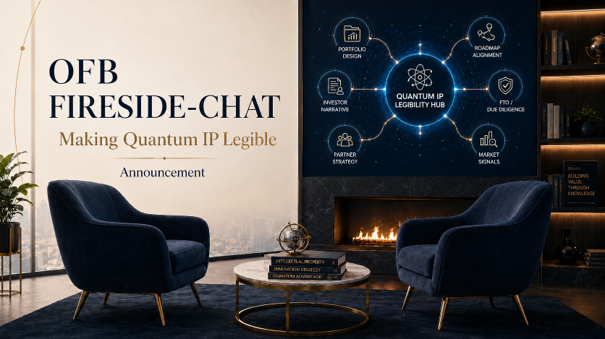
This is why Making Quantum IP Legible will be the topic of an upcoming Fireside Chat. The discussion will focus on a strategic question that many quantum companies face very early, but cannot answer with traditional patent logic alone: How can a company decide which quantum innovations are not only technically interesting, but commercially important enough to protect?
That question matters because quantum companies cannot simply wait until the market is clear. By the time architectures, application fields and dominant value chains become obvious, many relevant IP positions may already be occupied by competitors, universities, suppliers, platform companies or industrial partners. At the same time, no company can protect every technical result as if it were equally important. Filing broadly without strategic focus can become expensive, confusing and commercially weak.
The challenge is therefore not only to create patents. The challenge is to make quantum IP understandable as a decision system. A company needs to know what it controls, what it depends on, which technical paths may become commercially relevant, where partners may create dependencies, and where third-party rights may limit future freedom to operate.
Quantum IP is not only about patenting inventions
A common misunderstanding is that IP strategy in quantum technologies begins with the question of whether an invention is patentable. That question is important, but it is not sufficient. A quantum innovation can be scientifically impressive and still have limited commercial relevance. Another technical detail may look narrow at first, but later become essential because it controls system performance, scalability, reliability or integration.
In quantum technologies, value is often distributed across layers. It may sit in a qubit control method, a calibration routine, an error mitigation approach, a photonic integration concept, a cryogenic interface, a sensing configuration, a secure communication protocol, a material process, a software pipeline or a manufacturing adjustment. Sometimes the commercially relevant asset is not the most visible invention. It is the element that makes the system usable, scalable or attractive for a specific application.
This is why quantum IP needs to be made legible. Business leaders, investors, R&D teams and partners need a way to understand which technical achievements may become commercial control points. A list of patent filings is not enough. A technical invention disclosure is not enough. A patent landscape alone is not enough. What is needed is a translation layer between scientific progress and business strategy.
From technical promise to commercial protectability
The first management question is whether a quantum innovation creates dependency. Does the company need this technical solution for its own product architecture? Does it support a performance threshold that customers will care about? Does it enable a manufacturing process, an application field, a partner integration or a future platform position? If the answer is yes, the innovation deserves closer IP attention.
The second question is whether competitors can easily design around it. If alternatives are simple, cheap and technically equivalent, exclusivity may have limited strategic value. But if alternatives are slower, less stable, less scalable or incompatible with the expected system architecture, the innovation may become strategically important even if it looks like a small technical contribution.
The third question is visibility. Some quantum innovations will be visible in products, publications, interfaces, benchmarks or standards. Others will remain hidden in lab routines, software workflows, datasets, tuning methods or manufacturing know-how. Visible inventions may be candidates for patent protection. Hidden knowledge may be more effectively protected through confidentiality, contracts, access controls, documentation and trade secret management.
The fourth question is timing. Filing too early may disclose a technical direction before the company knows whether it will remain relevant. Filing too late may allow others to occupy the space first. In quantum technologies, timing is not only a legal issue. It is a strategic choice under uncertainty.
The protection mix changes as the company develops
A university spin-out, a start-up, a scale-up and an established technology company do not need the same IP strategy. They operate with different resources, different risks and different audiences.
For a university spin-out, the first issue is often ownership and clarity. Which results belong to the university? Which rights are licensed? Which inventors contributed? Which publication obligations exist? Which background IP may restrict future commercialization? At this stage, a small number of well-positioned patent applications can be valuable, but only if title, access rights and future use are clear.
For a start-up, IP must support both focus and optionality. The company usually cannot afford to file across every possible use case. It must decide which technical core needs patent protection, which know-how must remain confidential, which software or data assets require contractual and technical control, and which future applications should remain open through carefully designed filing logic.
For a scale-up, the portfolio must become more connected to products, markets, financing rounds, partnerships and FTO. The company moves from scientific proof to productization, customer pilots and market-entry preparation. IP becomes less about individual filings and more about managing strategic options.
For an established company, quantum IP may need to fit into a broader technology architecture. It may connect with semiconductors, cloud infrastructure, telecoms, cybersecurity, sensing, materials, medical devices, industrial automation or advanced computing. Here the question is not only whether quantum inventions should be protected, but how they reinforce existing platforms, standards, customer relationships, manufacturing capabilities and ecosystem positions.
Portfolios must stay connected to roadmaps
A quantum patent portfolio can become outdated quickly if it is not continuously connected to the company’s roadmap. A portfolio may reflect the founding research direction while the company has already shifted toward a different architecture, customer segment or application field. It may contain technically strong patents that no longer support the business. It may miss the features that became important only after customer feedback, investor discussions or partner projects.
This makes portfolio management a dynamic task. Patent families should be mapped against roadmap hypotheses, not only against current products. Which filings protect the present technical core? Which ones support future application fields? Which ones create partner value? Which ones reduce risk? Which ones have become legacy assets?
Financing adds another dimension. Investors do not evaluate quantum IP by counting patents alone. They want to understand whether the company controls something that matters. They ask whether ownership is clear, whether the core technology is protectable, whether third-party rights could block commercialization, and whether the portfolio supports the growth story.
Partnerships make the issue even more complex. Quantum companies often depend on universities, component suppliers, system integrators, cloud providers, industrial customers, research consortia and public funding programs. Each cooperation can affect background IP, foreground IP, improvement rights, publication rights, access rights, field-of-use restrictions and future licensing options.
Market signals must be read before markets are obvious
Because quantum markets are still emerging, companies need to read signals early. Patent landscapes can help, but only if they are interpreted strategically. Patent counts alone do not explain value. More useful signals include claim focus, assignee movement, citation clusters, continuation behavior, geographic coverage, collaboration patterns and repeated filings around specific technical bottlenecks.
Competitor monitoring also needs a broader view. In quantum technologies, competitors may not always be direct product competitors. A university lab, a start-up, a semiconductor company, a telecom provider, a defense supplier, a cloud platform or a component manufacturer may each control a relevant part of the value chain.
Public funding can indicate where policy priorities and industrial expectations are concentrating. Standardization and interoperability discussions may reveal where interfaces, protocols, benchmarking methods or security requirements could become strategically important. Industrial application signals show where quantum-enabled value may first become operationally meaningful.
None of these signals predicts the future. But together, they help companies form better hypotheses about where quantum value may concentrate.
FTO and due diligence must influence business decisions
Freedom-to-operate in quantum technologies should not be treated as a late-stage legal checkpoint. If FTO analysis begins only shortly before market entry, it may be too late to influence architecture, supplier choice, partner strategy or product design.
Quantum systems are layered. A product may combine hardware, control software, optical components, cryogenics, materials, calibration routines, data processing, communication protocols and cloud interfaces. Third-party rights may exist at any of these layers. A company may be free to use one component but exposed in relation to a method, interface or integration architecture.
This means FTO, competitor monitoring and IP due diligence should feed directly into business and R&D decisions. They help management decide whether to continue, redesign, license, partner, challenge, delay or exit a technical direction. Their value lies not only in avoiding infringement risk, but in preserving freedom of action.
Why this Fireside Chat matters
The upcoming Fireside Chat will address quantum IP as a practical strategy issue. The focus will not be on abstract patent doctrine, but on the decisions quantum companies must make while technology paths, financing priorities, partner roles and market opportunities are still developing.
How can a quantum company recognize which innovations may become commercially protectable? How should the protection mix change from spin-out to scale-up? How can portfolios remain aligned with roadmaps and investors? Which market signals help identify future value concentration? And how should FTO and competitor monitoring shape business decisions before commitments become difficult to change?
These questions matter because quantum companies operate in a field where waiting can be dangerous and over-filing can be wasteful. They need IP strategy that supports uncertainty, not only stability. They need portfolios that are understandable to investors, useful for partners, relevant for R&D and connected to market entry.
Making quantum IP legible means turning IP from a list of rights into a management instrument. It helps companies see what they control, where they are exposed, which options they should keep open and where protection can create future strategic value.
Further reading and contact
For readers who would like to explore the topic in more depth, the related dIPlex Deep Dive Making Quantum IP Legible: Portfolios, Roadmaps and Market Signals in an Emerging Field provides a structured perspective on how to make quantum IP legible to translate scientific and technical progress into portfolio decisions, roadmap choices, investment narratives, partnership positions and market-entry options:
👉 https://profwurzer.com/diplex/docs/ip-strategy/making-quantum-ip-legible/
The Deep Dive complements the upcoming OFB Fireside Chat by looking on why quantum IP should not be treated only as a patent filing topic, but as a strategic decision issue that connects portfolio design, technology roadmaps, investor expectations, cooperation models, market signals, freedom-to-operate and long-term value capture.
For questions regarding the Open Foresight Board or the upcoming OFB Fireside Chat, please contact:
Theo Grünewald
Secretary of the CEIPI IP Business Academy’s Open Foresight Board
theo.gruenewald@ipbaportal.com
More details on the upcoming OFB Fireside Chat will follow soon.