From Reputation to Recognition: A New White Paper How to Turning Quiet Expertise into Visible Trust in IP

Most IP experts do not struggle with competence. They struggle with recognition. They deliver excellent work, often over years. They prevent problems that never become visible. They handle uncertainty with discipline. Their clients trust them deeply once the relationship exists. Yet outside that circle, the market often has only a vague picture. Not because the expert is unknown, but because the expertise is not legible at a glance.
That gap is the reason we published our new IPBA Connect white paper: “From Reputation to Recognition: Turning Quiet Expertise into Visible Trust.” It is written for patent and trademark attorneys, in house IP leaders, licensing professionals, and law firm partners who want a systematic, professional way to translate strong reputation into signals that travel. Not louder. Not more content. Just clearer trust.
Here you get access to the white paper “From Reputation to Recognition: Turning Quiet Expertise into Visible Trust”
Send download link to:White Paper: Reputation to Recognition
Why this white paper exists
IP is a people business with high stakes and low everyday visibility. When IP work is done well, little happens. No headline. No crisis. No urgent meeting. That invisibility is a sign of quality, but it also creates a communication problem. Buyers cannot judge what they cannot see.
At the same time, the decision environment has changed. Many mandates are still relationship based, but the path to relationships is increasingly digital. Before anyone schedules a first call, they skim signals. They look for clarity, judgement, and fit. They try to answer one question quickly: can this person reduce uncertainty for my situation.
If the signals are unclear, buyers default to safer heuristics. They pick the name they have heard before. They pick the firm brand. They pick whoever seems easiest to justify internally. That is not a “marketing problem.” It is a recognition problem. The white paper treats recognition as a capability. It can be built without sacrificing professionalism, discretion, or nuance.
What “recognition” means in IP
We draw a sharp line between two concepts that are often mixed up.
- Reputation is trust that exists because someone has experienced your work.
- Recognition is trust that can form before that experience, based on visible evidence of how you think.
In IP, recognition is rarely about popularity. It is about cognitive clarity. A general counsel wants to see how you frame trade-offs. A product leader wants to see that you speak in outcomes, not only in doctrine. A licensing counterpart wants to see that you anticipate second order effects, not only first round terms. A law firm partner wants to see that your expertise attracts the right kind of work, not just more work.
So the goal is not self-description. The goal is building trust assets that make your judgement visible without exposing confidential matters.
What is inside the white paper
The core of the paper is a set of principles that convert quiet expertise into visible trust, while staying aligned with the realities of IP practice.
You will find, among other elements:
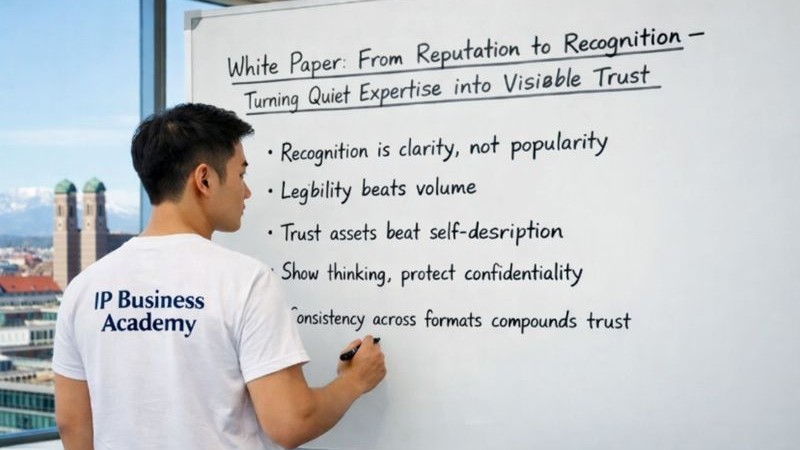
- Legibility over volume. Recognition grows when people can accurately describe your expertise after brief exposure.
- Trust assets instead of claims. Frameworks, decision maps, checklists, definitions, and scenario patterns travel better than “I am experienced.”
- Outcome language for non-lawyers. Not simplified law, but translated implications, such as option preservation, negotiation leverage, decision readiness, and risk containment.
- Confidentiality safe visibility. Showing how you think without revealing what you know about a client.
- Consistency across formats. The same core lens should appear across long form writing, short posts, audio, and events, without feeling copied.
- Pattern proof. Credibility through repeatable judgement patterns and failure modes, not through case bragging.
The paper also includes practical guidance on channels and formats that work particularly well in IP, and it introduces the IP Subject Matter Expert model on IPBA Connect and the IP Business Academy as a neutral platform context for turning expertise into educational assets.
A realistic example of the reputation to recognition gap
Consider a typical situation.
A scale up is preparing a product launch. The CEO believes patents are optional because execution speed matters more. The CTO wants to publish technical material to attract talent. Meanwhile a competitor has started to file aggressively.
An experienced IP advisor sees the full picture quickly. The real challenge is not “file or not file.” The challenge is timing, disclosure discipline, and option preservation. The advisor can structure the decision, so the team does not trap itself.
If this advisor is only recognised through their CV, the scale up may never reach out. They might call a generalist firm, or they might delay until it is too late. The advisor’s reputation cannot help because recognition did not happen early enough.
Now imagine the advisor has published a simple decision map on “what makes IP decisions irreversible,” plus a short explanation of common failure modes in agile teams. That is not promotion. That is decision support.
This is the difference between being excellent and being findable for the right problem.
How to use the white paper without repeating yourself
One reason IP experts resist “visibility advice” is that it often sounds like content treadmill logic.
This white paper takes the opposite view.
Recognition compounds when you build a small set of anchor assets, then express them across formats with variation in angle, not in message. A single decision framework can generate:
- A short post that highlights one criterion.
A longer article that explains the full map.
A short glossary entry that defines the key terms in plain language.
A podcast conversation that shows tone, trade-offs, and judgement.
The point is not production volume. The point is coherence. That coherence also protects your time. It makes publishing sustainable even with client work, internal responsibilities, and professional obligations.
Connection to the ETL IP experience exchange in Berlin
This white paper is also a conceptual preparation for an in person experience exchange on digital business development with ETL IP on March 24, 2026 in Berlin.
The event framing is direct: authenticity in digital IP business development is not a soft topic. It is a practical challenge for professionals who want visibility to feel aligned with the person behind the expertise, especially in a field where trust and responsibility matter.
The experience exchange focuses on how the human factor can be brought back into professional visibility, without turning IP experts into performers. It is exactly the environment where the reputation to recognition question becomes tangible.
Not as theory, but as shared patterns, working routines, and real constraints.
Where the 🌱 Resource Hub fits in
A white paper can create clarity. Many people then want a structured next step that builds basic capability in small increments.
For that reason, we also point to the 🌱 Resource Hub, where a free Email Course Business Development for IP experts is available.
The course is designed as an accessible foundation. It is delivered as concise lessons and it focuses on practical building blocks that many IP professionals were never taught explicitly, such as positioning language that still feels professional, and ways to connect visibility with better fit conversations.
The key idea is consistent with the white paper: business development works best when it feels like structured helpful communication, not self-promotion. In IP, trust is rarely built by being louder. It is built by being clearer. Recognition does not replace reputation. It makes reputation reachable earlier, by people who have not met you yet, but who still need your judgement.
When quiet expertise becomes visible trust, the whole ecosystem benefits. Better decisions happen earlier. Misfit work decreases. Good advice finds the right moment to matter.
The entire series at a glance (with direct links)
Building Visible Expertise: Personal & expert branding translates that positioning into consistent signals—tone, focus, proof, and recognition—so people can remember you.
LinkedIn for IP Experts becomes the operating layer where those signals are distributed: profile clarity, repeatable content, and visible engagement create discoverability.
Thought Leadership for IP Experts. Turn deep IP expertise into public authority by packaging it as repeatable insight.
International Business Development for IP Experts. Build international IP business development as a system, not a travel schedule.
Positioning: From Expertise to Recognized Authority defines the exact problem you solve, for whom, and why you’re different; it gives your communication a sharp “center of gravity.
Referral marketing (“Trusted, Not Touted”) turns trust into transfer: it makes your work easy and safe for others to recommend through shareable stories and proof assets.
Business development archetypes ensure sustainability by aligning formats and outreach with your natural style—so consistency is realistic.
Networking: From Visibility to Qualified Conversations connects everything to real opportunities: it converts visibility and trust into specific relationships, introductions, and follow-ups that reliably lead to mandates.
Digitally Real – Authentic Visibility Without Performing translates authenticity into a practical operating model for professional visibility that does not require building a persona, turning into a full-time creator, or forcing a style that feels unnatural.
The Human Side of Authority in IP frames authority as a practical capability that can be trained and communicated clearly.