
The Human Side of Authority in IP: A New White Paper on Confidence, Vulnerability, and Trust

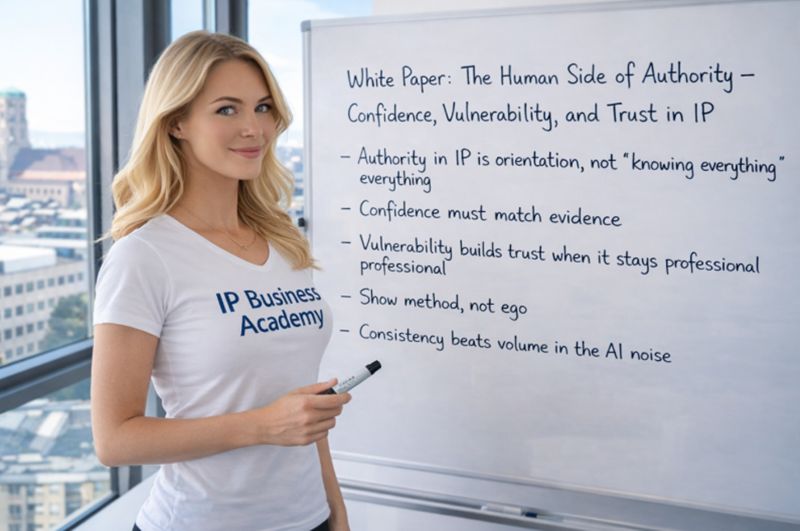
Authority in intellectual property has long been treated as a function of knowledge. Technical depth still matters. Yet many trust defining moments are not decided by who knows the most. They are decided by who can offer orientation when the situation is messy, the facts are incomplete, and the consequences are hard to reverse.
That is the idea behind the IPBA Connect white paper “The Human Side of Authority: Confidence, Vulnerability, and Trust in IP.” It frames authority as a practical capability that can be trained and communicated clearly. The focus is not lifestyle branding. The focus is credibility that holds even when not every answer is settled.
Here you get access to the white paper “The Human Side of Authority: Confidence, Vulnerability and Trust in IP”
Send download link to:White Paper The Human Side of Authority
Why authority in IP now has a human layer
Digital visibility has changed how trust is formed. Many mandates start before the first call. Decision makers watch experts through posts, articles, comments, and interviews, and they infer what working together would feel like.
Overconfidence has become riskier because public statements are permanent while IP outcomes remain uncertain. Patentability depends on prior art, examiner reasoning, and evidence. Trademark outcomes depend on context, market perception, and use. Yet vagueness is also costly. “It depends” without a usable frame slows decisions and makes expertise feel interchangeable.
The human side of authority sits between these extremes. It is the skill of being precisely confident. You name boundaries without sounding defensive, and you acknowledge uncertainty without losing direction.
What the white paper covers
The white paper is written for patent and trademark attorneys, in house IP leaders, licensing professionals, and law firm partners. It translates authenticity into repeatable choices that fit the reality of IP work.
It starts with a shift: authority is not dominance. It is the ability to create confidence in uncertain situations. In IP, that means reducing ambiguity. People want a recommendation, plus the reasoning and the conditions under which it would change.
From there, the white paper introduces core principles that make authority credible in public communication.
Calibrated confidence means matching the strength of a statement to the strength of evidence behind it. Transparent boundaries mean stating assumptions and constraints in plain language before misunderstandings turn into conflict. Judgment means prioritising a path instead of listing options. Professional vulnerability means naming limits and uncertainty in a way that increases reliability, not hesitation.
To keep the paper practical, it also includes a short checklist and a glossary that teams can reuse when reviewing public content, preparing client facing notes, or replying to high stakes questions in writing.
What this looks like in real IP situations
Consider a common software case. A product team says a feature is “obviously patentable” because it uses machine learning. In reality, the decision is rarely about whether it uses AI, and more about whether the application can describe a measurable technical effect and link it to the claimed mechanism. Human authority shows up when an expert says, calmly, what can be assessed now and what must be checked first.
Or take trademarks. A team wants to extend a brand into adjacent goods and assumes clearance means checking for identical names. A more senior posture is to explain that the risk often sits in context: how consumers encounter the marks, what the dominant elements are, and how channels shape perception. That is not hesitation. It is orientation.
Practical language patterns you can reuse
Many IP experts hesitate to publish because they fear being wrong in public. The white paper addresses this with language patterns that protect credibility while still creating value.
Instead of an absolute claim, use a decision frame: “I cannot judge this without full facts, but here is the checklist that decides it.” Use conditional clarity: “If X is true, route A is reasonable. If not, route B is safer.” Add one sentence that names what would change your view. This turns uncertainty into a shared map.
These patterns also reduce risk by separating public education from individual legal advice.
Formats that make authority visible without performing
The goal is not volume. The goal is legibility.
Short posts work when they teach one decision. A software patent post can focus on what counts as measurable technical effect and what evidence to document early. A trademark post can focus on how consumers encounter a mark across channels, not only on identical name checks.
Long form articles allow you to show method. Interviews and podcasts add an extra layer because they carry tone and pacing. Across formats, the white paper recommends teaching patterns rather than cases. Patterns protect confidentiality and still convey experience.
Comments also matter. A concise reply that acknowledges a concern, states a boundary, and adds one useful distinction often builds trust faster than a standalone post.
The IP Subject Matter Expert model as a visibility structure
A dedicated part of the white paper links the principles to the IP Subject Matter Expert model on IPBA Connect and the IP Business Academy. The expert brings judgment and expertise. The platform context supports consistent structure, editorial clarity, and education oriented distribution.
This matters because most IP professionals do not need more pressure to publish. They need a structure that helps them communicate like they already advise: precise, calm, and decision oriented. Authority then accumulates through coherence and a stable lens.
Preparation for the Experience Exchange at ETL IP in Berlin
This white paper is also a conceptual preparation for the peer experience exchange “Authenticity in Digital IP Business Development: Bringing the Human Factor Back into Visibility,” hosted in Berlin with ETL on March 24, 2026. The event is designed as an in person peer exchange with practical impulses and moderated discussion.
You can register for the event here free of charge.
The topic is timely because many IP professionals feel a tension between offline trust and online validation. Real credibility is built quietly in opinions, negotiations, workshops, and long term mandates. Yet visibility is increasingly expected before the first meeting. The Berlin exchange explores how to connect these worlds so digital presence feels aligned with the person behind the expertise.
A practical companion in the 🌱Resource Hub
The Resource Hub also includes a free email course called “Free Email Course Business Development for IP Experts.” It is tailored to IP experts and focuses on visibility and trust without pushy sales tactics.
Used together, the two resources complement each other. The white paper explains the credibility logic and communication posture. The email course turns that into a simple sequence that fits a busy practice.
In a world where information is abundant and AI can generate fast answers, the differentiator for IP experts is rarely access to facts. It is the ability to create confidence under uncertainty.
The human side of authority is not a soft extra. It is part of what makes expertise trustworthy when stakes are high, and it helps digital presence become a calm extension of real professional work.
The entire series at a glance (with direct links)
Building Visible Expertise: Personal & expert branding translates that positioning into consistent signals—tone, focus, proof, and recognition—so people can remember you.
LinkedIn for IP Experts becomes the operating layer where those signals are distributed: profile clarity, repeatable content, and visible engagement create discoverability.
Thought Leadership for IP Experts. Turn deep IP expertise into public authority by packaging it as repeatable insight.
International Business Development for IP Experts. Build international IP business development as a system, not a travel schedule.
Positioning: From Expertise to Recognized Authority defines the exact problem you solve, for whom, and why you’re different; it gives your communication a sharp “center of gravity.
Referral marketing (“Trusted, Not Touted”) turns trust into transfer: it makes your work easy and safe for others to recommend through shareable stories and proof assets.
Business development archetypes ensure sustainability by aligning formats and outreach with your natural style—so consistency is realistic.
Networking: From Visibility to Qualified Conversations connects everything to real opportunities: it converts visibility and trust into specific relationships, introductions, and follow-ups that reliably lead to mandates.
Digitally Real – Authentic Visibility Without Performing translates authenticity into a practical operating model for professional visibility that does not require building a persona, turning into a full-time creator, or forcing a style that feels unnatural.