
Outsourcing in IP Management: What CEIPI’s Module 4 Lecture Reveals About the Future of Legal and Innovation Work


In the fourth module of the Master Program for IP Law and Management at CEIPI, the lecture on outsourcing explored a topic that is often treated as a purely operational issue, but is in fact deeply strategic. Outsourcing in IP and legal work is not simply about moving tasks outside the organization to reduce cost. It is about deciding which capabilities define the organization, which activities should remain under direct control, and which parts of the value chain can be delegated without weakening long-term competitive strength.
This perspective is especially important in intellectual property management. IP work connects law, technology, business strategy, innovation processes, and organizational design. As a result, outsourcing decisions in this field are rarely neutral. They affect internal know-how, portfolio quality, responsiveness, confidentiality, and even the way a company understands its own innovation logic. The lecture made clear that outsourcing is not a binary decision between internal and external work. It is a continuous organizational design choice that must be aligned with the role IP plays in the wider business model.
Outsourcing as a Reduction of Vertical Integration
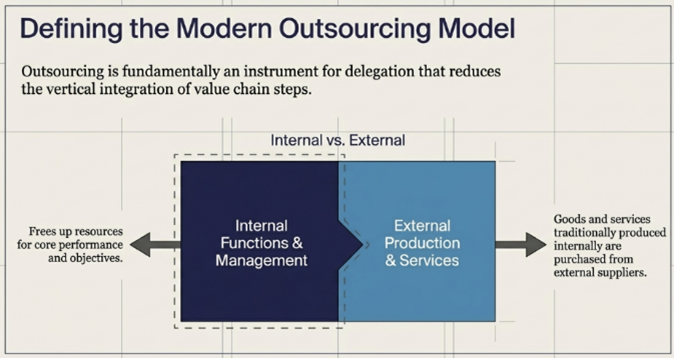 A central starting point of the lecture was the idea that outsourcing is an instrument of delegation. In business organization, it reduces the vertical integration of value chain steps. Activities that were previously carried out internally are transferred to external providers, who then supply the required goods or services. In principle, this gives organizations greater flexibility and allows them to focus their resources on what they consider their most important internal objectives.
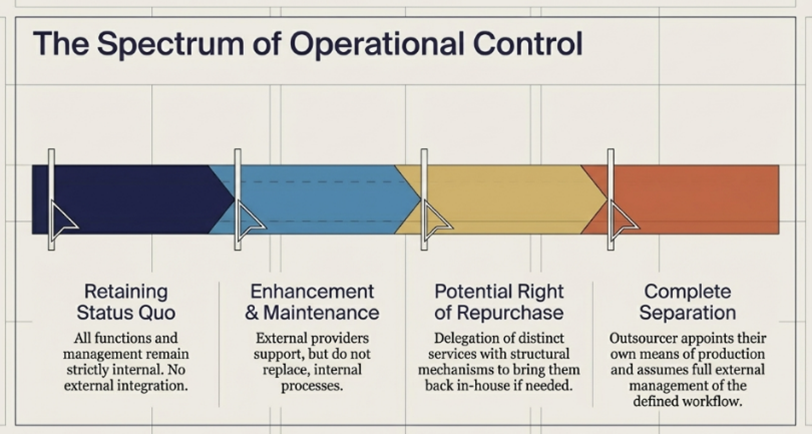 That sounds straightforward, but the lecture immediately balanced these advantages with a set of structural disadvantages. Outsourcing can create dependency on external firms. It can disturb internal procedures. It can lead to lock-in effects when suppliers become difficult to replace. It can weaken internal know-how over time. And it can generate significant transaction costs, especially when the outsourced work requires coordination, review, or correction.
This is particularly relevant in IP management because many IP-related activities are interdependent. Patent drafting is connected to invention harvesting. Portfolio decisions are connected to technology strategy. Enforcement depends on documentation quality, ownership clarity, and procedural consistency. A company may outsource a specific step, but the consequences often travel far beyond that step. The lecture therefore framed outsourcing not as a tactical purchasing decision, but as an organizational intervention that reshapes how a firm creates, protects, and governs intangible value.
Why Companies Outsource IP Services
The lecture then moved into the specific reasons why IP services are outsourced. Some are operational. A company may face low internal capacity or highly variable workloads. In these cases, external providers offer scale and flexibility. Another reason is a low level of expertise in peripheral areas or in new technological fields. When internal teams do not possess specialized knowledge, outsourcing becomes a way to access advanced competence without building it from scratch.
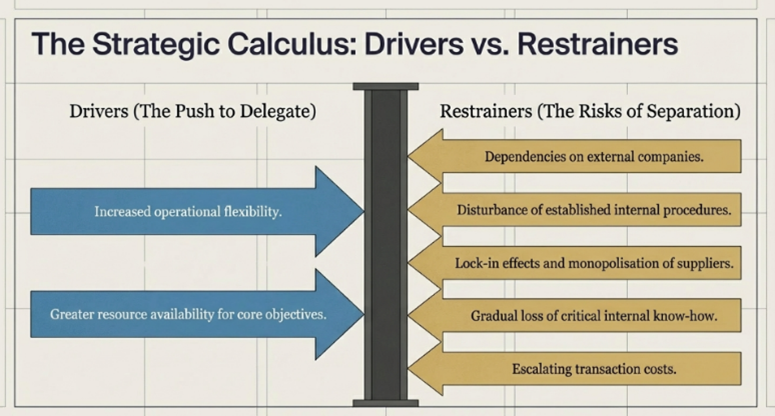 There are also legal reasons. In some settings, compulsory representation requires the involvement of external professionals before courts or agencies. In other cases, independence and confidentiality matter. External experts may be needed for neutral opinions, infringement assessments, or reports that benefit from a degree of separation from the internal organization.
These arguments remain highly relevant for modern IP departments. No internal team can be equally strong across all jurisdictions, all technologies, and all procedural scenarios. Outsourcing can therefore improve responsiveness and quality when used selectively. It can help firms absorb peaks in filing activity, enter new technology areas more safely, and access litigation or opinion work that demands narrow expertise.
 At the same time, the lecture did not present these reasons as automatically persuasive. It showed that outsourcing solves some problems while creating others. A company that outsources because of capacity constraints may gain short-term relief, but may also become less capable of learning from repeated filings or developing internal judgment about patent scope and portfolio direction. In this sense, outsourcing is useful, but never free. The organizational costs are simply less visible than the invoice.
Why Some IP Functions Should Stay In-House
One of the strongest parts of the lecture was its discussion of the reasons not to outsource IP services. This is where the strategic dimension became especially clear. Certain activities are too closely linked to the firm’s identity, coordination needs, and long-term capability building to be handed over easily.
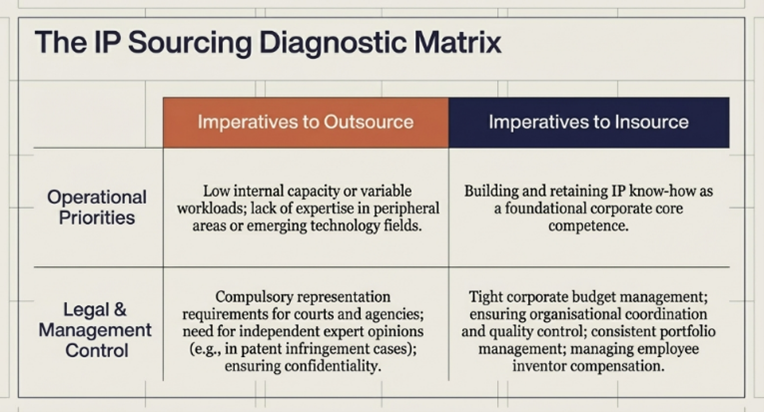
The lecture highlighted several such areas: the development of patent clusters, the build-up of IP know-how as a core competence, corporate budget management, organizational coordination and quality management, consistent portfolio management, and employee inventor compensation. These are not just administrative topics. They are central elements of how a company governs innovation.
For example, consistent portfolio management depends on deep familiarity with technology trajectories, business priorities, competitor moves, and the internal logic behind earlier filing decisions. External providers can support execution, but they rarely have the same embedded perspective as internal teams. The same is true for inventor compensation and organizational coordination. These functions depend on trust, internal process knowledge, and alignment across departments.
This insight matters because many companies underestimate the cumulative strategic value of internal IP competence. If too much is outsourced, the organization may still receive good legal documents, but lose the ability to ask better questions, detect patterns across inventions, or connect IP choices to broader business goals. The lecture therefore encouraged a more nuanced view: outsource for scale, specialization, or procedural efficiency where appropriate, but retain the capabilities that define strategic control, learning, and coherence.
The New Outsourcing Landscape: ALSPs, Legal Operations, and Digital Workflows
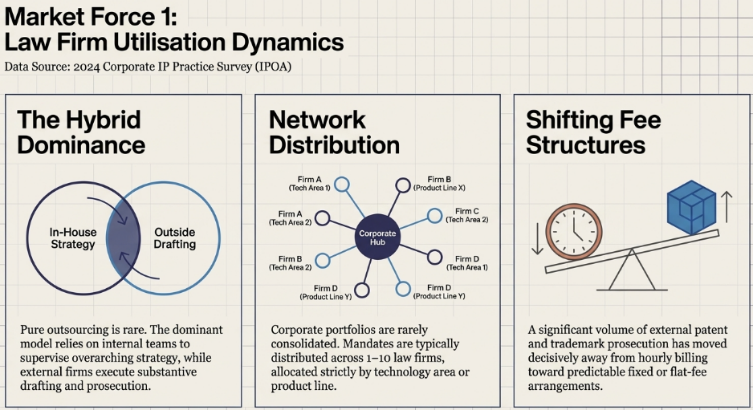
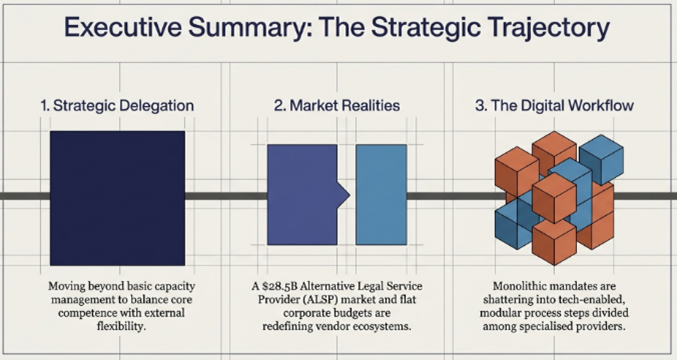 The lecture also introduced current trends that are reshaping outsourcing decisions in corporate legal and IP departments. Outside counsel remains widely used, especially for patent prosecution and trademark work. Yet the model is changing. Many companies now combine internal involvement with external support, using in-house teams to supervise strategy while law firms handle drafting, prosecution, or specialized matters. Work is increasingly allocated in structured ways, for example by technology area, business unit, or product line.
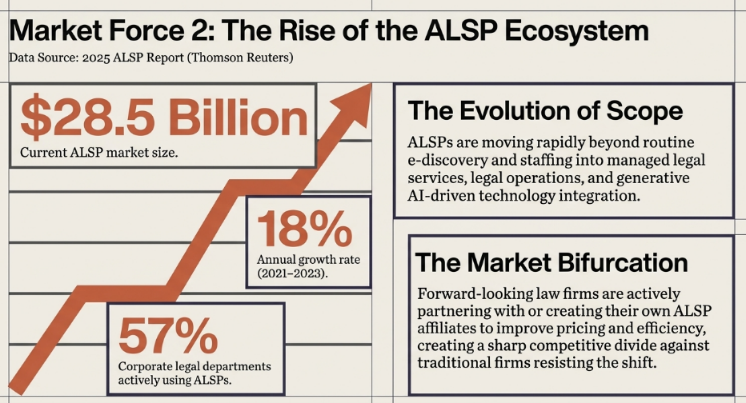
 Another major development is the rise of Alternative Legal Service Providers. These organizations are expanding rapidly and are no longer limited to low-complexity support tasks. They increasingly offer managed legal services, legal operations support, flexible staffing, e-discovery, contract management, analytics, and technology-enabled process solutions. Their growth reflects a wider shift in the market: legal work is becoming more modular, more data-driven, and more process-oriented.
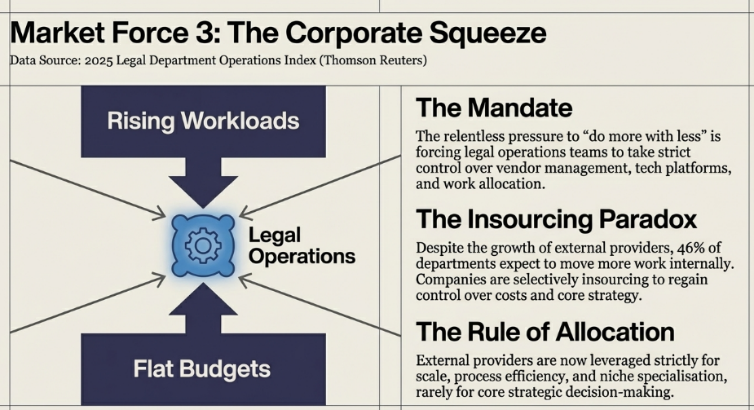
 This shift is reinforced by budget pressure. Legal departments are expected to do more with less, even as workloads rise. As the lecture showed, this leads to a more selective approach to outsourcing. Companies are not simply pushing work outside. They are trying to decide which work requires strategic proximity and which can be handled through specialized external capacity.
Digitalization intensifies this development. Legal and IP tasks can increasingly be broken down into defined process steps such as research, document drafting, analytics, and workflow management. Once work becomes modular, the classic make-or-buy question changes. The issue is no longer only whether something is performed internally or externally. The more important question becomes who operates which part of the digital workflow, with which tools, and under whose supervision.
 That has major implications for IP management. Strategic legal and IP decisions are more likely to remain in-house, while operational and repeatable tasks are automated, outsourced, or coordinated through digital platforms. The result is not the disappearance of internal IP departments, but their transformation. Their role shifts toward governance, orchestration, vendor coordination, and strategic interpretation.
IP Subject Matter Expert Adam Novak’s Contribution: Digital Interfaces as a Form of Outsourced Capability
 A particularly interesting and highly contemporary part of the lecture was the explicit reference to Adam Novak’s contribution. In the context of digitalization and changing client expectations, the lecture described how law firms are increasingly outsourcing the operation of specialized digital tools in order to streamline client interactions and meet the expectations of younger, digitally oriented clients.
Adam Novak’s contribution was presented as a concrete example of this development. The lecture referred to his approach of embedding patent searching and patentability pre-assessment tools directly into law firm webpages. This example is important because it shows that outsourcing in IP is no longer limited to back-office tasks or legal process support. It can also concern the design of the client interface itself.
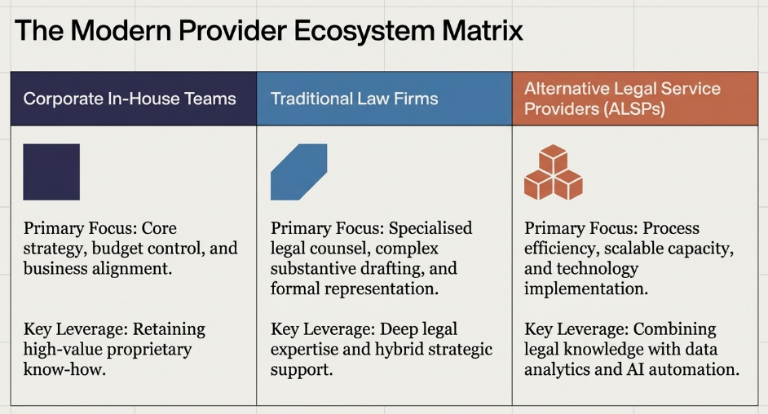 That changes the meaning of outsourcing. A law firm may still keep its core legal judgment in-house, but rely on external technological expertise to create better entry points for prospective clients, improve pre-screening, accelerate information gathering, and reduce friction in the early stages of engagement. In this sense, outsourced digital capability becomes part of business development, service design, and client experience.
The strategic value of Adam Novak’s contribution lies precisely here. His example illustrates how digital tools can mediate between legal expertise and market access. Instead of treating outsourcing only as a cost or capacity question, the lecture used this case to show how outsourcing can support a more scalable, client-friendly, and innovation-oriented service model. For IP professionals and law firms, this is a powerful lesson. The future of outsourcing is not just about who writes the document. It is also about who shapes the interaction, the workflow, and the digital touchpoint through which IP services are discovered and experienced. Here you can find here the CEIPI IP Business Talk Interview with Adam Novak:
In that sense, the Module 4 lecture offered more than a standard overview of outsourcing. It presented outsourcing as a question of institutional design in a digital economy. For students in the Master Program for IP Law and Management, that is an essential insight. The future of IP work will belong neither to fully internalized models nor to indiscriminate delegation. It will belong to organizations that know which capabilities must remain close, which can be shared, and which can be enhanced through carefully chosen external partners.