Visible IP Episode #1 Part 1/2: What Client Journeys Can Look Like for IP Experts

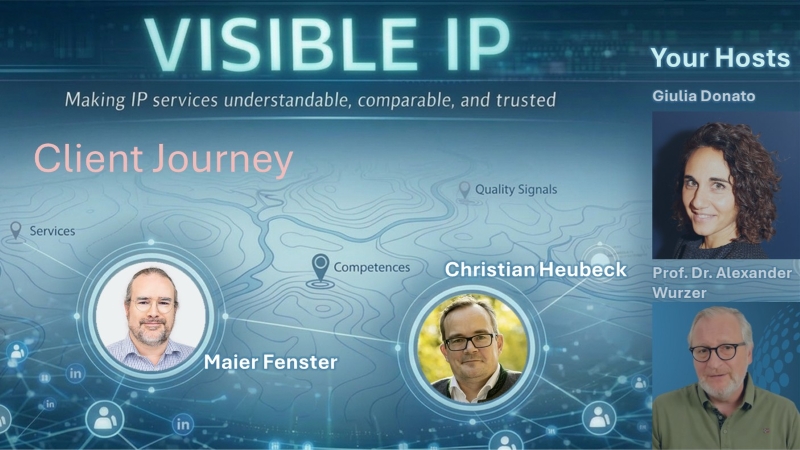
In the first episode of Visible IP within the CEIPI IP Business Live Talks, the conversation with Giulia Donato focused on a question that matters far beyond LinkedIn tactics or content production: how can intellectual property experts make their expertise visible in a way that actually leads to trust, meaningful interaction, and qualified opportunities? The answer discussed in the session was the idea of the client journey.
For many IP experts, visibility is still treated as an isolated communication task. A profile is updated, a few posts are published, perhaps a webinar is delivered, and then the expectation is that the market will somehow respond. But in practice, professional services rarely work like that. Especially in IP, where the work is complex, confidential, and difficult for outsiders to evaluate, clients do not move from first impression to instruction in one step. They move gradually. They need to understand what an expert stands for, how that expert thinks, whether the expertise fits their own problem, and what kind of interaction they can expect. That is exactly where the idea of the client journey becomes strategically important.
In the discussion with Giulia Donato, this was illustrated through two very different best-practice examples from the digital expert marketing of IP experts: Maier Fenster and Christian Heubeck. Both show that there is no single ideal route. But both also show that expert visibility becomes much more effective when it is designed as a sequence of touchpoints rather than as isolated acts of communication.
Why Client Journeys Matter for IP Experts
A client journey describes the path through which a potential client, collaboration partner, or interested stakeholder moves from first awareness to deeper trust and, eventually, to a concrete professional interaction. In consumer marketing, this idea is often explained through stages such as awareness, consideration, and decision. For IP experts, the logic is similar, but the substance is more demanding.
An IP expert is not selling an impulse purchase. They are offering judgment, interpretation, strategic thinking, and the ability to navigate uncertainty. That makes the decision to contact them much more dependent on credibility than on promotion alone. A client journey therefore has to do more than attract attention. It has to reduce uncertainty.
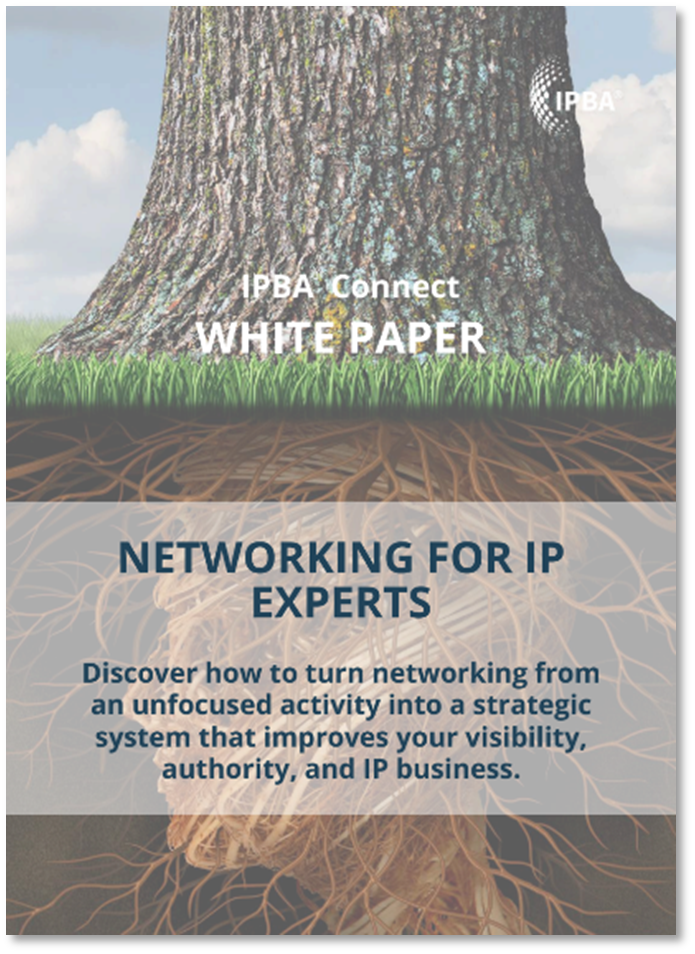 The white paper on networking for IP experts helps clarify why this matters. It argues that networking is not a social extra, but a strategic capability that turns knowledge into value. Relationships, repeated touchpoints, and proof assets all play a role in helping others understand when and why an expert should be involved. This is highly relevant for client journeys. A strong journey is not just a communication funnel. It is a trust-building system. It gives people several opportunities to experience the relevance of the expert before they are expected to act.
That is particularly important in the IP field because so much of the best work cannot be openly displayed. Patent strategy, portfolio decisions, enforcement tactics, licensing structures, or freedom-to-operate assessments are often confidential. As a result, IP experts cannot always rely on showcasing their most impressive mandates. They need other ways to make their value visible. A well-designed client journey does exactly that. It allows expertise to become tangible through formats, themes, and interactions that reveal how a person thinks and works.
Here you can download the White Paper “Networking For IP Experts” free of charge which provides a detailed explanation of how the client journey concept is applied to the business development of IP experts.
From Visibility to Trust: What a Good Journey Actually Does
During the conversation, one point became very clear: digital visibility on its own is not enough. A LinkedIn profile, a post, or even a polished website does not yet constitute a client journey. These elements only become effective when they are connected in a way that moves a person step by step toward deeper engagement.
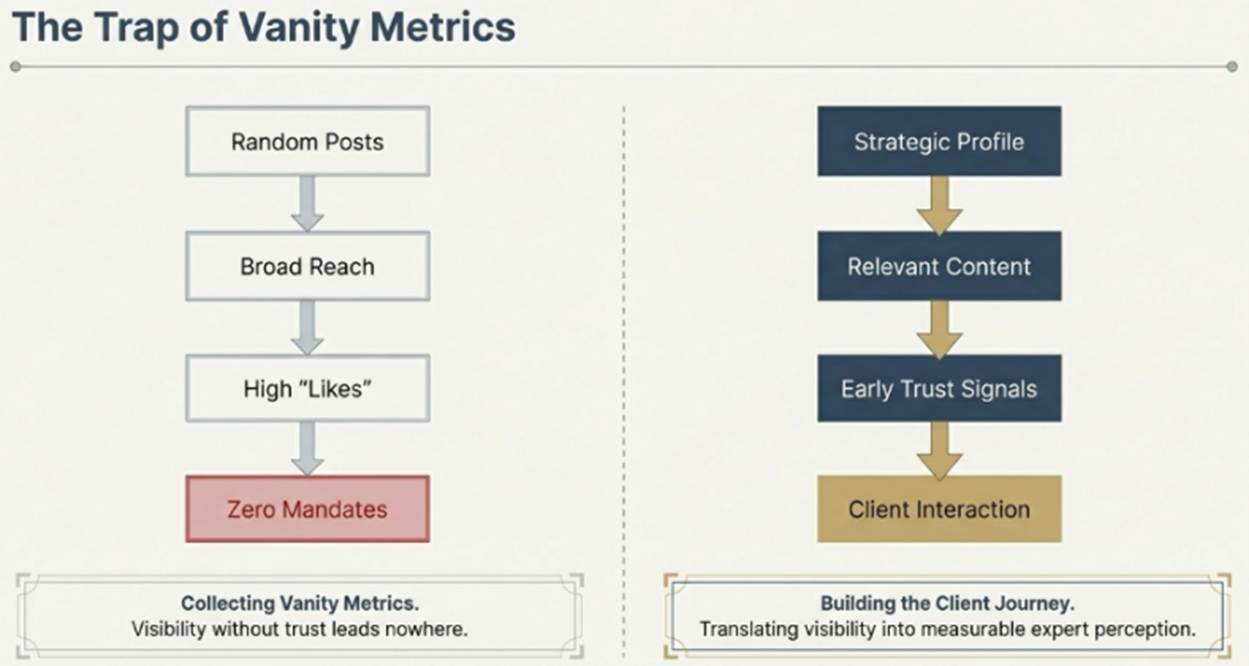 For IP experts, a good client journey usually includes at least four elements. First, there is a clear starting point, often the LinkedIn profile or another public-facing expert profile. This first point of contact must make the core topic recognizable. If the positioning is too broad or vague, the journey loses direction immediately.
Second, there is an entry touchpoint that creates interest. This could be a short post, a comment on a current development, a glossary entry, a podcast appearance, or an invitation to a live format. The purpose here is not to explain everything. It is to signal relevance and create a reason to continue.
Third, there is a deeper proof asset. This is where the white paper’s logic becomes especially useful. Proof assets can be checklists, mini-cases, diagnostic tools, white papers, or other resources that help a potential client understand the expert’s approach more concretely. In IP, these assets are often more powerful than generic self-description because they make method visible.
Fourth, there is a next best action. A good journey never ends in passive consumption. It leads toward a specific step: joining a discussion, downloading a paper, subscribing to a newsletter, attending office hours, or requesting a conversation. The point is not to push aggressively. The point is to make the next step obvious and easy.
Giulia Donato’s perspective added an important nuance here. She emphasized that the real strength of a good journey is not only that it informs people, but that it lets them experience an expert’s judgment. In highly specialized professional markets, that is often what people are actually buying. Not just information, but the confidence that someone can interpret complexity, ask the right questions, and structure the problem well.
The Maier Fenster Example: A Live and Interactive Client Journey

The first example discussed in the episode was Maier Fenster. His case shows a client journey built around live interaction and visible expert reasoning. It begins with a clearly focused profile that already signals a specialization in the field of medical devices. That matters because the journey starts working only when the audience can quickly understand the thematic territory.
From there, Maier uses formats such as IP Safari and IP Zoo. In the case of IP Safari, the path can be described as follows: people encounter his LinkedIn profile, then a LinkedIn post, then open slides related to a case, and finally an invitation to a live Zoom discussion. What makes this journey powerful is that it does not stop at content distribution. It creates a situation in which participants can observe how the expert thinks in real time.
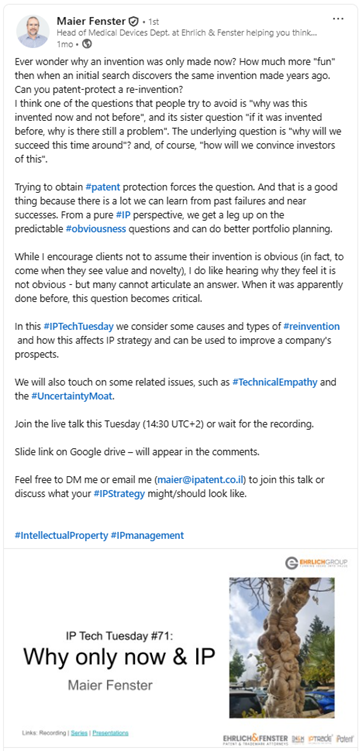
This was one of the key points raised in the discussion with Giulia. Maier does not merely state that he is knowledgeable. He creates a format in which his analytical style, his practical judgment, and his ability to respond to questions become visible. That is a major difference. The journey moves from awareness to witnessed performance.
This is particularly valuable in the IP context. Because legal and strategic expertise is often hard to assess from the outside, a live format creates something close to a professional demonstration. People can see how an issue is framed, how arguments are weighed, and how unexpected input is handled. In other words, the journey reveals the expert’s working mind.
IP Zoo follows a similar logic, though with a somewhat more theoretical angle because it revolves around the discussion of a paper rather than a case. Yet the principle remains the same. A concrete object becomes the anchor for interaction, and the audience is invited into a shared intellectual space rather than treated as passive spectators.
The broader lesson is that a client journey can be built through synchronous, dialogic formats that turn visibility into experience. This model works especially well for experts whose strength lies in discussion, interpretation, and the ability to make complex issues accessible in conversation.
The Christian Heubeck Example: An Asynchronous and Resource-Based Journey
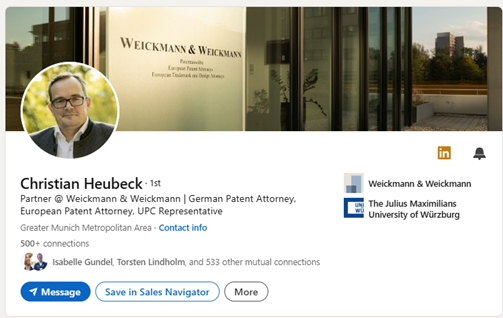
The second example, Christian Heubeck, illustrates a very different but equally effective model. His area of focus is Life Sciences, and his client journey is less centred on live interaction and more on structured resource-building.
The path discussed in the episode begins again with a clear LinkedIn profile. From there, a user encounters a topical expert post. In the comments, there is a link to Christian’s expert page in the digital IP lexicon, and from there the journey continues to a white paper that can be accessed in exchange for an email address.
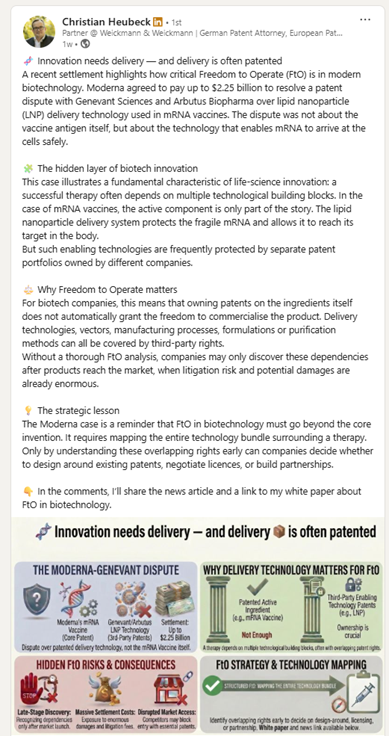
Giulia described this as a particularly smart model because it uses LinkedIn as a low-threshold entry point while reserving the deeper conversion step for a more substantial asset. The post creates initial awareness. The expert page adds context and credibility. The white paper then acts as a proof asset that signals deeper interest and invites a more serious form of engagement.
This is a more asynchronous client journey. It is well suited to people who do not want to join a live session immediately but prefer to read, reflect, and evaluate before entering direct contact. In this sense, it respects a different user behaviour. Some people want conversation first. Others want substance first.
The Christian Heubeck example also shows how content depth can function as a bridge between visibility and trust. A white paper is not just a lead-generation mechanism. In the best case, it demonstrates clarity, relevance, and the ability to structure a field of complexity. It gives the audience something valuable before any direct exchange takes place.
That fits closely with the white paper’s broader argument about networking and proof assets. Useful, shareable resources help other people advocate internally for an expert. They make expertise easier to forward, discuss, and remember. For IP experts, that is a major advantage because referrals and trust transfers often happen through internal conversations long before the expert is contacted directly.

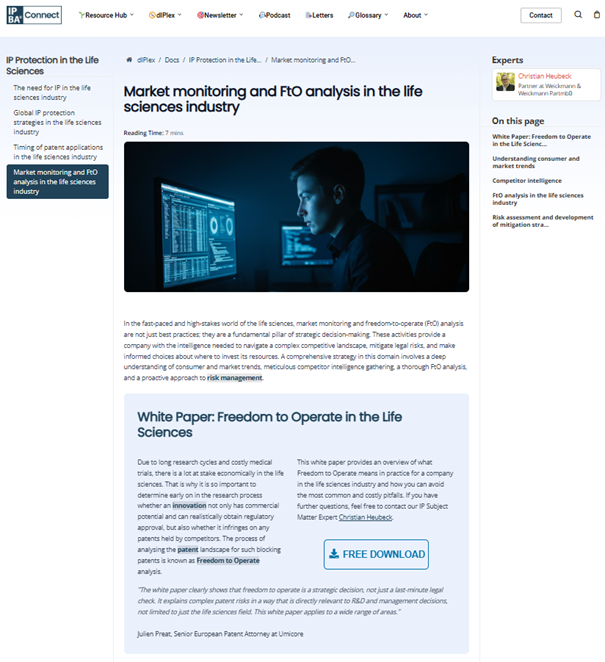
Christian Heubeck’s download section for his white paper on the digital IP Lexicon 🧭dIPlex
Taken together, the two examples from Visible IP Episode #1 show that the best client journeys are not generic funnels copied from mainstream marketing. They are carefully designed sequences of trust-building touchpoints adapted to the realities of IP work. Maya Fenster demonstrates the power of live, interactive visibility. Christian Heubeck demonstrates the strength of thoughtful, resource-based progression. Both routes succeed because they translate expertise into a form that others can actually experience.
That may be the most important insight from the discussion with Giulia Donato. For IP experts, visibility becomes valuable only when it is structured. A client journey gives that structure. It connects positioning, content, proof, and next steps into a professional pathway that reduces uncertainty and increases the likelihood of meaningful interaction. In a field where expertise is difficult to judge from the outside, that is not just a marketing advantage. It is a strategic necessity.