
How Should Quantum Software Companies Build Their IP Strategy? Important industry topic with Dr. Daniel Volz

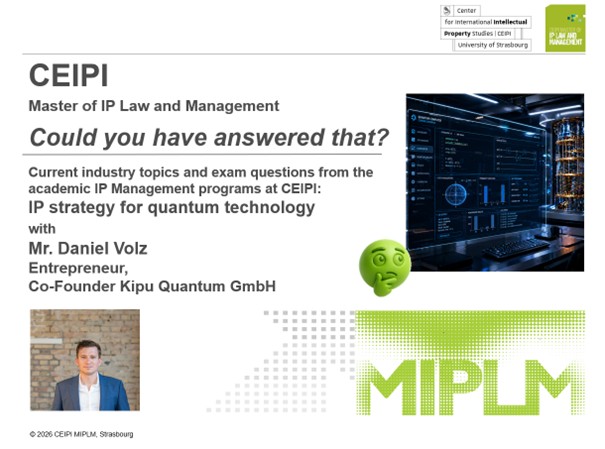
The demand for IP services, IP competence, and strategic support in the field of quantum technologies is steadily increasing. To better understand this development, the CEIPI IP Business Academy recently conducted an Open Foresight Board study in Europe, which confirmed the growing need for practical guidance at the interface of quantum technology, business development, and intellectual property management.
Here you find the Findings of this study: “The Quantum IP Gap”
Against this background, the CEIPI IP Business Academy continuously adapts its teaching content in close exchange with practitioners from industry and advisory services. The aim is to ensure that concrete practice-relevant questions and real industrial needs are systematically integrated into the training programs.
Quantum technology is a dynamically evolving technological and economic field of action. We are therefore particularly pleased to collaborate with experts from industrial practice. The following practical question was evaluated by Mr. Daniel Volz. Daniel is co-founder and former CEO of Kipu Quantum GmbH, a quantum computing startup with the mission to deliver industrially useful quantum computing applications for end users by leveraging application- and hardware-specific algorithms. Here is his assessment of this exam case:#
„As former CEO of KIPU Quantum, I can confirm that this case study is extremely relevant for practical applications, as it directly touches real questions and discussions I had with my management team, and my investors. IP in quantum software is not black or white, and the spectrum between publishing, patenting and keeping under wraps (as trade secrets) affects many day-to-day tactical decisions, but also overall strategy“.
Mini case study
A young quantum technology company does not manufacture its own hardware. Instead, it develops highly specialized software that makes existing quantum hardware more useful for industrial customers. Its commercial value lies in a combination of elements: problem-specific algorithms, hardware-adapted implementation, workflow integration, performance tuning, and close collaboration with customers in sectors such as chemicals, finance, and manufacturing.
The company is now entering a growth phase. It wants to attract investors, expand partnerships, and scale internationally. At the same time, it faces a strategic dilemma. Some parts of its advantage may be patentable. Other parts may be better protected as trade secrets. Some value may lie in software copyright, contractual control over collaboration results, or simply in being faster and better integrated than competitors.
Question:
How should such a company design its IP strategy? What should it try to protect through patents, what should remain confidential, and what should be secured through contracts, software control, or ecosystem position?
Why this is a highly practice relevant question
This is an important practical question because in quantum technology the key competitive advantage often does not sit in one isolated invention. It is frequently distributed across algorithms, implementation know-how, software architecture, hardware adaptation, customer-specific integration, and application expertise. That makes IP strategy much more complex than simply asking whether something can be patented.
The question is also commercially important because the wrong protection choice can weaken the business. A company that patents too much may disclose valuable know-how too early. A company that relies only on secrecy may struggle in partnerships, fundraising, enforcement, or talent mobility. A company that ignores contracts may lose control over jointly developed value in customer or hardware collaborations.
In addition, this is exactly the kind of issue future IP managers will face in practice. They will need to advise not only on legal protection, but on how protection supports business model, market access, investor confidence, collaboration structure, and long-term defensibility. In other words, the real challenge is not just legal qualification. It is building a protection architecture that fits how the company creates value.
That is why this mini case is strong for IP Management students. It forces them to connect IP law with technology strategy, commercialization, contracts, and competitive positioning in an emerging field.
Here you will find the lecture “Quantum Software IP Strategy – Protecting Reusable Capabilities and Market Access” regarding this exam question:
Dr. Daniel Volz
 Daniel Volz is an entrepreneur and co-founder of Kipu Quantum GmbH. His work focuses on industrially useful quantum computing applications, especially through application-specific and hardware-specific algorithms.
Before founding Kipu Quantum, he worked at BASF SE as Project Manager, where he led a group-wide initiative on quantum computing strategy, use-case exploration, and partnerships with external quantum vendors. Earlier, he was a Senior Management Consultant at McKinsey & Company, where he helped build global quantum computing capabilities across industries including chemicals, pharma, manufacturing, and finance.
Daniel Volz holds a PhD in chemistry from Karlsruhe Institute of Technology and has a strong background in specialty chemicals, OLED materials, optoelectronics, and strategic technology development. Earlier in his career, he spent eight years at CYNORA, where he worked across R&D, IP, team leadership, product development, and strategic planning.