The Quantum IP Gap in Germany: What Quantum Companies Need, and What the Public Market Still Fails to Address

A recent study conducted with the Open Foresight Board of the CEIPI IP Business Academy points to a clear mismatch in the German market for IP support in quantum technologies. Quantum companies do have a strong and specific need for intellectual property guidance. Yet much of that need is not visibly addressed in the way patent attorneys and IP experts publicly present their services.
This article is not about opportunity. It is not about what could be built next. It is about the current gap.
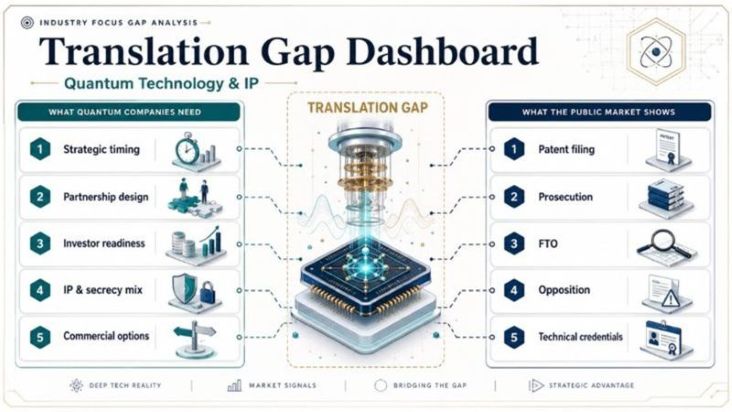
On one side, there are quantum companies navigating uncertainty, partnerships, funding pressure, long development cycles, and technically complex business models. On the other side, there is a public market narrative from IP experts that still leans heavily on scientific credentials, broad technical competence, and traditional patent procedures.
The issue is not that patent attorneys lack intelligence or technical depth. In many cases, the opposite is true. The issue is that the public communication of IP expertise often does not reflect the actual decision environments quantum companies are dealing with.
The demand side: what the study reveals
The Open Foresight Board study suggests that quantum technology companies are not primarily struggling with the abstract question of whether patents matter. They already know IP matters. Their challenge is more specific.
They need support in situations where legal, technological, commercial, and strategic questions collide.
A quantum company may be asking whether a specific innovation should be patented now, kept confidential longer, or embedded in a broader platform strategy. It may be dealing with joint development settings involving universities, suppliers, software teams, hardware teams, and public research partners. It may be preparing for investor conversations and needing a portfolio narrative that supports valuation without creating avoidable disclosure risks. It may be uncertain about how to sequence protection, collaboration, publication, and market entry when the technology itself is still evolving.
These are not isolated filing questions. They are practical business situations with an IP dimension.
The study indicates that the demand is therefore not limited to patent drafting in the narrow sense. What companies are looking for is orientation in a landscape of uncertainty. They need IP support that is connected to timing, funding, collaboration risk, secrecy, commercialization logic, and future bargaining power.
This is important because emerging technology companies do not experience IP as a neat legal category. They experience it as part of the operating reality of building a business under pressure.
The supply side: what public communication still emphasizes
When one looks at how many IP experts publicly present themselves in relation to quantum technologies, a different picture becomes visible.
The most common signal is scientific legitimacy. Public profiles often stress a doctorate in physics, research experience in quantum optics or quantum information, a background in superconducting systems, cryogenics, photonics, semiconductors, or advanced software, and in some cases a deep connection to well-known research institutions. This makes sense. Quantum technology is highly technical, and any advisor in the field must be able to understand complex inventions.
But in public communication, this often becomes the main story.
The message is: I understand the science.
Much less often, the message becomes: I understand the recurring business-side IP situations that quantum companies face.
A second recurring pattern is the language of classical patent work. Public descriptions often focus on prosecution, drafting, opposition, litigation, nullity, portfolio management, or freedom to operate. These are all important services. But they are typically presented as standard legal capabilities rather than as answers to the concrete uncertainty patterns of quantum ventures.
A third pattern is categorization. Quantum technologies are often listed as one technical field among many, alongside semiconductors, telecommunications, electronics, software, robotics, or physics more broadly. From a law firm perspective, this is logical. From a market communication perspective, it can flatten the problem. It suggests that quantum is simply another field requiring high technical literacy, rather than a category where the interface between IP, strategy, timing, and ecosystem risk is unusually intense.
Where the mismatch becomes visible
The gap becomes clearest when we compare the actual situations quantum companies face with the way public IP expertise is framed.
One common public positioning pattern is the research-heavy profile. An IP expert presents an impressive scientific background in physics, quantum mechanics, photonics, or related fields, along with experience in patent drafting and prosecution. That signals technical credibility. What it does not necessarily signal is an ability to help a quantum company decide how to manage IP around a consortium agreement, a financing round, or a product architecture that may combine hardware, software, and data-driven control layers.
Another pattern is the full-service patent firm description. Here, quantum technologies are visible as a competence area, but only as one item within a broad matrix of industries and technical domains. The public message is that the firm can handle quantum-related patent matters because it has the right technical lawyers or patent attorneys. Again, that is useful. But it still does not publicly describe the lived decision-making pressures inside a quantum company.
A third pattern is the educational patentability narrative. Some public-facing content explains that quantum computing, quantum annealing, or similar developments can indeed be patentable, and may even offer talks or introductory content on the subject. This is more direct and more market-facing than purely credential-based positioning. Yet it still often stops at the threshold question of patentability, rather than moving into the more difficult questions of sequencing, valuation, collaboration exposure, and strategic timing.
There is also a pattern of procedural excellence messaging. Public profiles emphasize litigation strength, prosecution experience, office practice, international filing ability, or strong work before the EPO or national offices. This can be highly persuasive in established markets. But in quantum, many companies are not yet primarily searching for a litigation story. They are trying to understand how to build future leverage while the market and the technology stack are still unstable.
What companies need is not visible enough
That is the central point.
The gap is not that quantum companies need IP and the market offers no patents. The gap is that the real need appears to be broader, earlier, and more operational than the public narrative of IP expertise currently suggests.
Companies need support in deciding what to disclose and when. They need help understanding how to protect value when multiple actors contribute to one technical trajectory. They need guidance on how IP affects investor readiness, future licensing options, and competitive positioning long before a dispute ever emerges. They need an advisor who can translate IP into the language of strategic choice under uncertainty.
Yet public communication still leans strongly toward science, qualifications, and standard procedure.
That creates a market problem. If the visible narrative is too narrow, quantum companies may assume that the available support is narrower than it actually is. They may see technical brilliance, but not recognize a partner who understands the practical architecture of their business problems.
In other words, the communication gap can turn into an access gap.
Why this matters especially in quantum technologies
This mismatch is particularly pronounced in quantum technologies because the field is still emerging and fragmented.
Many quantum companies operate at the intersection of research and commercialization. Their products may not yet fit stable market categories. Their competitive advantage may depend on combinations of hardware design, error correction approaches, software abstraction, manufacturing know-how, control systems, data handling, and ecosystem positioning. Their route to market may involve pilots, public funding, strategic alliances, or hybrid licensing models before revenue becomes predictable.
In such a setting, IP decisions are rarely isolated legal events. They are part of company building.
That is why a public narrative centred mainly on technical depth and classical patent categories can fall short. It reflects competence, but not necessarily relevance to the company’s immediate operating questions.
The Open Foresight Board findings suggest that this is exactly where the current disconnect lies. The need is there. The public signal that the need is fully understood is still weak.
A gap in translation
What we see, then, is not primarily a gap in intelligence, legal quality, or scientific excellence. It is a gap in translation.
Quantum companies seem to need IP support framed around uncertainty, coordination, timing, and commercial consequence. Publicly visible IP positioning still tends to frame expertise around technical mastery, credentials, and established patent procedures.
Those two worlds are related, but they are not the same.
And as long as the market continues to speak mainly in one language while companies experience their problems in another, the gap will remain visible.
That is the present state of the quantum IP market interface in Germany.