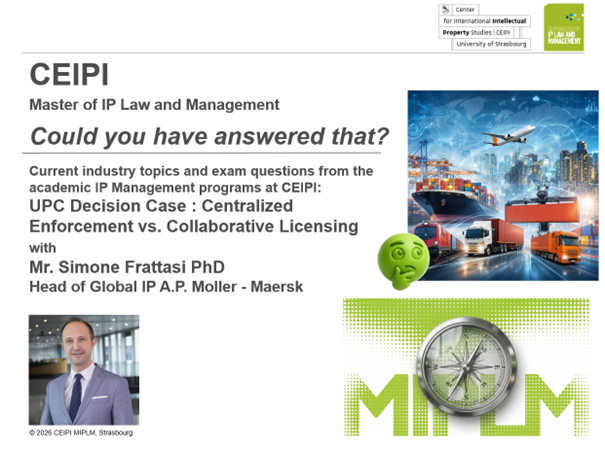
UPC Decision Case: Centralized Enforcement vs. Collaborative Licensing in Transportation and Logistics with Simone Frattasi

The introduction of the Unitary Patent and the Unified Patent Court (UPC) has fundamentally changed how companies can enforce and manage patent rights across Europe. In transportation and logistics, this development meets a sector undergoing deep technological transformation. Decarbonization, alternative fuels, energy-efficient vessel systems, digital optimization tools, and integrated supply chain solutions are increasingly developed within complex ecosystems of technology partners, infrastructure providers, regulators, and industry alliances.
This decision case with Simone Frattasi focuses on a core strategic tension: whether a global transportation and logistics company should use centralized UPC enforcement to strengthen licensing leverage and protect key decarbonization technologies, or whether it should prioritize collaborative licensing models that accelerate ecosystem adoption and long-term sustainability goals. The case shows why UPC strategy in this field cannot be treated as a purely legal enforcement question. It must be aligned with value capture, value creation, regulatory expectations, ESG-related initiatives, patent pools, pledges, and the broader need for industry-wide transformation.
This reflects exactly the concern described in the UPC Strategy Gap study: companies face centralized injunction risks, revocation exposure, forum choices and portfolio vulnerabilities, while the market still often frames UPC advice too narrowly as procedural litigation expertise. The CEIPI IP Business Academy recently addressed the UPC Strategy Gap in Europe, showing that companies increasingly recognize the strategic relevance of the Unified Patent Court, while much of the market still frames UPC support mainly as procedural or litigation expertise.
Here you find the Findings of the study: “The UPC Strategy Gap in Europe”
Decision Context
A global transportation and logistics company is actively investing in technologies aimed at decarbonizing its operations, including alternative fuels, energy-efficient vessel systems, digital optimization tools, and integrated supply chain solutions. These innovations are not developed in isolation, but within a broader ecosystem involving technology partners, infrastructure providers, regulators, and industry alliances.
Intellectual Property (IP) plays a central role in enabling and accelerating this transformation. It supports differentiation, secures technological investments, and increasingly serves as a basis for collaboration through licensing frameworks, joint development agreements, and emerging sustainability-driven initiatives such as patent pools and pledges.
With the introduction of the Unitary Patent and the Unified Patent Court (UPC), the company gains new options for enforcing its rights across Europe. However, enforcement decisions must be carefully aligned with broader sustainability objectives, collaborative industry dynamics, and evolving regulatory expectations.
The Decision
Should the company leverage centralized enforcement under the UPC to strengthen its position in licensing negotiations and protect key decarbonization technologies, or should it prioritize collaborative licensing approaches that favour ecosystem adoption and long-term sustainability goals, even at the cost of reduced enforcement intensity?
Why This Decision Is Difficult
This decision reflects a fundamental tension between control and collaboration:
- Enforcement Power vs. Ecosystem Adoption
Strong enforcement under the UPC can increase leverage in licensing negotiations and protect competitive advantage. However, in sustainability-driven contexts, widespread and faster adoption of technologies may depend on more open or coordinated licensing approaches. - Value Capture vs. Value Creation
Centralized enforcement supports value capture from proprietary technologies. At the same time, decarbonization often requires collective action, where value is created through shared standards, interoperability, and industry-wide implementation. - Risk Management vs. Strategic Signalling
Enforcement decisions signal how a company positions itself within the industry. Aggressive strategies may deter competitors but also affect partnerships, alliances, and participation in sustainability initiatives. - Portfolio Strategy vs. Licensing Models
Decisions on enforcement influence how patent portfolios are structured, utilized and monetized. They interact with licensing frameworks, including bilateral agreements, cross-licensing, and participation in patent pools and pledges, or ESG-driven initiatives. - Regulatory and Policy Context
Sustainability and decarbonization are increasingly shaped by regulatory frameworks and public policy. Enforcement strategies must therefore consider not only legal outcomes, but also alignment with regulatory expectations and broader societal objectives.
Practitioner Perspective
In the context of decarbonizing transportation and logistics, IP is not only a tool for exclusion, but also a mechanism for enabling large-scale transformation.
The UPC introduces powerful enforcement capabilities that can strengthen negotiation positions and protect critical innovations. However, in sustainability-driven environments, the strategic use of IP often extends beyond enforcement toward facilitating collaboration and accelerating adoption.
Licensing becomes a central instrument, allowing companies to balance protection with openness. Decisions must therefore reflect how IP contributes to both competitive positioning and collective progress within the industry.
The relevance of UPC considerations depends on how companies define the role of IP within their sustainability strategy, how they engage with partners and competitors, and how they navigate the interplay between proprietary advantage and shared technological advancement.
Implication for IP Management Education
This case highlights the need to rethink the role of IP in contexts where collaboration and competition coexist.
IP professionals must be able to design strategies that integrate enforcement, licensing, and sustainability objectives into a coherent framework. This requires understanding how IP can support both value capture and value creation in complex, multi-stakeholder environments.
The UPC provides a concrete setting in which these tensions become visible, requiring a shift from isolated enforcement decisions to integrated approaches that align with business strategy, regulatory developments, and long-term societal goals.
Simone Frattasi
 With over a decade of experience in IP, Simone currently serves as the Head of Global IP at MAERSK, Denmark, where he leads a team dedicated to maximizing the utilization of IP assets and safeguarding the brand. Prior to this role, he held the position of Head of the Patent Department at Sony Mobile Communications, Sweden, where he led a team overseeing patent strategies and execution.