The UPC Strategy Gap in Europe: What Companies Need, and What the Market Still Fails to Address

A growing number of signals from the industry suggest a clear mismatch in the European market for patent support around the Unified Patent Court. Companies do recognize the strategic relevance of the UPC. Yet much of what they need is not visibly addressed in how patent expertise is publicly framed.
This article is not about whether the UPC matters. That debate has largely passed. It is about a gap.
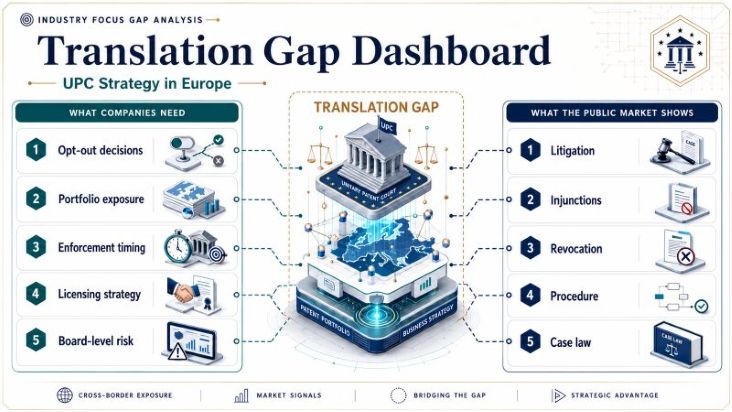
On one side, there are companies facing a fundamentally changed enforcement environment: centralized injunction risks, pan-European revocation exposure, forum choices, portfolio vulnerabilities, and litigation decisions that increasingly intersect with business strategy. On the other side, much public communication from IP experts still emphasizes procedural competence, litigation credentials, and doctrinal expertise, without sufficiently reflecting the broader decision environments companies are navigating.
The issue is not that expertise is missing. In many cases, the opposite is true. The issue is that public communication often does not fully reflect the strategic problems companies are trying to solve through UPC-related advice.
The demand side: what companies increasingly need
Many companies are not primarily asking abstract questions about the UPC as a legal system. They are facing operational decisions under uncertainty.
A company may be asking whether a European patent should remain opted in or be opted out. It may be assessing whether prosecution strategy should already anticipate future UPC enforcement. It may be considering how litigation risk affects licensing leverage, freedom-to-operate, supply chains, or investment decisions. It may need to understand whether the UPC changes not just dispute resolution, but the architecture of IP risk management itself. These are not isolated litigation questions. They are business situations with a legal dimension.
What many companies appear to need is support where enforcement, portfolio strategy, competitive dynamics, and governance intersect. They need orientation in a system where one decision can have multi-jurisdictional consequences. That need often begins earlier than litigation. It concerns preparation, not only disputes. It concerns institutional readiness, not only courtroom representation. That is a different demand profile than traditional patent litigation alone.
The supply side: what public communication still emphasizes
When one looks at how UPC expertise is often publicly presented, a different picture becomes visible.
The dominant signals are often legal pedigree and procedural competence. Public LinkedIn profiles emphasize representation before European courts, litigation experience, dual prosecution-litigation capabilities, or familiarity with the structure of the new court. All of this matters. But it often becomes the main story.
The message is: We know UPC litigation. Much less often, the message becomes: We understand the recurring strategic decisions companies now face because of the UPC.
A second recurring pattern is a strong focus on doctrinal questions: early case law, injunction practice, bifurcation risks, jurisdictional issues, revocation dynamics. Again, all important. But they are often framed as legal developments to monitor, rather than as business decisions to prepare for. Early UPC decisions have already shown how quickly centralized remedies can affect competitive positions across markets.
A third pattern is categorization. UPC expertise is often communicated as one litigation capability among many. But for many companies, the UPC is not simply another forum. It changes the economics and governance of patent decisions. That distinction is not always visible in public positioning.
Where the mismatch becomes visible
The gap becomes clearest when comparing the situations companies face with the way expertise is often framed. What companies need is often not visible enough. That is the central point. The gap is not that companies need UPC support and the market offers no litigators. The gap is that the actual need appears broader, earlier, and more strategic than the visible narrative often suggests.
Companies may need guidance on patent portfolio exposure under centralized revocation risk. They may need support in integrating UPC scenarios into licensing, prosecution, or board-level risk management. They may need help understanding when litigation preparedness should influence filing strategy years before disputes emerge. Yet public communication often still leans toward litigation excellence as such.
That can create a market problem. If the visible narrative is too narrow, companies may assume the support available is narrower than it is. They may see excellent litigators, but not necessarily recognize advisors who understand the business architecture of UPC decisions. In other words, a communication gap can become an access gap.
A gap in translation
What appears visible, then, is not primarily a gap in legal quality. It is a gap in translation. Companies increasingly experience the UPC through questions of uncertainty, coordination, strategic exposure, and institutional preparedness. Publicly visible expertise often still frames the subject primarily through procedure, doctrine, and litigation credentials. Those worlds are related. But they are not identical. And as long as the market continues to speak mainly in one language while companies experience their problems in another, the gap remains visible.
The opportunity may therefore not lie primarily in more UPC expertise, but in making existing expertise legible in the language of business decisions. That may be where the next stage of differentiation in the UPC market begins.