
How to Develop an IP Strategy for Quantum Infrastructure? Industry case study with Erik Visscher

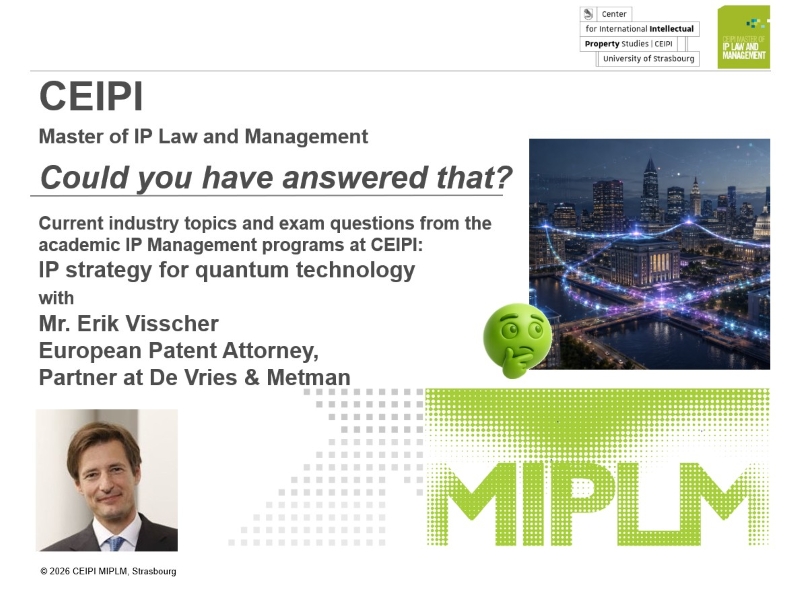
The demand for IP services, IP competence, and strategic support in the field of quantum technologies is steadily increasing. To better understand this development, the CEIPI IP Business Academy recently conducted an Open Foresight Board study in Europe, which confirmed the growing need for practical guidance at the interface of quantum technology, business development, and intellectual property management.
Here you find the Findings of this study: “The Quantum IP Gap”
Against this background, the CEIPI IP Business Academy continuously adapts its teaching content in close exchange with practitioners from industry and advisory services. The aim is to ensure that concrete practice-relevant questions and real industrial needs are systematically integrated into the training programs.
Quantum technology is a dynamically evolving technological and economic field of action. We are therefore particularly pleased to collaborate with experts from private practice. Erik Visscher is European Patent Attorney, Attorney at Law, UPC Representative and Partner at De Vries & Metman. He is Co-chair WG IP and Trade Eorpean Quantum Industry Consotrium (QuiC) and Lecturer Patent Law ant Technische Universiteit Delft.
Mini Case Study
A European deep-tech scale-up is developing a quantum communication infrastructure based on quantum key distribution (QKD) for secure data transmission between financial institutions and government entities.
The company’s core innovation lies not only in its photonic hardware, but increasingly in its network orchestration layer – software that dynamically manages quantum channels, error correction, and hybrid classical-quantum routing.
During early pilot deployments, the company collaborates with telecom operators and integrators to embed its technology into existing fiber networks. These partners request deeper technical access to ensure interoperability and scalability. At the same time, competitors – including large telecom incumbents – are rapidly building adjacent solutions, often leveraging standardization bodies and open interfaces.
The management team now faces a critical decision:
- Whether to patent key elements of the system (e.g. protocols, synchronization methods, hybrid routing logic),
- Or to keep parts of the system architecture confidential, especially the orchestration and control layer that enables system-level performance advantages.
This decision is complicated by the fact that future value is highly uncertain and depends on ecosystem adoption, outcomes of different – potentially competing – standardization initiatives of well-known international-operating standardisation organisations such as ETSI with very specific IPR rules and regulations, and the ability to scale deployments across networks.
The situation reflects the type of decision pressure regularly encountered by IP practitioners working at the intersection of quantum technologies, telecommunications, and software-based control systems, as also seen in the work of experts such as Dr. Erik Visscher, who advices European companies that are active in quantum communication, telecommunications standards, and advanced computing systems.
Practical Question
How should a quantum communication company decide which parts of its system architecture to patent and which to keep as trade secrets, when the primary competitive advantage lies in system-level orchestration and future ecosystem positioning rather than in isolated technical components?
Why This Question Matters in Practice
This question becomes highly relevant in early commercialization phases, when companies move from lab-scale validation to real-world deployment and ecosystem integration. At this stage, technical solutions are still evolving, standards are not yet fixed, and the long-term sources of value are uncertain.
It is particularly relevant for:
- Deep-tech scale-ups and quantum technology companies transitioning into market deployment
- Telecom and infrastructure players integrating quantum capabilities into existing networks
- IP strategists, CTOs, and business development leaders responsible for aligning protection strategies with market positioning in a field of technology where technical standards will play a major role.
The challenge arises under conditions where:
- Competitive advantage is systemic and dynamic, not tied to a single invention
- Collaboration with partners requires controlled disclosure of core know-how
- Standardization efforts may shift the market from proprietary technology to interoperability layers
- Investment decisions depend on credible signals of defensibility and scalability
- Strategic positioning may require participation in different standardisation efforts
From a strategic and economic perspective, the decision is not about maximizing legal protection, but about shaping future market positions and revenue streams:
- Patents can support participation in standards, licensing models, and valuation narratives
- Trade secrets can protect implementation depth and performance advantages that are difficult to replicate
- Hybrid strategies must consider timing, disclosure risks, and ecosystem dependencies
Ultimately, this question determines whether the company can retain control over the critical leverage points of its technology – not just technically, but commercially – in a market that is still being formed.
Erik Visscher
 Erik Visscher is a European patent attorney, attorney at law, UPC representative and partner at De Vries & Metman in Amsterdam. His work focuses on patent prosecution, opposition and litigation in advanced technologies, including telecoms, IoT, AI, chip security, photonics, MEMS, quantum computing, quantum communication and QKD.
He previously worked as a lawyer at De Brauw Blackstone Westbroek and as a patent examiner at the European Patent Office. He holds a PhD from Delft University of Technology in single-electron tunneling devices and an LLM in civil law from Leiden University. He also lectures in patent law at TU Delft and co-chairs QuIC’s IP and Trade Working Group.
You can find Erik Visscher on LinkedIn here.