Timing of UPC-Related Decisions in Medical Technology with Bernhard Thum

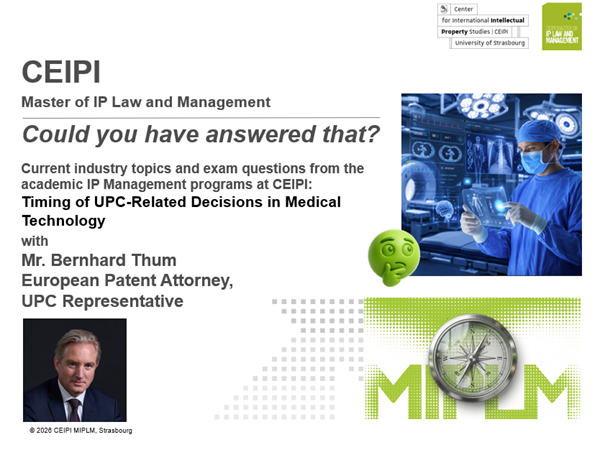
Medical technology is one of the fields where IP decisions are rarely made at a single moment in time. Product development, clinical validation, regulatory approval, reimbursement, market access, and competitive positioning often unfold over many years. This means that patent decisions taken at an early stage may only reveal their full strategic relevance much later, when the product is closer to market and enforcement questions become more concrete.
The introduction of the Unitary Patent and the Unified Patent Court adds another layer to this timing problem. For medical technology companies, the UPC is not simply a litigation option to be considered shortly before enforcement. It can influence how patent portfolios are structured, how European coverage is planned, how risks are distributed, and how future strategic flexibility is preserved. The central challenge is therefore to connect early-stage filing decisions with late-stage commercial and enforcement realities.
This case with Bernhard Thum asks how medical technology companies should manage UPC-related considerations across this extended decision horizon. It highlights the need to treat IP strategy as a sequence of interdependent choices rather than as a set of isolated legal decisions. The question is especially relevant where companies face long development cycles, uncertain regulatory outcomes, and evolving competitive dynamics across multiple European markets.
Mini Case Study
A medical technology company develops innovative devices that combine mechanical components, electronics, and software-driven functionalities. Its products are subject to long development cycles, clinical validation requirements, and strict regulatory approval processes before market entry.
Patent protection is typically initiated at an early stage, often before the final product configuration and market positioning are fully defined. At the same time, key commercial decisions — including market rollout, partnerships, and enforcement strategies — only materialize at much later stages, when regulatory approval is secured and competitive dynamics become visible.
With the introduction of the Unitary Patent and the Unified Patent Court (UPC), the company is faced with new strategic options regarding how to structure protection and enforcement across Europe. However, these options must be considered at different points in time, under varying levels of uncertainty.
Practical Question
How should medical technology companies balance early-stage and late-stage decision-making when determining how UPC-related considerations should influence their patent and enforcement strategies?
Why This Question Matters in Practice
This question becomes particularly relevant in medical technology, where innovation timelines are long and the gap between initial patent filings and actual market entry can span several years.
At early stages, decisions must be taken under high uncertainty regarding product success, regulatory approval, and market relevance. UPC-related considerations may appear abstract at this point, yet early choices can shape the structural options available later on.
At later stages, when products approach commercialization and competitive pressure increases, enforcement and market positioning become more concrete. However, the flexibility to adapt may be constrained by earlier decisions regarding patent structure and geographical coverage.
The challenge lies in connecting these stages. Companies must determine how much strategic weight to assign to UPC-related considerations early on, without overcommitting under uncertainty, while ensuring that sufficient options remain available when enforcement and commercial decisions become critical. This question is especially relevant for organizations that operate across multiple jurisdictions, manage complex product portfolios, and need to align IP decisions with regulatory pathways, clinical timelines, and business strategy.
Ultimately, the role of the UPC is not fixed at a single decision point. Its relevance evolves over time, requiring companies to manage IP as a sequence of interrelated decisions rather than isolated choices.
Bernhard Thum
 Bernhard Thum is a Munich-based patent attorney, European Patent, Trademark and Design Attorney, and UPC Representative. He has been a partner at Thum & Partner since 2021, after nearly two decades at Wuesthoff & Wuesthoff, where he served as partner and advised on patent prosecution and IP litigation in a leading Munich IP law firm.
His background combines engineering, IP law, and commercial IP practice. He holds a Dipl.-Ing. in Mechanical Engineering from the University of Stuttgart and an LL.M. in European Intellectual Property Law from FernUniversität in Hagen. Before private practice, he worked as Licensing Manager in Siemens’ Intellectual Property Group.