The Unified Patent Court in Motion – How the UPC Is Reshaping European Patent Litigation

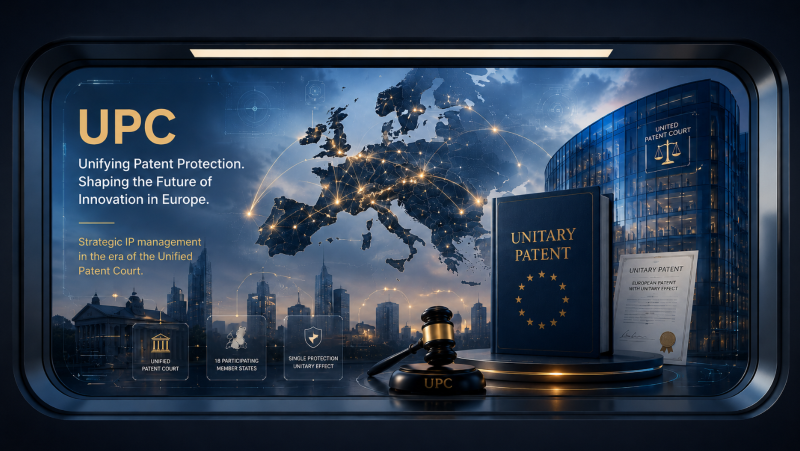
The UPC has moved from a legal experiment to an established forum for European patent litigation. Rising infringement actions, growing case law and stronger use by patent-intensive industries show increasing market confidence. The court is shaping new patterns in enforcement, revocation, preliminary injunctions, jurisdiction and technology-specific litigation. Germany has become a central UPC hub, while the Court of Appeal is building legal certainty. For companies and IP experts, the UPC changes patent strategy: portfolio decisions, opt-outs, freedom-to-operate, licensing and enforcement now require a more integrated European view.
From Experiment to Established Litigation Forum
Since its launch in June 2023, the Unified Patent Court has moved from institutional promise to practical reality. The early question was whether companies would trust a new court with the power to grant cross-border remedies and to centrally revoke patents. Two and a half years later, the answer is increasingly clear. The UPC has become a functioning litigation forum with growing case numbers, developing case law, and rising strategic importance for patent owners and defendants across Europe.
This transition is captured well by JUVE Patent’s overview of how the UPC has evolved into an established court. The article describes a court system that has moved beyond its start-up phase and now operates with growing procedural confidence, an expanding body of decisions, and increasing market acceptance. The UPC is no longer only a legal innovation project. It has become a venue that companies must actively consider when designing European patent enforcement and defence strategies.
The same trend is visible in Herbert Smith Freehills Kramer’s analysis, “Two and a half years of the UPC – Trends and turning points”. Their assessment highlights that the UPC has entered a phase in which early uncertainty is being replaced by identifiable patterns. Companies, patent attorneys, litigators, and in-house teams can now observe how the court deals with procedural questions, preliminary injunctions, validity attacks, claim interpretation, and jurisdictional issues. This does not mean that all major questions have been settled. But it does mean that the UPC has generated enough practice to become a serious planning factor.
Case Numbers Show Growing Confidence
One of the clearest signs of the UPC’s development is the increase in infringement actions. JUVE Patent reported that the UPC received 50% more infringement cases in 2025. This is important because infringement actions show active use of the court as an enforcement tool. They indicate that patent owners are not merely testing the system defensively, but increasingly using it to pursue commercial objectives across multiple European markets.
This rise in infringement cases is significant for several reasons. First, it suggests that right holders see real value in centralized enforcement. A single UPC action can potentially produce remedies across participating member states, making litigation more efficient and strategically powerful. Second, it shows that companies are becoming more comfortable with the procedural risks of the UPC. Centralized enforcement always comes with the mirror risk of centralized invalidity attacks. The willingness to use the UPC despite that risk signals growing confidence in the court’s reliability.
D Young & Co’s statistical review, “UP & UPC statistics and trends: a two-year check in”, provides a useful quantitative perspective on this development. Their overview shows how quickly the court accumulated a substantial caseload in its first two years. The figures confirm that the UPC has not remained a niche forum. It has become part of the operational reality of European patent litigation.
The distribution of cases is also important. Infringement actions, revocation actions, counterclaims for revocation, provisional measures, and appeals together create a litigation ecosystem in which legal principles can mature quickly. The court is not developing in isolation through a few landmark decisions. It is developing through repeated procedural and substantive questions across a growing number of disputes.
Legal Doctrine Is Taking Shape
The development of UPC case law is perhaps the most important factor in the court’s long-term credibility. At the beginning, one of the main uncertainties was how the UPC would interpret patent law, especially where national traditions differed. Would the court lean toward German litigation practice, EPO-style reasoning, Dutch proportionality thinking, or a new synthesis of European approaches? The answer is still evolving, but the contours are becoming clearer.
IPWatchdog’s article “Examining Developments and Trends at the Unified Patent Court in 2025” points to key developments in substantive patent law and procedural practice. Decisions on inventive step, sufficiency, claim interpretation, preliminary injunctions, and procedural access are beginning to create a recognizable UPC jurisprudence. This is essential because the court’s authority depends not only on speed and reach, but also on predictability.
The Chambers practice guide on the Unified Patent Court 2025 is useful in this respect because it does not only look at individual cases. It places the UPC in a wider litigation context, including remedies, jurisdiction, procedural options, and strategic behaviour. This broader view shows that the UPC is shaping not only legal doctrine but also litigation behaviour. Parties are learning how to frame claims, how to combine infringement and validity arguments, how to use preliminary measures, and how to coordinate UPC proceedings with national or non-European disputes.
Grünecker’s article “Two Years of the UPC – A New Era in European Patent Litigation” also emphasizes the emergence of a new litigation culture. The UPC is not simply a combination of existing national systems. It is creating its own procedural identity. This matters because European patent litigation has historically been fragmented. The UPC introduces a shared forum where procedural speed, technical expertise, and cross-border remedies come together in a new way.
At the same time, the court’s case law remains in consolidation. Different local and central divisions may still develop different emphases. The Court of Appeal will therefore play a crucial role in harmonizing standards and giving the system long-term coherence. The next phase of UPC development will likely be shaped less by the raw number of new cases and more by appellate clarification of core legal principles.
Technology, Geography, and Forum Strategy
The UPC’s development is not evenly distributed across technologies or locations. Clarivate’s analysis of technology trends at the Unified Patent Court shows that particular sectors and divisions are becoming especially relevant. Patent-intensive industries such as telecommunications, medical devices, biotechnology, pharmaceuticals, electronics, and digital technologies are naturally among the early users of the system. These industries often involve high commercial stakes, multi-country markets, and portfolios that justify centralized enforcement.
This technological concentration matters for IP strategy. If certain technical fields are litigated more frequently before the UPC, the court will develop expertise and case law in those fields more quickly. Over time, this may influence where companies choose to litigate, how they draft patents, and how they assess enforcement risk. A UPC division that repeatedly handles complex telecom or life sciences cases may become strategically attractive because parties expect technical familiarity and procedural experience.
Geography is equally important. Germany has quickly become a central hub for UPC litigation, reflecting its long-standing role in European patent enforcement. Local divisions such as Munich, Düsseldorf, Mannheim, and Hamburg are important because they combine Germany’s litigation culture with the UPC’s cross-border effects. This creates a powerful forum dynamic. For many patent owners, the UPC offers something close to the traditional attractiveness of German enforcement, but with potentially broader territorial impact.
At the same time, the Central Division and the Court of Appeal contribute to the system’s structural balance. Revocation actions, validity disputes, and appeals shape the UPC as more than an infringement forum. Defendants and competitors also use the court strategically. This is why the UPC should not be understood only as a tool for patent owners. It is equally a forum for challenging patents, managing market entry risks, and shaping competitive freedom.
The uneven distribution of UPC cases also raises broader questions. If certain divisions, industries, or procedural tools become dominant, the court’s development may be shaped by a relatively narrow set of disputes. This is not unusual in a young court system, but it means that observers should look beyond headline case numbers. The real question is which industries, legal issues, and procedural strategies are building the UPC’s identity.
Strategic Implications for Companies and IP Experts
For companies, the UPC changes the logic of European patent strategy. The choice is no longer simply whether to litigate in Germany, France, the Netherlands, Italy, or another national forum. The choice now includes whether to use a centralized forum that can produce wider effects. This makes portfolio management more strategic. Opt-out decisions, enforcement planning, validity risk analysis, and competitor monitoring are now closely connected.
The UPC also changes the role of IP experts. Patent attorneys, litigators, and in-house counsel must help companies understand not only legal rules but also litigation architecture. A UPC case is not just a lawsuit. It is a decision about market leverage, territorial scope, timing, risk concentration, and negotiation power. This requires a more integrated form of IP advice.
The articles by JUVE Patent, Herbert Smith Freehills Kramer, Grünecker, D Young & Co, Chambers, IPWatchdog, and Clarivate together show that the UPC is developing at several levels at once. It is growing in case volume. It is building legal doctrine. It is creating technology-specific litigation patterns. It is reshaping forum strategy. And it is becoming a practical reference point for companies that operate across Europe.
The most important insight is that the UPC is no longer a future issue. It is already part of the present structure of European innovation competition. Companies that ignore it risk misunderstanding how patent power is now exercised in Europe. Companies that overreact to it may underestimate the continuing relevance of national courts, opt-outs, and parallel strategies. The strategic challenge lies in understanding the UPC as one layer in a broader enforcement and risk-management system.
For the coming years, three developments will be especially important. First, the Court of Appeal will continue to shape legal certainty by clarifying contested principles. Second, case distribution across divisions and technologies will influence the court’s practical identity. Third, industry adoption will determine whether the UPC becomes the default forum for high-value European patent disputes or remains one powerful option among several.
The current trajectory points toward a court that is becoming more confident, more used, and more strategically relevant. The UPC has not eliminated complexity from European patent litigation. Instead, it has reorganized that complexity. It offers broader remedies, faster procedures, and a developing body of case law, but it also concentrates risk and requires more sophisticated decision-making.
This is why the UPC’s development matters far beyond litigation departments. It affects how companies protect innovation, how they assess freedom to operate, how they negotiate licences, how they prepare market entry, and how they value patent portfolios. The UPC is becoming part of the infrastructure of European technology competition. Its evolution will therefore shape not only patent law, but also the way innovation is commercialized and contested across Europe.
Sources Mentioned
JUVE Patent, “UPC received 50% more infringement cases in 2025”
👉 https://www.juve-patent.com/legal-commentary/upc-received-50-more-infringement-cases-in-2025/
JUVE Patent, “How the UPC has evolved into an established court”
👉 https://www.juve-patent.com/legal-commentary/how-the-upc-has-evolved-into-an-established-court/
Herbert Smith Freehills Kramer, “Two and a half years of the UPC – Trends and turning points”
👉 https://www.hsfkramer.com/insights/2026-01/two-and-a-half-years-of-the-upc-trends-and-turning-points
Grünecker, “Two Years of the UPC – A New Era in European Patent Litigation”
👉 https://grunecker.de/en/insights/two-years-unified-patent-court/
D Young & Co, “UP & UPC statistics and trends: a two-year check in”
👉 https://www.dyoung.com/en/knowledgebank/articles/up-upc-statistics-jun2025
Chambers, “The Unified Patent Court 2025”
👉 https://practiceguides.chambers.com/practice-guides/the-unified-patent-court-2025
IPWatchdog, “Examining Developments and Trends at the Unified Patent Court in 2025”
👉 https://ipwatchdog.com/2025/12/22/upc-developments-trends-2025/
Clarivate, “UPC litigation trends: Tech specialization by Division”
👉 https://clarivate.com/intellectual-property/blog/technology-trends-at-the-unified-patent-court/