
Making Technical IP Expertise Visible: What VOSSIUS and HGF Show About Digital Marketing for IP Law Firms

Digital marketing for IP law firms works best when technical competence becomes easy for the market to recognise. This is especially difficult in patent work, because much of the most valuable expertise is hidden inside drafting choices, opposition strategy, procedural judgement, technical argumentation and long-term portfolio thinking. Clients may benefit from that work, but the market does not automatically see why one firm should be remembered over another.
This is why VOSSIUS and HGF are useful examples. Both firms received strong recognition at the Managing IP EMEA Awards 2026, but they represent different routes to visible patent authority. VOSSIUS was recognised as Germany Patent Prosecution Firm of the Year, while HGF celebrated five wins across the awards and framed them as recognition of its strength as a leading European IP firm. The marketing lesson is not simply that both firms won awards. The more interesting point is how each firm can use recognition to translate patent expertise into a clearer reason to be chosen.
VOSSIUS: Turning prosecution excellence into market authority
VOSSIUS is a strong example of a firm whose digital positioning can be built around the authority of patent prosecution. Patent prosecution is often commercially decisive, but it can be hard to communicate because its value is not always visible at the moment the work is done. A strong application, a carefully shaped claim set, a well-managed EPO procedure or a technically precise response may create strategic options years later, yet the market often remembers litigation outcomes more easily than prosecution quality.
The Managing IP EMEA Awards 2026 recognition as Germany Patent Prosecution Firm of the Year therefore gives VOSSIUS a powerful visibility signal. It does not just say that the firm is active in prosecution. It confirms that prosecution can be treated as a distinctive market position, not as a background service. This matters because many IP firms list prosecution as part of their offering, but fewer manage to turn it into a recognised authority architecture.
For digital marketing, this creates a clear opportunity. VOSSIUS can be understood as a firm whose patent authority begins early in the innovation process, at the point where technical inventions are translated into legally and commercially usable patent assets. That is a different message from simply saying that the firm handles filings. It connects prosecution to value creation, freedom of action, opposition resilience and long-term strategic optionality.
This positioning becomes stronger because VOSSIUS is not limited to non-contentious work. JUVE Patent describes the firm as one of the strongest mixed patent litigation firms in Germany and highlights the strength of its patent attorneys in EPO oppositions and nullity work. VOSSIUS also communicates strong JUVE and JUVE Patent 2025 rankings in patent litigation for patent attorneys, patent litigation for lawyers and patent filing across fields such as pharma, biotechnology, medical technology, chemistry, digital communication, computer technology, electronics and mechanical engineering.
From a marketing perspective, this creates an important bridge. Prosecution excellence gives technical and procedural credibility before disputes arise, while opposition, nullity and litigation strength show that the firm understands how patents behave under pressure. The digital story should therefore not separate filing, opposition and litigation into isolated website categories. The stronger story is that VOSSIUS helps shape patents so that they can carry value in real technical and legal conflict.
That is the core marketing logic for VOSSIUS. The award can be more than a badge if it becomes part of a broader story about turning invention into enforceable, defensible and strategically useful patent positions. In that sense, prosecution is not a quiet back-office activity. It is one of the places where the future strength of an IP position is built.
HGF: Turning European scale into structured IP visibility
HGF represents a different route to digital authority. The firm’s five wins at the Managing IP EMEA Awards 2026 create a broader signal of European IP strength. This is not primarily a narrow technical-positioning story. It is a scale-and-structure story, because a large European IP firm must make its breadth understandable rather than overwhelming.
Scale can be a strength in IP marketing, but only if it is organised. A firm with many offices, many professionals, many technologies and many practice areas can easily appear broad but indistinct. The market does not choose a firm merely because it is large. It chooses a firm because that scale appears useful for a specific client problem, sector, technology field or jurisdictional challenge.
This is where HGF’s digital marketing opportunity lies. The firm can use award recognition to support a message of European reach combined with sector-specific and technology-specific relevance. The Managing IP recognition helps create external validation, but the commercial value depends on how that validation is connected to the firm’s visible architecture of services, people, sectors and client problems.
The broader award context supports this. HGF had been shortlisted across 20 categories at the Managing IP EMEA Awards 2026, with the nominations described as reflecting the strength and depth of its patent and trade mark expertise across Europe, as well as individual recognition for several colleagues. Such a pattern is useful because it does not point only to one narrow service line. It suggests a firm with multiple recognised competence centres that need to be made navigable for clients.
For digital marketing, this creates both an advantage and a challenge. The advantage is that HGF can communicate depth across a wide European platform. The challenge is that breadth must not become noise. The strongest positioning would not simply say that HGF is a leading European IP firm. It would show how European scale helps clients make better IP decisions across sectors, technologies and jurisdictions.
This makes HGF a good example of what might be called structured scale. The firm’s recognition becomes more meaningful when it is translated into client-facing logic: which clients need this European platform, which problems require cross-border coordination, which sectors benefit from integrated technical coverage, and where does the firm’s scale reduce uncertainty rather than simply add more names and locations.
Two routes to visible patent expertise
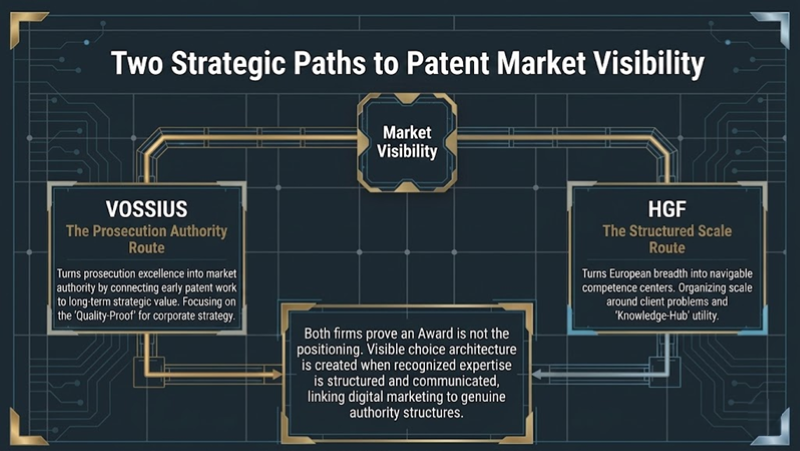
VOSSIUS and HGF show the same principle through two different routes. VOSSIUS represents the prosecution authority route. Its strongest signal is focused: Germany Patent Prosecution Firm of the Year. The digital marketing logic is to make prosecution visible as a strategic source of patent value, not merely an administrative stage in the filing process.
HGF represents the European scale route. Its strongest signal is broader: five Managing IP EMEA Awards 2026 wins and a wide award footprint across European IP categories. The digital marketing logic is to make scale intelligible, so that clients do not just see size, but understand how a European IP platform helps them solve concrete problems.
Both routes matter because patent expertise is often difficult for non-specialist decision-makers to evaluate. A board member, founder, investment committee, research leader or business development team may not be able to assess claim language, EPO strategy or opposition tactics in detail. They need recognisable signals that translate legal and technical competence into confidence. Awards can help, but only if they are connected to a clear story about what the firm should be remembered for.
That is why VOSSIUS and HGF work well together in one analysis. One shows how a firm can make a specific competence field more visible. The other shows how a firm can make broad European capacity more usable. Both demonstrate that recognition becomes stronger when it explains the firm’s role in the client’s decision environment.
The award is not the positioning
The common mistake in law firm marketing is to treat awards as the positioning itself. A firm wins a category, publishes the news, shares a congratulatory post and moves on. This creates a moment of attention, but it rarely changes how the market understands the firm. The award is seen, appreciated and then quickly forgotten.
The stronger approach is to use the award as evidence. For VOSSIUS, the question is what Germany Patent Prosecution Firm of the Year reveals about the firm’s role in shaping valuable patent positions. For HGF, the question is what five Managing IP wins reveal about the firm’s European platform and its ability to organise IP expertise across sectors, technologies and jurisdictions.
This shift changes the communication task. The firm should not only say that it has been recognised. It should explain what the recognition confirms, how it connects to client problems and why it matters for future decisions. In digital marketing terms, the award should lead into practice pages, technology pages, case commentary, partner profiles, insight series and concrete client scenarios.
Without that structure, an award remains a reputation event. With that structure, it becomes part of a market-facing authority system. The difference is not cosmetic. It determines whether the award merely signals past success or helps a future client understand why the firm belongs on the shortlist.
What IP law firms can learn from this
The main lesson is that digital marketing for IP law firms must translate expertise into a form the market can use. Technical quality alone is not enough, because the people who influence selection decisions often need a clearer frame. They need to see where the firm is especially strong, which problems it is built to handle and why its expertise matters in a business context.
VOSSIUS shows that prosecution can become a strong market signal when it is connected to strategic patent value. This is important because prosecution is too often communicated as a service category rather than as a source of future leverage. A firm that can make prosecution quality visible can help clients understand why early patent work affects later freedom of action, opposition risk, transaction value and litigation strength.
HGF shows that scale can become a strong market signal when it is made navigable. A large European IP platform becomes more valuable in communication when clients can understand how the platform maps to their needs. This requires structure, not just volume. It requires sector logic, technology logic, jurisdictional logic and a visible connection between people, services and client decisions.
Together, the two examples show that strong digital marketing does not invent a firm’s authority. It organises authority that already exists. It takes awards, rankings, professional expertise, technical fields, services and people, and connects them in a way that turns scattered signals into a recognisable reason to be chosen.
From expertise to choice
For IP law firms, the commercial challenge is rarely that there is no substance. The more common challenge is that substance is dispersed across awards pages, attorney biographies, technical descriptions, ranking announcements, practice pages and occasional insights. Each element may be correct, but the market needs more than correctness. It needs a memorable logic.
VOSSIUS and HGF offer two different versions of that logic. VOSSIUS shows how a focused prosecution award can become a broader story about building patent value from the beginning. HGF shows how a wide European award footprint can become a story about structured scale and cross-border IP capacity. Both examples show why digital marketing for IP law firms should not stop at recognition.
Digital marketing for IP law firms works when it turns recognised expertise into a visible choice architecture. VOSSIUS shows how prosecution excellence can become market authority when it is connected to strategic patent value. HGF shows how European scale can become commercially meaningful when it is organised around client problems. Together, they show that the strongest IP marketing does not merely report success. It explains why that success matters to the next client decision.