
UPC Decision Case Simon Lud: Enforcement Leverage vs. Systemic Exposure in Data Compression

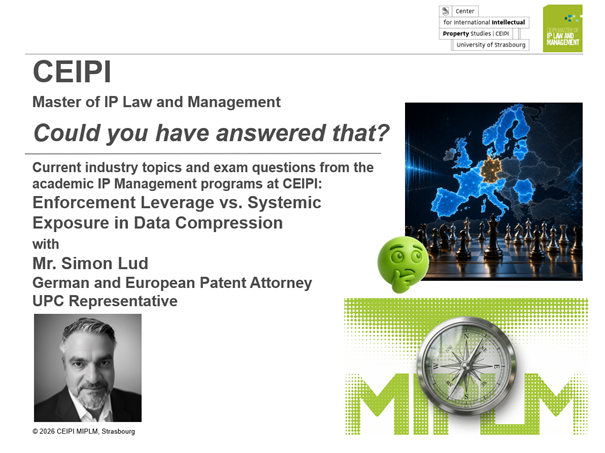
In data compression, patent strategy is no longer only about protecting technical inventions. Video and audio codecs, AI-enabled optimisation tools and interoperability layers sit deep inside digital ecosystems, where enforcement can affect not just one competitor, but entire implementation chains. This case shows why the Unified Patent Court changes the strategic architecture of European patent portfolios. A company can use a Unitary Patent to create pan-European enforcement pressure, while German national fallback patents preserve leverage if centralized revocation becomes a threat. The decision is therefore not simply EP versus UP. It is a choice between fragmented risk control and an intentionally designed double-enforcement position.
This reflects exactly the concern described in the UPC Strategy Gap study: companies face centralized injunction risks, revocation exposure, forum choices and portfolio vulnerabilities, while the market still often frames UPC advice too narrowly as procedural litigation expertise. The CEIPI IP Business Academy recently addressed the UPC Strategy Gap in Europe, showing that companies increasingly recognize the strategic relevance of the Unified Patent Court, while much of the market still frames UPC support mainly as procedural or litigation expertise.
Here you find the Findings of the study: “The UPC Strategy Gap in Europe”
The following IP Decision Case was reviewed by Simon Lud and addresses a central strategic challenge in digital technology IP: how to structure European patent protection for data compression, video codecs and AI-enabled optimisation tools in the era of the UPC. Simon Lud is a German and European Patent Attorney and UPC Representative with a strong focus on telecommunications, 5G/6G, video data compression, software-related inventions and AI patents. His practitioner perspective shows how companies can balance pan-European enforcement leverage, centralized revocation risk and national fallback options when designing patent portfolios for highly interconnected digital ecosystems.
Decision Context
A technology company develops advanced data compression solutions (video/audio codecs) and AI-enabled optimization tools. These technologies are deeply embedded in digital ecosystems and often essential for industry interoperability. As the company expands its European portfolio, it must decide how to architect its patent filings to maximize enforcement pressure.
In the data compression sector, practice shows that patentees often pursue aggressive, simultaneous litigation campaigns. By utilizing the Unified Patent Court (UPC) for pan-European reach while concurrently filing in national German courts, patentees can exert maximum leverage on implementers. To facilitate this, portfolio strategies have shifted from purely traditional European Patents (EP) toward a tiered approach: Unitary Patents (UP) backed by German national “fallback” patents.
The Decision
Should the company prioritize a “Double Enforcement” strategy – using the UPC for centralized cross-border leverage while maintaining national German patents to hedge against systemic invalidation – or stick to a traditional, fragmented EP-based approach with mainly national patent litigation to limit exposure?
Why This Decision Is Difficult
This choice involves structural trade-offs between aggressive monetization and risk management:
- Enforcement Leverage vs. Centralized Revocation: The UPC allows for an immediate, pan-European injunction, which is a massive bargaining chip in licensing. However, a single UPC loss could invalidate the UP across all participating states.
- The “German Fallback” Cost-Benefit: Backing up a UP with a national German patent allows for “double litigation.” Even if the UP is revoked by the UPC, the German national patent remains, ensuring the patentee maintains pressure in Europe’s most critical venue. This adds filing and maintenance costs but reduces strategic risk.
- Standardization & Industry Relations: In codec technologies, enforcement doesn’t just impact one competitor; it signals a stance to the entire standard-setting ecosystem, broader industry relationships and licensing frameworks.
- Initial Jurisprudential Uncertainty: The UPC’s interpretation of software-related and algorithmic claims is still evolving. Without a “national safety net,” a company risks its entire technology position on an unpredictable court.
Practitioner Perspective
In data compression, enforcement is a high-stakes tool to shape monetization. A flexible portfolio strategy allows a company to scale its aggression. A “low-level” strategy relies on standard EPs; a “high-level” strategy involves UPs for pan-European reach.
The most sophisticated players now use UPs to signal an interest in centralized enforcement, but they safeguard their position with national German patents. This ensures that even if a UPC litigation fails, the patentee doesn’t lose their foothold in the German market — effectively forcing implementers to settle or face permanent litigation on two fronts.
Implication for IP Management Education
This case highlights that IP strategy is a two-step process: first, purpose-built portfolio design (deciding the mix of EP, UP and national filings), and second, modularly scalable enforcement.
IP professionals must move beyond viewing patents as isolated assets by implementing “Architected Portfolio Design” to engineer interdependent strategic portfolios. This approach integrates filing decisions — such as opting for a UP while securing national backbones — with a “Modular Escalatory Enforcement” strategy, balancing high-impact pan-European injunctions with resilient national fallback positions.
Simon Lud
 Simon Lud is a German and European Patent Attorney and UPC Representative based in Munich. He advises clients on IP matters involving digital innovation, with a particular focus on telecommunications, 5G/6G, video data compression, software-related inventions, AI, machine learning, IoT, automotive and Industry 4.0 systems.
His work includes patent drafting, prosecution, portfolio development, SEP/FRAND strategy, opposition and appeal proceedings, as well as enforcement-oriented patent advice before the EPO and the UPC. With a background in physics and experience at leading IP firms, he supports companies in turning complex technologies into valuable patent assets.