Inside the New IP Market Study on Quantum Technology: What IP Experts Need to Know Before the Market Gets Crowded

Quantum technology is no longer only a scientific promise. It is becoming an industrial field in which patent strategy, collaboration architecture, investor communication, export control, public funding, and regulatory positioning begin to interact. For companies working on quantum computing, quantum communication, quantum sensing, post-quantum cryptography, or enabling hardware, this creates a new type of IP challenge. For IP experts and adjacent advisory providers, it creates a new market.
The new IP Market Report on Quantum Technology was written for exactly this moment. It is not a technical textbook on quantum computing. It is a market intelligence and business development companion for patent attorneys, IP consultants, law firms, technology transfer professionals, and advisory teams that want to understand where the European quantum IP market is moving, which topics are becoming commercially relevant, who is already shaping the public conversation, and where the strongest unmet client needs can be found.
The central message is clear: technical credibility is necessary, but it is no longer sufficient.
Quantum companies do not only need someone who understands qubits, photonics, ion traps, cryogenics, quantum algorithms, or post-quantum cryptography. They need advisers who understand how IP decisions affect funding, partnerships, market access, product architecture, disclosure strategy, and long-term bargaining power. The relevant question for IP service providers is therefore no longer simply: “Can we draft and prosecute quantum patents?” The stronger question is: “Can we help quantum companies make better strategic decisions under uncertainty?”
A market that is becoming visible at institutional level
The report shows that the European IP conversation around quantum technology has intensified significantly between late 2025 and mid 2026. Patent-office data, institutional reports, policy initiatives, practitioner publications, and corporate patent grants all point in the same direction: quantum is becoming a strategic IP market.
One of the strongest signals comes from the EPO and OECD report “Mapping the global quantum ecosystem.” According to that report, international patent families in quantum increased sevenfold between 2005 and 2024, growing at around 20 percent per year. That is roughly ten times faster than patenting across all technologies. This is not a marginal increase. It shows that the field has moved beyond isolated research filings and is entering a phase in which patent positions begin to reflect commercial expectations.
The German Patent and Trade Mark Office adds an important national perspective. Its 2026 analysis reported 815 quantum-relevant published patent applications with effect for Germany in 2024, compared with 120 a decade earlier. Quantum computing was identified as the largest segment, ahead of quantum components and quantum communication. For a European IP market with a strong German center of gravity, this is a powerful signal. Quantum IP is becoming visible not only in research policy, but also in the patent data that clients, investors, and advisers use to judge technological momentum.
The European Quantum Industry Consortium adds another layer. Its white paper “A Portrait of the Global Patent Landscape in Quantum Technologies” shows that quantum computing has overtaken quantum communication in patent intensity since 2022. This shift matters because it changes the type of advisory work that will be needed. The market is increasingly concerned with architectures, software layers, error correction, control systems, platform integration, standards, and commercialization routes.
This is why the report reads quantum IP not only as a patenting topic, but as a market structure topic. The issue is not simply whether quantum inventions can be protected. The issue is how IP experts can help companies organize options, reduce uncertainty, communicate value, and protect future freedom to act.
The structural gap: competence exists, but the market often cannot see it
The most important finding of the report is the gap between what quantum companies need and what the public-facing IP service market currently communicates.
Many European IP firms and patent attorneys have deep scientific credentials. Some have physicists, engineers, software specialists, and attorneys with direct quantum research experience. But public communication often still emphasizes the familiar markers: PhD background, technical field, drafting capability, EPO prosecution, opposition experience, and general patent strategy.
Those elements matter. But for quantum companies, they are only part of the answer.
A quantum start-up may need to decide whether a core technical result should be patented now, kept confidential, disclosed in a grant application, shared with a consortium partner, submitted to arXiv, or prepared for an investor data room. A company may need to align university-originating background IP with future foreground IP. It may need to manage publication pressure from academic co-founders while preparing for a Series A round. It may need freedom-to-operate insight before committing to a hardware platform or software architecture. It may need to understand how the EU Quantum Act, FDI screening, export control, public funding rules, and public procurement interact with IP ownership and licensing.
That is why the report frames the quantum IP market as a translation problem. The competence often exists, but the market cannot always recognize it. Clients do not only look for a patent attorney who “knows quantum.” They look for someone who can translate IP into the operating reality of building a quantum business.
For IP service providers, this is the opening. The market is not yet saturated with visible, named experts who communicate in this way. That means a focused individual, boutique, or specialist team can still build a credible position if they move early, publish consistently, and package services around the decisions quantum companies actually face.
The experts already shaping the conversation
The report maps a relatively small group of visible European voices. This matters because the field is still open enough for named experts to shape the agenda.
Dr. Robert Harrison of Sonnenberg Harrison in Munich is one of the most active European voices in the field. He combines a PhD in quantum physics and optics with European patent practice and work in the European Quantum Industry Consortium. His profile shows that quantum IP cannot be reduced to patentability. It requires advisers who understand research institutions, EU funding, consortium agreements, technology development, and market formation.
Dr. Maximilian Keck of Hoffmann Eitle in Munich represents another important pattern. As a patent attorney with deep physics credentials operating inside a top-tier German prosecution environment, he illustrates how quantum patenting must address both the EPO’s technical-effect requirements and US eligibility hurdles. In quantum, claim architecture is not just formal wording. The choice between system-level claims, software-level claims, algorithmic formulations, and technical implementation features can shape the commercial value of a portfolio.
Dr. Julian F. Wienand of Bardehle Pagenberg in Munich stands for a new generation of quantum-trained physicists entering the European IP profession. His profile points to one of the central translation tasks in this market: turning complex quantum-physics concepts into legally robust and commercially useful IP positions.
Erik Visscher of De Vries & Metman in Amsterdam brings the Dutch ecosystem perspective into the discussion, closely linked to Quantum Delta NL and the start-up environment around Dutch quantum innovation. This is important because quantum IP often emerges in collaborative settings: spin-outs, publicly funded projects, university-industry partnerships, supplier ecosystems, and cross-border consortia.
The Marks & Clerk quantum team, publicly associated with figures including Phil Merchant, Rhian Williams, David Caulfield, and Graham Murnane, shows how a broader European IP firm can build a credible sector position through named people, visible sector pages, and repeated public writing. Their work around quantum algorithms, quantum AI, and the international patent landscape demonstrates how important communication cadence becomes in a market where clients are still learning whom to trust.
Gregory Aroutiunian and the Bird & Bird quantum team add another crucial dimension. Their work positions quantum IP within a wider legal environment including export control, FDI screening, public procurement, cybersecurity, and regulatory strategy. This broader perspective will likely become more important as the forthcoming EU Quantum Act pushes IP into a larger governance framework.
The report also highlights institutional voices. Yann Ménière, Chief Economist of the European Patent Office, is important because EPO economic analysis translates patent data into evidence for policymakers, investors, and industry. Eva Schewior, President of the German Patent and Trade Mark Office, adds a German institutional signal by framing Germany’s research base, industrial strength, and start-up ecosystem as a competitive opportunity in quantum innovation.
Together, these voices show that the European conversation is forming, but not yet crowded. This is exactly why the timing is attractive.
Where the strongest service opportunities sit
The opportunity map in the report is especially valuable for IP experts because it converts market needs into concrete service propositions.
Some services are close to traditional patent work: quantum-specific drafting and prosecution, freedom-to-operate analysis, patent landscaping, and claim strategy across Europe, the US, China, Japan, and Korea. These remain foundational. But the report shows that the higher-value opportunities often sit earlier, broader, or more strategically.
A “Quantum IP Strategy Workshop” can help a founding team decide which innovations should be filed now, filed later, kept as trade secrets, defensively published, or left unprotected. This type of service does not start with a patent application. It starts with the company’s business model, funding timeline, collaboration structure, and disclosure pressure.
An “Investor-Grade IP Narrative” can help quantum companies explain their IP position in funding rounds. Investors do not want only a patent count. They want to understand chain of title, blocking potential, competitive overlap, future filing roadmap, and whether the company has a credible IP story. This creates a service opportunity for advisers who can turn technical portfolios into board-level language.
A “Consortium and Joint Development Agreement IP Architecture” service can help companies structure background IP, foreground IP, access rights, publication windows, improvement rights, and post-project commercial use. In quantum, this is particularly relevant because innovation often happens across universities, start-ups, research organizations, suppliers, industrial partners, and public funding instruments.
Other opportunities include university spin-out IP support, public funding strategy, internal IP governance, standards and SEP strategy for QKD and post-quantum cryptography, IP and regulatory integration around FDI and export control, pre-exit IP due diligence, and fractional outside-in Chief IP Officer support for quantum scale-ups.
The lesson for private practice is simple: quantum should not be hidden as one technical item in a long capability list. It should be translated into a small number of named services that match real client decisions.
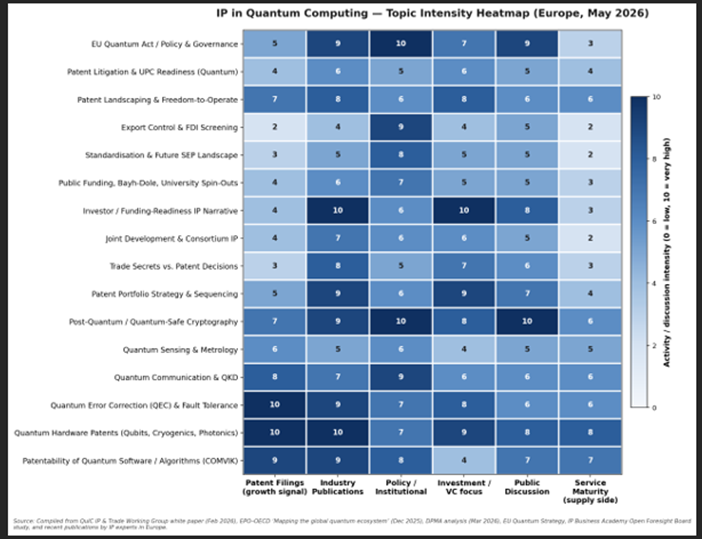
Fig. 1: Excerpt from the IP Market Report in Quantum Computing Topic Intensity
Why now is the right moment
The next 18 to 36 months will likely define which experts become visible in this field. The market is no longer too early. Patent activity is increasing. Public institutions are paying attention. Funding and consolidation pressures are rising. The EU Quantum Act will bring IP closer to regulatory and strategic governance. Standardization will create future SEP questions in post-quantum cryptography, quantum key distribution, and quantum networking. Litigation may still be a few years away, but the conditions for future disputes are already forming.
For IP experts, this is a constructive window. It is still possible to establish a credible position before the market becomes crowded. But visibility must be intentional. The report recommends that IP experts reposition communication from technical depth to operational relevance, publish consistently on strategic questions, build joined-up commercial and technical teams, re-skill adjacent technical specialists, enter the quantum ecosystem, and anchor their practice in a few concrete service propositions.
That is why the full Market Report is worth downloading. It provides the detailed market reading: current topics, key voices, topic clusters, a heatmap of the European quantum IP debate, unmet market needs, twelve concrete service opportunities, private-practice implications, and an outlook for the next 18 to 36 months.
More background on the structural market logic behind the study is available in the Industry Focus on the digital IP lexicon 🧭dIPlex:
👉 https://profwurzer.com/diplex/docs/quantum-technology-and-the-structural-lag-of-ip-decision-making/
The full IP Market Report on Quantum Technology is available here free of charge and can be downloaded from this page:
👉 https://profwurzer.com/diplex/docs/quantum-technology-and-the-structural-lag-of-ip-decision-making/market-study/
Here you find the episode of 🎧𝗜𝗣 𝗠𝗮𝗻𝗮𝗴𝗲𝗺𝗲𝗻𝘁 𝗩𝗼𝗶𝗰𝗲 with an overview of the Market Report. The episode will help listeners understand why quantum IP is becoming a strategic market for IP experts, and why the next phase will be shaped not only by patent filing, but by timing, collaboration, investor readiness, regulatory awareness, and ecosystem positioning.
👉 https://ip-management-voice.podigee.io/87-ip-in-quantum-technology#t=0
Expert voices and source links
Dr. Robert Harrison, Sonnenberg Harrison, Munich. The report highlights his view that quantum IP requires advisers who understand the ecosystem of research institutions, EU funding, consortium agreements, and technology, not only patentability.
Source: https://www.euroquic.org/a-portrait-of-the-global-patent-landscape-in-quantum-technologies/
Source: https://www.sonnenbergharrison.law/searching-and-classifying-quantum-patents/
Dr. Maximilian Keck, Hoffmann Eitle, Munich. The report highlights his contribution to the view that quantum patenting must address EPO technical-effect requirements and US eligibility hurdles at the same time, making claim architecture a strategic decision.
Source: https://www.euroquic.org/a-portrait-of-the-global-patent-landscape-in-quantum-technologies/
Source: https://www.lexology.com/library/detail.aspx?g=91d91dc7-b6d2-4162-a91c-39f7d38051b4
Dr. Julian F. Wienand, Bardehle Pagenberg, Munich. The report highlights his role as part of a new generation of quantum-trained physicists translating complex quantum concepts into legally robust IP positions.
Source: https://www.euroquic.org/a-portrait-of-the-global-patent-landscape-in-quantum-technologies/
Erik Visscher, De Vries & Metman, Amsterdam. The report highlights his contribution to the QuIC IP and Trade Working Group and the Dutch perspective on quantum start-ups, university spin-outs, and consortium structures.
Source: https://www.euroquic.org/a-portrait-of-the-global-patent-landscape-in-quantum-technologies/
Source: https://www.euroquic.org/working-groups/
Phil Merchant and the Marks & Clerk quantum team, London, Oxford, and Cambridge. The report highlights their visible sector positioning around quantum algorithms, quantum AI, quantum platforms, and the international patent landscape.
Source: https://www.marks-clerk.com/insights/articles/what-is-the-patentability-of-quantum-algorithms/
Source: https://www.marks-clerk.com/insights/latest-insights/102k9jc-quantum-ai-patentable-by-design/
Gregory Aroutiunian and the Bird & Bird quantum team, Düsseldorf and European offices. The report highlights their broader legal framing of quantum IP across export control, FDI screening, public procurement, cybersecurity, and regulation.
Yann Ménière, European Patent Office, Munich. The report highlights the EPO and OECD evidence base showing how patents function not only as protection, but also as signals for trade, investment, and policy.
Source: https://www.oecd.org/en/about/news/press-releases/2025/12/mapping-the-global-quantum-ecosystem.html
Eva Schewior, German Patent and Trade Mark Office, Munich. The report highlights the DPMA’s German patenting data and her framing of Germany’s research, industrial, and start-up base as a competitive opportunity in quantum technology.
Source: https://www.dpma.de/service/presse/pressemitteilungen/16032026/index.html