
Practical Question MedTech: When Does Diagnostic Data Become the Strategic IP Control Point with Gabriel Zimmerman

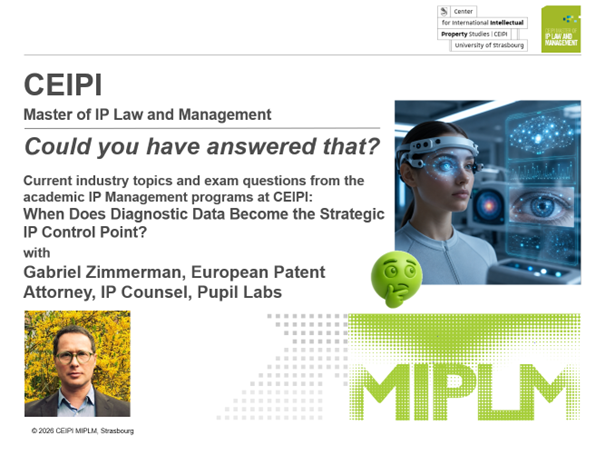
Data-driven diagnostics are changing the way MedTech companies must think about IP strategy. In many digital health applications, the decisive value is no longer located only in the physical device, the sensor unit or the user interface. It often emerges from the way raw measurement signals are transformed into clinically meaningful indicators that physicians, hospitals and patients can trust.
This creates a strategic challenge for companies working with wearable sensors, eye-tracking systems and AI-supported diagnostic tools. A company may have advanced sensor hardware and a well-designed clinical test environment, but still remain exposed if its IP strategy does not protect the layer where diagnostic value is actually created. In eye-movement-based diagnostics, for example, the key bottleneck may lie in how gaze patterns, pupil dynamics, fixation behaviour and response times are converted into reliable medical insights.
This is exactly the type of shift described in the CEIPI IP Business Academy analysis “The MedTech Strategy Gap”. The study shows that MedTech companies increasingly need IP advice that goes beyond classical device protection. They need support that connects sensor technology, clinical validation, data processing, regulatory credibility, workflow integration and commercial control.
Here you find the findings of this study: “The MedTech Strategy Gap: What Connected Healthcare Companies Need, and What IP Advice Still Often Fails to Integrate – IP Business Academy”
Against this background, the CEIPI IP Business Academy integrates practice-based questions from industry into its teaching. These questions help students understand IP not only as a legal protection tool, but as a management instrument for strategic decision-making in complex innovation systems.
Here you find the findings of this study: The MedTech Strategy Gap: What Connected Healthcare Companies Need, and What IP Advice Still Often Fails to Integrate – IP Business Academy
We are therefore pleased to include this industry case study with Gabriel Zimmermann, European Patent Attorney, IP Counsel at Pupil Labs. His practical question focuses on a central issue for data-driven diagnostics: how to identify whether the strategic IP control point lies in the sensor technology, the clinical test protocol, the data-processing model or the medically interpretable output.
The case asks whether exclusivity should be built around the wearable measurement device, the structured visual task, the transformation of eye-movement data into diagnostic indicators, or the clinical output that creates trust in medical decision-making. This decision matters before clinical validation, investor discussions, hospital partnerships, licensing negotiations and integration into broader healthcare platforms, because it determines whether the company controls the layer that creates technical differentiation, clinical adoption and future bargaining power.
Mini Case Study
A digital MedTech company is developing an diagnostic support system for early detection of neurological or ophthalmological conditions. The system uses wearable sensors to capture gaze patterns, pupil dynamics, fixation behaviour and response times during structured visual tasks. The initial product was built for research use, but clinical partners now see potential for screening, monitoring and therapy support.
The company faces a strategic IP decision before entering clinical validation and partner discussions. The hardware is important, but comparable sensors may become available from other suppliers. The clinical test design creates differentiation, but it may be difficult to protect as a stand-alone asset. The most valuable layer may be the transformation of raw eye-movement data into medically meaningful indicators that clinicians can trust.
Management asks the IP team where protection should be built. Patent filings around sensor arrangements may create a visible portfolio, but may not capture the diagnostic logic. Keeping data-processing models confidential may preserve know-how, but may not support investor confidence, licensing or enforceability. Protecting only the software interface may miss the layer where medical value is actually created.
Practical Question
How should a MedTech company decide whether the primary IP control point in a data-driven diagnostic system lies in the sensor technology, the clinical test protocol, the data-processing model or the medically interpretable output?
Why This Question Matters in Practice
This question becomes relevant when a research-grade measurement technology is translated into a medical diagnosis, screening, monitoring or clinical decision-support application. It typically arises before clinical validation, regulatory planning, fundraising, hospital partnerships, licensing negotiations or integration into a larger medical platform.
The question matters for digital MedTech companies, AI diagnostics ventures, sensor-platform providers, clinical research spin-offs, in-house IP teams, product leaders, investors and business development teams. These actors need to understand whether the company controls the layer that creates medical trust, commercial differentiation and future bargaining power.
The issue becomes especially critical when diagnostic value depends on a combination of sensors, data quality, patient interaction, algorithmic processing, clinical evidence and workflow integration. Under these conditions, a patent strategy focused only on the visible device may leave competitors free to reproduce the diagnostic service through different hardware or alternative data pipelines.
The economic implication is direct. If the wrong layer is protected, the company may own a device but lose control over the diagnostic value chain. If the right layer is controlled, IP can support clinical partnerships, investment narratives, licensing models, platform integration and long-term positioning in data-driven medical diagnosis.
Gabriel Zimmermann
 Gabriel Zimmerman is a European Patent Attorney and IP Counsel at Pupil Labs in Berlin, focusing on MedTech, data-driven technologies, machine learning and AI. With more than 15 years of international experience, he works at the intersection of R&D, business strategy and patent law, helping research-intensive companies turn technological differentiation into durable market advantage. His current role builds on previous positions as Patent Attorney and Of Counsel at Pearl Cohen, IP Manager at Sheba Tel HaShomer City of Health, and work in healthcare licensing at Yissum Ltd.
He combines legal and strategic IP expertise with a strong scientific background in life sciences, molecular neuroscience and neural computation. Gabriel holds a PhD in Molecular Neuroscience, an M.Sc. in Neural Computation and a B.A. in Psychology from The Hebrew University of Jerusalem. He is certified as both a European Patent Attorney and an Israeli Patent Attorney, and brings multilingual capabilities including English, Spanish, Hebrew, Portuguese, German and Italian.