
IP Market Study MedTech 2026: Where Patents, Data, AI and Regulation Now Collide

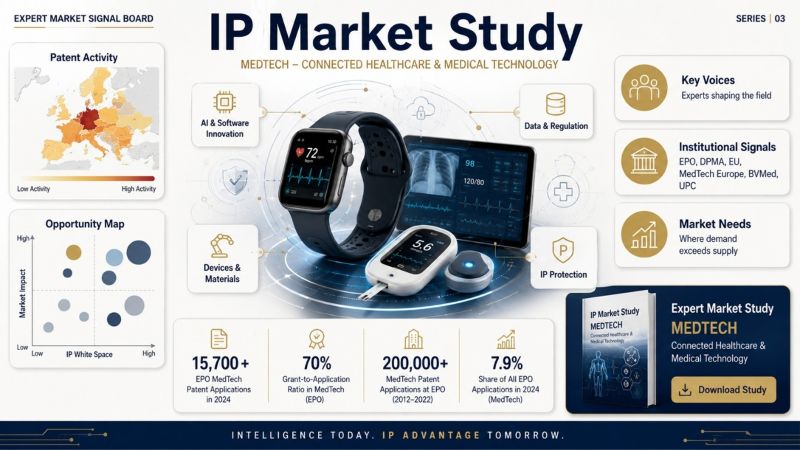
MedTech has always been an IP-intensive field. But the MedTech market in 2026 no longer looks like the familiar world of mechanical devices, careful patent drafting and regulatory approval as a separate compliance track. Medical technology now sits at the intersection of software, AI, connected devices, clinical evidence, design protection, trade secrets, data access obligations, cybersecurity rules and increasingly sophisticated investor expectations.
That is why this IP Market Report on MedTech is not simply another overview of patent filing numbers. It is a market intelligence and business development companion for IP experts, patent attorneys, trade mark attorneys, design specialists and adjacent IP service providers who want to understand where the real demand in the European MedTech IP market is emerging.
The core message is simple: MedTech companies do not only need stronger IP rights. They need IP advice that can translate technical, regulatory and commercial complexity into defensible business decisions.
MedTech is still a top IP field, but the work has changed
The report shows why MedTech remains one of the most attractive sectors for IP service providers in Europe. Medical technology is one of the largest fields of patent filing activity at the European Patent Office. It also shows one of the strongest grant to application ratios across technical fields. This matters commercially because MedTech is not only a field with high innovation activity. It is a field where IP work can result in meaningful, granted protection.
But the nature of that work is changing quickly.
The new MedTech IP landscape is not defined by patents alone. A connected wearable, a surgical robot, an AI diagnostic tool or a patient specific implant may raise patent questions, design questions, data access questions, software architecture questions, trade secret questions and freedom to operate questions at the same time. The market therefore rewards advisers who can connect these layers instead of treating them as separate legal categories.
For IP firms and consultants, this creates a positioning challenge. Many firms already have the technical capability. What is often missing is public visibility around how that capability helps MedTech clients make concrete business decisions.
The most important gap is not competence, but translation
One of the strongest insights from the report is that the European MedTech IP market is not primarily suffering from a lack of patent expertise. Europe has many excellent MedTech patent attorneys. The real gap is between what MedTech companies need and what IP experts visibly communicate.
Connected healthcare companies do not usually experience their IP questions as abstract questions of patentability, trade secrets or design registration. They experience them as business questions.
Where is the commercial control point in the product? Is it the sensor? The software layer? The training dataset? The clinical workflow integration? The device interface? The regulatory dossier? The reimbursement logic? The distribution channel?
That is why the report frames MedTech IP as a translation problem. IP experts who can translate legal capability into business decision language will be easier to recognize for founders, investors, in house teams, clinical partners and strategic buyers.
This is particularly relevant for IP service providers. The market opportunity is not just to “do MedTech patents.” The opportunity is to become visible as the expert who helps MedTech companies organize protection around the parts of the product that actually create market control.
AI, software and data are changing the centre of gravity
The report identifies AI enabled medical devices, Software as a Medical Device, connected MedTech and diagnostics as key growth areas. This is where the traditional patent conversation becomes more complicated.
AI MedTech inventions must be drafted for technical contribution and medical exclusion issues at the EPO. At the same time, the most valuable assets may not be fully visible in the patent claim. Training data, model weights, preprocessing pipelines, specific hyperparameter choices and model tuning practices may be better protected as trade secrets.
This is where the hybrid patent plus trade secret architecture becomes central. Amy Kelly of HGF is highlighted in the report for her work on protecting digital health innovation in the AI revolution. Her contribution is especially relevant because it addresses the practical question that many AI MedTech companies now face: what should be patented, what should be kept secret, and how can both forms of protection work together?
Ben Chapman of Carpmaels & Ransford is also identified as an important voice on training data protection in MedTech AI. Her work is relevant because curated clinical and technical datasets are increasingly part of the value of AI driven MedTech, but they do not fit neatly into the old patent centric advisory model.
For IP experts, the implication is clear. The client conversation in AI MedTech no longer starts with the patent application. It starts with the protection architecture.
Regulation is becoming part of IP strategy
The report also shows that MedTech IP advice is being reshaped by regulation. The European Health Data Space, the EU Data Act, the Cyber Resilience Act, NIS2, the AI Act and MDR/IVDR developments are no longer background noise. They increasingly determine what can be kept secret, what must be disclosed, what data can be shared, what evidence must be documented and which product launches may trigger enforcement questions.
This creates a new advisory space.
For example, the European Health Data Space raises the question of how MedTech companies can protect trade secrets and proprietary data while facing secondary use obligations for health data. The EU Data Act affects connected medical devices because user generated device data may become accessible and shareable. Cybersecurity rules and software bill of materials expectations may expose parts of software architecture that were historically treated as confidential.
For IP experts, this is one of the strongest business development opportunities in the report. The heatmap in the study shows very high policy activity but low service maturity in fields such as EHDS related IP carve outs, EU Data Act compliance for connected medical devices, and cybersecurity related trade secret architecture. In plain terms: clients will need this advice, but the market has not yet fully organized the service offering.
Designs, GUIs and 3D printing are no longer side topics
Another major theme is the EU Design Act and its relevance for MedTech. The protection of graphical user interfaces, dynamic visual elements, animations, clinician dashboards, patient apps and digital physical hybrids is becoming more important.
This matters because MedTech products are increasingly experienced through interfaces. A glucose monitoring app, a surgical navigation overlay, an infusion pump display or a clinical dashboard may carry real commercial value. In the past, these elements were often difficult to protect in a clean and systematic way. The new design framework makes this a much more concrete IP strategy topic.
The same applies to 3D printed surgical guides, patient specific implants, customized anatomical models and digital design files. The boundary between the digital file and the physical product is becoming commercially important. MedTech companies therefore need advisers who can integrate design protection into the broader IP architecture rather than treating it as a decorative afterthought.
UPC case law is beginning to matter specifically for MedTech
The report is careful not to overstate the role of the Unified Patent Court. Most UPC decisions so far have not been specifically MedTech focused. But two decisions are particularly relevant: Edwards v Meril and Occlutech v Lepu.
Edwards v Meril is important because it addresses injunctive relief for life saving medical devices and introduces a narrow patient access exception. That matters for MedTech patentees and defendants because it shows that enforcement strategy cannot be separated from clinical reality.
Occlutech v Lepu is relevant because CE mark approval and related market communications were treated as indicators of imminent infringement. For MedTech companies, this connects the regulatory approval calendar directly with IP enforcement timing. For IP advisers, the implication is practical. CE mark monitoring, launch planning, trade fair communication and pre launch freedom to operate work are becoming part of one coordinated strategy.
The market opportunity for IP service providers
The report’s opportunity map points to several service categories that are likely to become increasingly valuable.
First, AI MedTech patent and trade secret architecture. Second, EHDS and Data Act readiness from an IP perspective. Third, EU Design Act strategies for GUIs and digital physical product appearances. Fourth, MedTech start up IP audits for fundraising. Fifth, MedTech specific M&A due diligence. Sixth, CE mark aligned freedom to operate and UPC enforcement readiness.
These services are especially attractive because they do not all require litigation infrastructure. Many of them require structured analysis, clear communication and the ability to make IP visible to non IP stakeholders. That opens the field not only for large law firms, but also for specialized patent attorney practices, boutique consultancies and advisory teams that understand MedTech business models.
This is also why the report is valuable for business development. It does not only describe what is happening in MedTech. It helps IP experts see where their services can be made more visible, more specific and more relevant to the actual decision makers in the market.
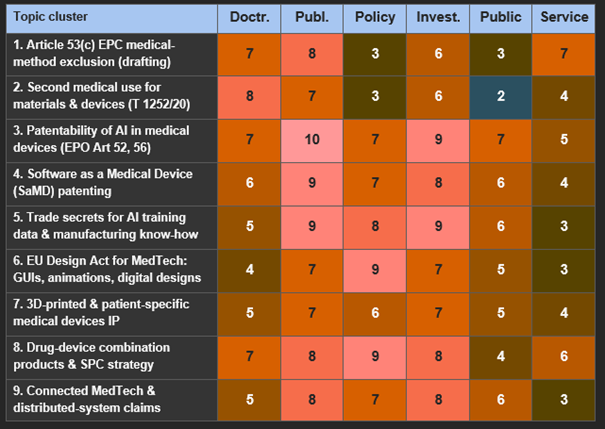
Excerpt from the IP Market Report MedTech Topic Intensity Heatmap.
Why this Market Study is worth downloading
The full IP Market Report gives a structured view of the European MedTech IP market. It covers current developments, key voices, topic clusters, market needs, opportunity areas for IP experts, implications for private practice and the outlook for the next 18 to 36 months.
For anyone offering IP services to MedTech, digital health or connected healthcare clients, this is not just background reading. It is a practical map of where demand is emerging, where service maturity is still low, and where first movers can build a visible position.
More background information on the broader IP Market Study logic is available in the Industry Focus on the digital IP lexicon 🧭dIPlex:
👉 https://profwurzer.com/diplex/docs/the-structural-shift-of-ip-in-medtech/
The full Market Report can be downloaded free of charge here:
👉 https://profwurzer.com/diplex/docs/the-structural-shift-of-ip-in-medtech/ip-market-report-ip-in-medtech/
There is also an overview episode in the podcast 🎧IP Management Voice, explaining the key findings of this Market Report and what they mean for IP experts, advisory firms and the wider MedTech innovation ecosystem.
👉https://ip-management-voice.podigee.io/91-ip-in-medtech
Expert voices and source references
Amy Kelly, HGF, Patent Attorney with a digital health and connected care focus, is cited for her article on protecting digital health innovation in the AI revolution. The report highlights her patent versus trade secret framing for AI MedTech assets, especially training data, model weights, model architecture and clinical workflow integration.
Source: https://www.hgf.com/knowledge-hub/articles/protecting-digital-health-innovation-in-the-ai-revolution/
Ben Chapman et al., Carpmaels & Ransford, Patent Attorney with an AI, MedTech and training data focus, is cited for her work on protecting training data for AI innovations in the MedTech space. The report uses his contribution as a key reference for copyright, database rights, trade secrets and contractual scaffolding around curated MedTech training datasets.
Source: https://www.carpmaels.com/protecting-training-data-for-ai-innovations-in-the-medtech-space-part-1/
MedTech Europe, Brussels, is cited as a key institutional voice because its Facts & Figures 2025 report provides core European data on medical technology filing volumes and grant to application ratios.
Source: https://www.medtecheurope.org/wp-content/uploads/2025/09/medtech-europe-facts-and-figures-2025-digital-1.pdf
BVMed and the BVMed Institut, Berlin, are cited as the key German institutional voices for MedTech patent activity and policy positioning, especially through the study on patent applications in medical technology from 2012 to 2022.
Source: https://www.bvmed.de/institut/veroeffentlichungen/medtech-analysis-01-2025-studie-patentanmeldungen-in-der-medizintechnik