
Practical Question MedTech Mike Duisken: An IP Strategy for a Medical Material?

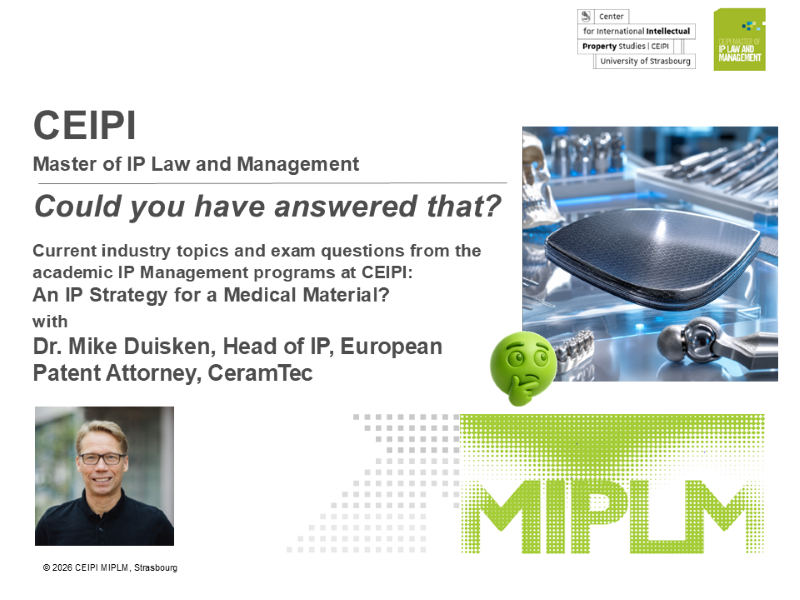
Advanced materials are becoming a strategic layer of MedTech innovation. In high-performance medical devices and implant-related applications, value is often not created by the visible product alone. It may sit deeper in the material itself, in its composition, its processing, its surface properties, its manufacturability, or in the quality-controlled production system that makes clinical reliability possible.
This creates a specific IP challenge for MedTech companies. A new material may offer high wear resistance, biocompatibility, dimensional stability and reliable performance under demanding clinical and manufacturing conditions. Yet the strategic question is not simply whether the material can be patented. The more difficult question is where protection and control should be placed so that the company captures the part of the value chain that is hardest to substitute and most relevant for customers, regulators, investors and future partners.
This is closely connected to the CEIPI IP Business Academy analysis “The MedTech Strategy Gap”. The study shows that MedTech companies increasingly need IP advice that goes beyond classical product protection. They need IP strategies that integrate technology, regulatory requirements, manufacturing realities, clinical adoption, customer co-development and commercial control.
Here you find the findings of this study: “The MedTech Strategy Gap: What Connected Healthcare Companies Need, and What IP Advice Still Often Fails to Integrate – IP Business Academy”
Against this background, the CEIPI IP Business Academy integrates practice-based questions from industry into its teaching. These questions help students understand IP not only as a legal protection tool, but as a management instrument for strategic decision-making in complex innovation systems.
We are therefore pleased to include this industry case study with Mike Duisken, Head of IP and European Patent Attorney at CeramTec. His practical question focuses on a central issue for material-enabled MedTech: how to decide whether the strategic IP control point lies in the material composition, the manufacturing process, the medical component design, or the quality-controlled production capability. Here is Mike Duisken’s evaluation of this case:
“In material-enabled MedTech, choosing the right protection instrument for each layer is just as decisive as the tight interlock of all relevant stakeholders – R&D, regulatory, manufacturing, business development and customers. Only when both are aligned does the patenting sequence, from material to product-specific embodiments, turn IP into a real value lever along the value chain.”
The case asks where economic control over medical performance should be located. A broad patent on the material composition may create visibility, but it may also disclose know-how that is difficult to reverse engineer. Protecting only the final component may be too narrow. Relying mainly on trade secrets may preserve manufacturing knowledge, but may weaken licensing, valuation and enforcement options.
This decision matters before investment rounds, customer co-development projects, supplier qualification, regulatory documentation and portfolio valuation. It determines whether the company protects a technical invention, a manufacturing advantage, a clinically relevant performance layer, or a production capability that makes the material commercially usable at scale. In material-enabled MedTech, the strongest IP position is often not a single right. It is the carefully sequenced combination of patents, know-how protection, quality evidence and product-specific embodiments that turns a material into a defensible strategic asset.
Mini Case Study
A global MedTech supplier has developed a new advanced material component for use in high-performance medical devices and implant-related applications. The material offers high wear resistance, biocompatibility, dimensional stability and reliability under demanding clinical and manufacturing conditions. Several product teams see potential applications in orthopaedics, dental systems, surgical instruments and precision medical equipment.
The commercial opportunity is attractive, but management faces a difficult decision. The material itself is only one part of the value proposition. Performance depends on composition, processing parameters, surface treatment, component geometry, quality control, supplier know-how, regulatory documentation and the ability to manufacture consistently at scale.
The IP team is asked to recommend where protection and control should be built before the next investment round and customer co-development projects begin. A broad patent filing on the material composition could create visibility, but it may disclose information that is difficult to reverse engineer. Protecting only the final medical component may be too narrow. Relying mainly on trade secrets may preserve manufacturing know-how, but may weaken licensing, valuation and enforcement options.
Practical Question
How should a MedTech company decide whether the strategic IP control point lies in the material composition, the manufacturing process, the medical component design, or the quality-controlled production capability
Why This Question Matters in Practice
This question becomes relevant when advanced materials move from laboratory development into regulated medical applications, customer co-development, clinical validation, supplier qualification, licensing discussions or portfolio valuation. At this stage, IP is no longer only about protecting an invention. It becomes a decision about where economic control over medical performance should be located.
The question matters for MedTech suppliers, implant manufacturers, advanced materials companies, in-house IP teams, R&D leaders, business development teams and investors. These actors must understand whether value is created by the material as such, by the ability to manufacture it reliably, by integration into a medical product, or by the evidence and quality systems that make the material commercially usable.
The issue becomes especially critical when the material is difficult to copy but easy to describe, when manufacturing know-how is hard to detect in the final product, when customers demand exclusivity, or when regulatory and quality requirements create high barriers to substitution. Under these conditions, a patent-only strategy may disclose too much, while a trade-secret-only strategy may fail to support licensing, valuation or market-entry negotiations.
The economic implication is direct. If the wrong layer is protected, competitors may work around the composition, capture downstream applications, or learn enough through customer projects to reduce dependency. If the right layer is controlled, IP can support premium pricing, long-term supply relationships, defensible co-development structures, licensing leverage and stronger strategic positioning in material-enabled MedTech.
Mike Duisken
 Mike Duisken is a European Patent Attorney and European Patent Litigator with UPC representative qualification, combining more than 14 years of in-house IP leadership with a scientific background as a PhD chemist. He currently serves as Head of Patents, Trademarks and Licenses at CeramTec, where he leads the global IP function across MedTech, electronics and industrial applications. In this role, he develops and executes group-wide IP strategy, manages internal and external IP teams as well as a global network of local IP counsel, and oversees licensing, enforcement and portfolio valuation.
Before joining CeramTec, Mike Duisken spent more than 15 years at SIG Group, where he accompanied the development of the IP function from an early in-house patent management role into a full IP unit covering prosecution, licensing and litigation. His work included international patent portfolio management for aseptic packaging technologies, FTO analyses, licensing negotiations, EPO proceedings and multi-jurisdictional enforcement. He is also named co-inventor on three granted patents for high-barrier composite packaging materials and has peer-reviewed scientific publications with more than 153 citations, reflecting his combined expertise in chemistry, technology development and strategic IP management.