OFB Fireside Chats: Turning Industry Demand into Expert Positioning

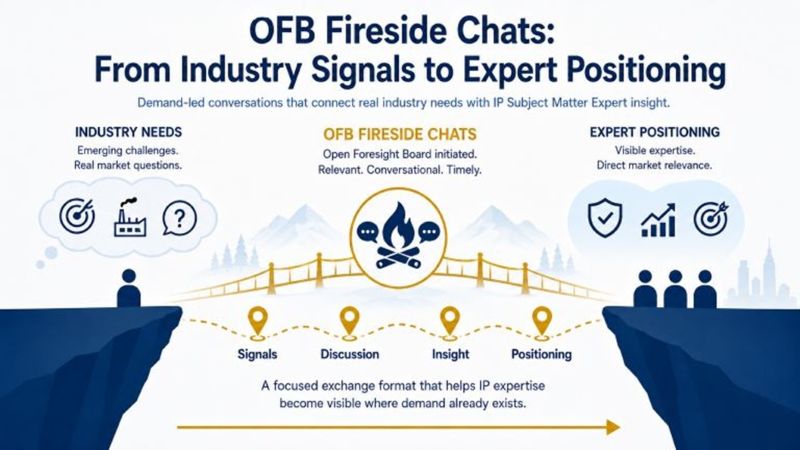
Many IP experts are highly visible within the professional IP community. They publish, speak at conferences, join panels, explain legal developments, and share insights on technical or strategic questions. Yet visibility inside the IP bubble does not automatically translate into relevance for companies that are dealing with concrete industrial challenges. The decisive question is not whether expertise exists, but whether it becomes visible in the right situation, to the right audience, and in relation to a problem that the market already recognizes as important.
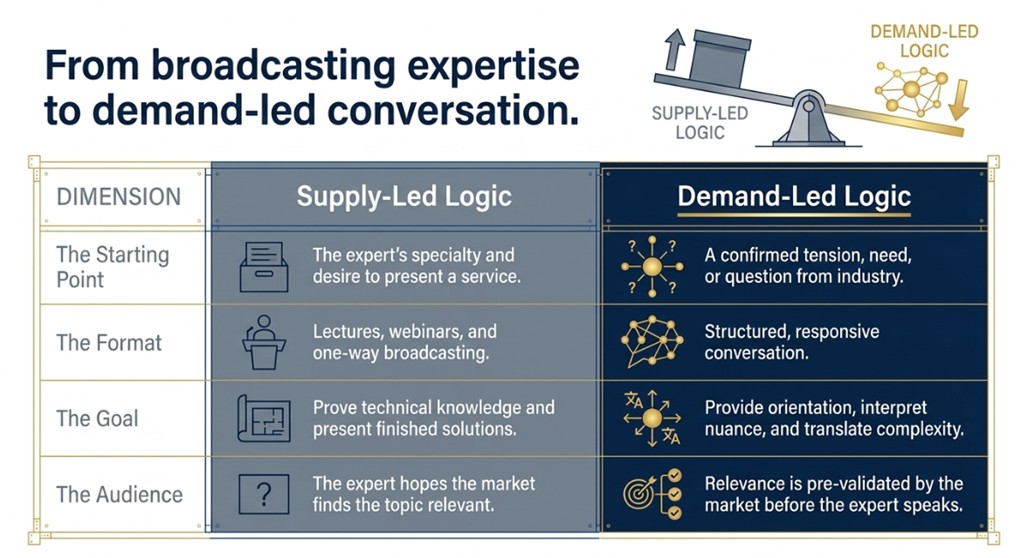
This is the starting point for OFB Fireside Chats. The format is designed to connect industrial demand with expert positioning. It creates a structured conversational setting in which IP Subject Matter Experts can engage directly with topics that have emerged from the Open Foresight Board context. Instead of beginning with an expert’s desire to present a service, the format begins with a need, tension, or question from industry.
That difference matters. Many formats in expert marketing are still supply-led. The expert chooses a topic, prepares a presentation, and hopes that the market will recognize its relevance. OFB Fireside Chats reverse this logic. They are organized around issues that have already shown practical importance in the broader IP management ecosystem. This gives the IP Subject Matter Expert a more credible and more precise opportunity to demonstrate how their expertise contributes to real decision-making.
From Expert-Led Communication to Demand-Led Conversation
In IP management, many conversations still start from the expert’s field of specialization. A patent attorney may explain a legal development, a licensing expert may discuss deal structures, or a portfolio strategist may present a method for evaluating patent value. These contributions can be highly valuable, but they often begin inside the professional logic of IP. Companies, however, rarely experience their challenges in that way.
From the perspective of industry, the starting point is usually different. Companies face uncertainty around technologies, business models, partnerships, regulation, market access, data, standards, or competitive positioning. IP appears as one part of a broader decision environment. In that environment, companies do not simply ask for abstract IP knowledge. They ask what a development means for their business, where risks and opportunities may arise, and which decisions need to be prepared.
This is where a gap often emerges. The IP expert may have exactly the right expertise, but the communication format may not connect that expertise to the company’s real question. As a result, valuable knowledge remains difficult to access for the people who could benefit from it. OFB Fireside Chats address this gap by moving the conversation closer to the market’s starting point.
What Makes OFB Fireside Chats Different
An OFB Fireside Chat is not a conventional webinar, lecture, or promotional expert event. It is a focused exchange built around a topic that has emerged from industry relevance. The Open Foresight Board context helps identify areas where companies are dealing with new forms of uncertainty and where IP expertise can provide orientation. The Fireside Chat then creates a setting in which this topic can be explored through expert conversation.
The format is deliberately conversational because many relevant IP management questions cannot be answered by simply presenting a finished solution. They require interpretation, translation, and the ability to connect legal, technical, commercial, and organizational perspectives. In a Fireside Chat, the IP Subject Matter Expert can show not only what they know, but how they think about a complex issue.
This makes the format especially valuable for positioning. A profile page can describe experience. A publication can demonstrate knowledge. A presentation can communicate a concept. But a structured conversation makes expert thinking observable. It allows participants to see whether an expert understands industrial realities, whether they can translate IP into business language, and whether they can provide orientation in situations where the answer is not obvious.
Why the Open Foresight Board Origin Matters
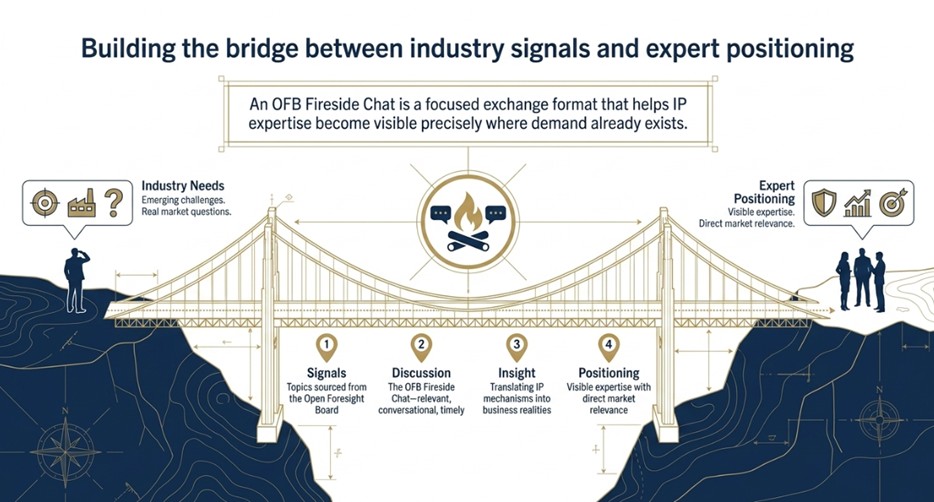
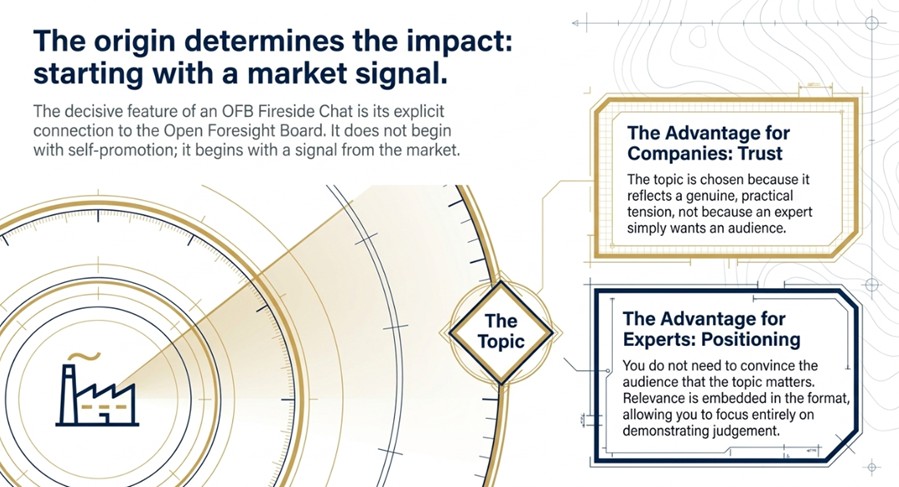
The decisive feature of OFB Fireside Chats is their origin. They are explicitly connected to the Open Foresight Board and therefore to a broader process of identifying relevant IP management questions from industry and practice. This means that the format does not begin with self-promotion. It begins with a signal from the market.
For companies, this creates trust. The topic is not chosen merely because an expert wants to talk about it. It reflects a question, tension, or need that has practical relevance. This increases the likelihood that the conversation addresses issues that matter in real business situations rather than remaining inside abstract IP discourse.
For IP Subject Matter Experts, the OFB origin creates a strong positioning advantage. The expert does not need to first convince the audience that the topic is relevant. The relevance is already embedded in the format. The expert can focus on demonstrating judgment, experience, and the ability to help companies navigate the issue. This turns the Fireside Chat into a demand-led positioning opportunity.
The Licensing Example
The Fireside Chat on licensing illustrates the logic of the format well. Licensing is often discussed as a legal or transactional subject. Many conversations focus on contracts, royalty structures, deal terms, enforcement risks, or negotiation tactics. These aspects are important, but they do not fully explain where licensing value is really created.
In an OFB Fireside Chat, licensing can be approached from a broader industrial perspective. The conversation can explore how licensing relates to business models, value capture, collaboration structures, market access, technology transfer, internal decision-making, and organizational readiness. In this framing, licensing is not treated merely as the final agreement at the end of a negotiation. It becomes part of a larger value creation logic.
This changes the role of the IP Subject Matter Expert. The expert is not only explaining legal instruments. They are helping participants understand how licensing connects to strategic choices inside a company. That kind of contribution is much closer to the actual challenges companies face when they try to turn IP into business value.
Making Expertise Tangible in Real Conversation
Professional services often face a visibility problem because expertise is difficult to evaluate before a collaboration begins. Companies can read biographies, publications, and service descriptions, but those formats rarely show how an expert handles uncertainty, nuance, or conflicting priorities. This is particularly important in IP management, where many relevant questions sit between law, technology, strategy, finance, and organizational behaviour.
OFB Fireside Chats make expertise tangible because they allow expert thinking to unfold in conversation. Participants can observe how an IP Subject Matter Expert frames a problem, which distinctions they introduce, how they connect different perspectives, and how they respond to practical concerns. This creates a richer form of trust than static content can provide.
The format also gives experts the chance to demonstrate the kind of competence that companies often value most but find hard to assess in advance. This includes the ability to listen, structure complexity, explain trade-offs, and translate IP issues into business-relevant language. In many cases, this is exactly what determines whether a company sees an expert as a potential advisor rather than merely as a knowledgeable commentator.
From Fireside Chat to Platform Asset
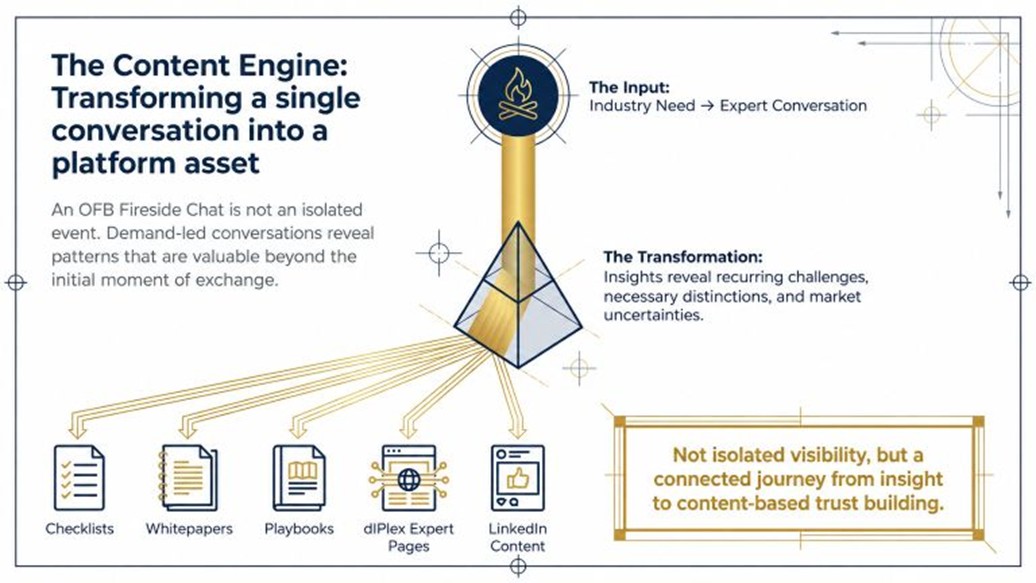
An OFB Fireside Chat is not only a single moment of exchange. It can become the starting point for a broader positioning architecture within the IPBA Connect platform. The insights generated in the conversation can be transformed into articles, summaries, expert pages, checklists, whitepapers, playbooks, LinkedIn content, or follow-up formats.
This is important because demand-led conversations often reveal patterns that are valuable beyond the event itself. A question raised by one company may reflect a broader uncertainty in the market. A distinction introduced by an expert may become the foundation for a checklist or decision tool. A recurring challenge discussed in the conversation may become the theme for a dIPlex Expert Page or a deeper explanatory article.
In this way, the Fireside Chat functions as both interaction and insight generation. It connects the expert directly with relevant market questions and then allows the platform to turn those insights into reusable positioning assets. The result is not isolated visibility, but a connected journey from industry need to expert conversation to content-based trust building.
Beyond Broadcasting Expertise
A common weakness of expert communication is that it often works like broadcasting. The expert speaks, publishes, or presents, and the audience decides whether to pay attention. This model can work when the audience already understands the relevance of the topic, but it is less effective when the market’s needs are still emerging or poorly articulated.
OFB Fireside Chats follow a different logic. They create a shared problem space before the expert contribution begins. The conversation is anchored in an industrial question, which makes the expert’s contribution more accessible and more relevant. Instead of asking the market to adapt to the expert’s language, the format encourages the expert to connect with the market’s situation.
This outside-in orientation is particularly important for IP management. Many companies do not describe their challenges in IP terminology. They talk about product roadmaps, collaboration risks, data access, standardization, market entry, valuation, regulatory uncertainty, or competitive pressure. The Fireside Chat gives the IP Subject Matter Expert a setting in which these themes can be connected back to IP in a practical and credible way.
The Role of OFB Fireside Chats in IPBA Connect
Within IPBA Connect, OFB Fireside Chats occupy a specific role. They connect the foresight function of the Open Foresight Board with the positioning needs of IP Subject Matter Experts and the practical questions of companies. This makes them a bridge between market demand, expert credibility, and platform-based amplification.
The first layer is industry demand. Through the Open Foresight Board context, relevant questions and emerging areas of uncertainty are identified. The second layer is expert positioning. IP Subject Matter Experts can demonstrate their thinking in relation to these questions. The third layer is platform amplification. The insights from the conversation can be developed into connected content formats across the IPBA ecosystem.
This combination is what makes the format powerful. It does not treat visibility as an end in itself. It connects visibility to relevance, interaction, and follow-up. The expert is not merely presented to the market. The expert is placed into a meaningful conversation with the market.
Why This Format Matters Now
IP management is becoming more complex because companies operate in faster technological cycles, more interconnected ecosystems, and markets where intangible assets increasingly shape competitive advantage. In this environment, many IP questions cannot be answered through legal explanation alone. Companies need orientation that connects IP to business models, technology development, collaboration structures, and strategic decision-making.
OFB Fireside Chats respond to this need by creating a space where industry signals and expert thinking meet. They allow companies to explore relevant questions in a structured but open format. At the same time, they give IP Subject Matter Experts a powerful opportunity to position themselves through direct, demand-led interaction.
The result is more than another content format. OFB Fireside Chats turn emerging industrial questions into meaningful expert conversations. They help make expertise visible where it is needed, understandable where it matters, and credible through real exchange. In that sense, they are not simply a way to talk about IP. They are a way to connect IP expertise with market demand.