
The GreenTech Strategy Gap: What Sustainable Innovation Companies Need, and What IP Advice Still Often Fails to Integrate

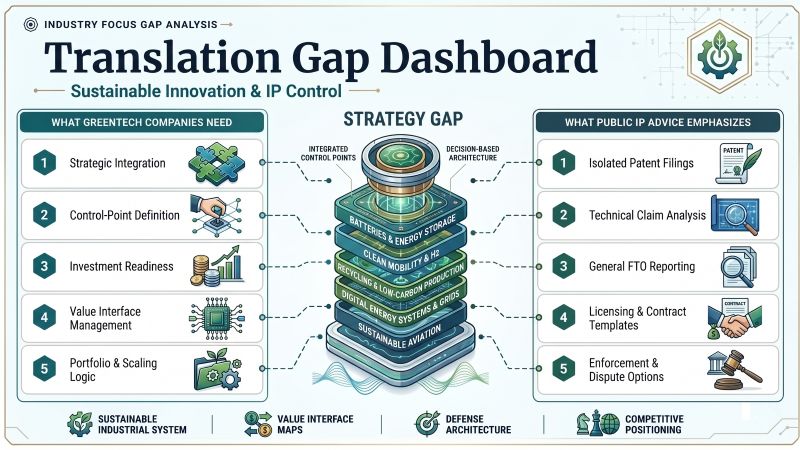
A growing number of signals from the GreenTech market point to a structural mismatch. Companies are no longer developing isolated environmental technologies. They are building industrial transition systems: batteries linked to mobility, storage and recycling; hydrogen linked to infrastructure; smart grids linked to software, data and interoperability; sustainable aviation linked to fuels, propulsion, materials and supply chains. Yet much IP advice is still publicly framed as if the central question were only whether a specific invention can be protected.
This article is not about whether IP matters in GreenTech. That debate has largely passed. It is about a gap.
On one side, GreenTech companies are facing a layered innovation environment in which patents, trade secrets, process know-how, data, contracts, standards, public funding, supply chains, partnerships and market access increasingly interact. On the other side, much visible IP communication still separates these questions into individual legal categories: patentability, FTO, trade secrets, contracts, licensing, standards, enforcement or due diligence. Each category matters. But companies often need something more integrated.
The issue is not that expertise is missing. In many cases, the opposite is true. The issue is that the way expertise is communicated does not always reflect the strategic decision environment in which GreenTech companies now operate. The core thesis is this: GreenTech is becoming one strategic environment, and IP is moving from a narrow protection function into a decision system for control, collaboration, market access, risk management and competitive positioning.
The demand side: what GreenTech companies increasingly need
Many GreenTech companies are not primarily asking whether they can obtain “a patent” for “a technology”. They are facing more complex operational questions.
A battery company may be developing a new cell chemistry, but its market position may also depend on manufacturing processes, thermal management, charging behaviour, recycling, supply chain access and software-controlled performance. A hydrogen company may depend on catalysts, plant configuration, safety standards, infrastructure partners and long-term offtake agreements. A smart grid company may depend on sensors, algorithms, cybersecurity, interoperability standards and platform governance.
The strategic question is therefore not only: what can we protect? The better question is: what must we control in order to scale, collaborate, attract capital and keep room to act?
This is where GreenTech differs from many classical product categories. Value often appears at interfaces. It may sit between a material and a process, between hardware and software, between a component and a standard, between a patent and a trade secret, between a public funding condition and a commercialization plan, or between a supplier relationship and a licensing model.
A company may therefore need to decide which elements should be patented, which process parameters should remain secret, which data flows create bargaining power, which standards may later shape market access, and which collaboration structures could weaken ownership of future improvements.
This need often arises before the filing decision. It concerns portfolio architecture, dependency analysis, investment readiness and business model design.
The supply side: what IP communication still often emphasizes
When one looks at how GreenTech IP expertise is often publicly presented, another picture becomes visible. The dominant public signals are often technical competence and legal categorization. Communication may focus on patent protection for clean technologies, FTO in the battery field, trade secret protection for manufacturing processes, contracts for collaboration, licensing in energy infrastructure or standards in smart mobility and grid systems.
All of these topics are relevant. But they can remain fragmented if they are not connected to the company’s strategic control problem. The message is often: we can protect GreenTech inventions. Much less often, the message becomes: we can help you understand where control, leverage and dependency arise in a sustainable industrial system.
This distinction matters. In GreenTech, protectability is necessary, but not sufficient. A patentable invention may still fail to protect the commercially decisive layer. A trade secret may preserve a process advantage but make investor communication more difficult. A collaboration agreement may enable scaling but transfer too much improvement ownership to the wrong partner. A standard may open the market but reduce exclusivity. A public funding programme may accelerate development but create disclosure or access obligations. A claim may be technically strong but commercially misaligned. Protection choices are becoming business model choices.
Where the mismatch becomes visible
The gap becomes clearest when comparing the situations companies face with the way IP expertise is often segmented. A GreenTech company does not experience its risk in separate legal boxes. It experiences the system as one decision environment.
The technology logic asks whether the solution works. The scaling logic asks whether it can be manufactured, deployed and scaled. The investment logic asks whether the company controls a defensible asset. The collaboration logic asks who owns improvements and who can commercialize them. The standardization logic asks who controls access to the market. The patent logic asks what can be claimed and enforced. The business logic asks where differentiation and bargaining power will come from. When these logics are treated separately, the company may receive correct advice and still remain strategically exposed.
It may patent the material but miss the process know-how. It may protect the device but overlook the data layer. It may enter a pilot project without securing ownership of improvements. It may disclose too much to attract partners and too little to reassure investors. It may build a technically strong solution but remain dependent on suppliers, infrastructure operators or standards it does not control.
This is why patent landscapes in GreenTech are becoming more than filing statistics. They are market maps. They show where competition is concentrating, where fields are becoming congested, where future dependencies may arise and where white spots may still exist. For example, batteries, energy storage, clean mobility, hydrogen, recycling, digital energy systems, low-carbon manufacturing and sustainable aviation are fields that are no longer isolated technical domains, but part of one industrial competition environment.
The investment layer
There is another reason why fragmented IP advice is becoming insufficient: GreenTech is capital intensive. Many sustainable technologies require long development cycles, technical validation, pilot plants, infrastructure integration, manufacturing partners and international scaling. This makes IP highly relevant for financing.
Investors need to understand whether a company controls something that can survive scaling pressure. They need to know whether the technology position is protectable, whether imitation can be delayed, whether FTO risks are manageable, whether collaboration will preserve value and whether the portfolio matches the commercial roadmap.
In this environment, IP becomes part of the credibility infrastructure around investment. A GreenTech company with a weak or fragmented IP position may not only face legal risk. It may face a financing problem, a partnership problem and a market access problem at the same time.
This is especially important because many GreenTech companies cannot scale alone. They work with manufacturers, utilities, automotive companies, aviation companies, public institutions, universities, infrastructure operators, suppliers and investors. Each collaboration creates a control question.
Who owns improvements? Who can use generated data? Who controls background IP? Who may sublicense? Who can commercialize in which markets? Who bears the risk if third-party rights block deployment? These questions are not administrative details. They define whether sustainable innovation can become industrial impact.
A gap in translation
What appears visible, then, is not primarily a gap in legal quality. It is a gap in translation. Companies increasingly experience GreenTech through questions of control, dependency, scalability, investment readiness, public funding, standardization, collaboration, infrastructure and market access. Publicly visible IP expertise often still frames the subject through separate legal categories: patents, trade secrets, FTO, licensing, contracts, standards, data and enforcement.
Those categories are necessary. But they are not the same as the company’s strategic problems.
The opportunity for IP experts is therefore not only to offer more technical expertise. It is to make existing expertise legible as decision support. Companies need to understand where the defensible control point lies. In one case, it may be a material composition. In another, a manufacturing process. In another, a recycling method. In another, a software-controlled energy system. In another, the strategic value may lie in combining patents, trade secrets, data, contractual access rights and licensing architecture. The next step is to translate this complexity into board-level choices.
The strategic opportunity
The market opportunity is not simply to tell GreenTech companies that IP is important. They already know that. The opportunity is to show them that IP can function as a decision system for sustainable industrial transformation. It can help management decide what to protect, what to disclose, what to keep secret, what to license, what to standardize, what to monitor, what to avoid building and where collaboration requires stronger ownership structures. That is where the next stage of differentiation in GreenTech IP advice may begin.
The companies that understand this early gain room to act. They can shape their portfolios around control points instead of assets alone. They can align patent filings with scaling plans, investment narratives, collaboration models and market access strategies. They can use IP not only to protect what has been invented, but to clarify how the business should compete.
Companies that treat IP reactively face a different risk. They may become technically strong but strategically dependent. Funded but exposed. Sustainable but easy to copy. Collaborative but weak in negotiation. Innovative but unable to control the industrial transition they helped create. The GreenTech gap is therefore not a gap between sustainability and IP. It is a gap between sustainable industrial systems and fragmented advisory narratives. Closing that gap means translating IP expertise into the language of strategic control.