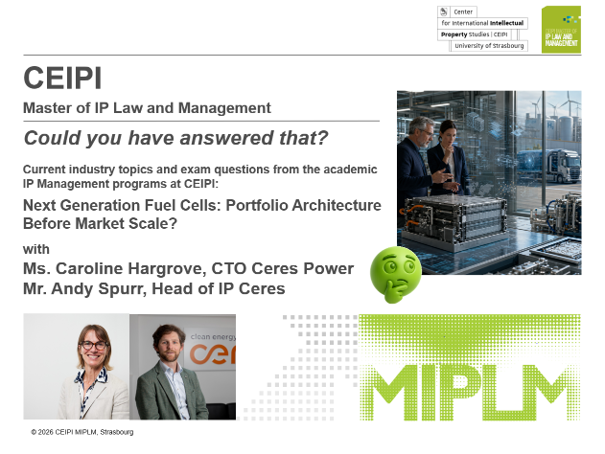
IP Decision Case Green Tech Caroline Hargrove, Andy Spurr. Next Generation Fuel Cells: Portfolio Architecture Before Market Scale

GreenTech is increasingly becoming a question of industrial scale-up. In many sustainable technology fields, value is no longer created only by a protected invention or a single technical breakthrough. It is created by the way materials, system design, manufacturing knowledge, software, operational learning and partner access are combined into a scalable industrial position.
This creates a demanding strategic challenge for GreenTech companies. A next generation fuel cell platform may be highly valuable because it can support industrial energy systems, heavy mobility applications and green hydrogen infrastructures. Yet the same development path that makes the technology attractive for investors, manufacturing partners and industrial customers also creates pressure to disclose technical detail, share know-how and enter collaborations before the full market structure has emerged.
This is exactly the type of shift described in the CEIPI IP Business Academy analysis “The GreenTech Strategy Gap”. The study shows that GreenTech companies increasingly operate in layered transition systems where IP strategy must connect patents, trade secrets, data, software, supply-chain position, collaboration models, procurement requirements and market access into one coherent strategic architecture.
Here you find the findings of this study: “The GreenTech Strategy Gap: What Sustainable Innovation Companies Need, and What IP Advice Still Often Fails to Integrate”
Against this background, the CEIPI IP Business Academy integrates practice based questions from industry into its teaching. These questions help students understand IP not only as a legal protection tool, but as a management instrument for strategic decision making in complex innovation systems.
We are therefore pleased to include this industry case study with Caroline Hargrove, CTO of Ceres Power, and Andy Spurr, Head of IP at Ceres. Their practical question focuses on a central issue for next generation fuel cell companies: how to design a portfolio architecture before market scale, when patents, trade secrets, partner confidence, manufacturing control and investment credibility must be balanced under uncertainty. Here is the evaluation of this case by Caroline Hargrove, CTO Ceres Power, and Andy Spurr, Head of IP Ceres:
“The IP issues raised in this exam question are extremely relevant to Ceres Power. Since securing early fundamental patents, our IP strategy is constantly evolving to find the optimum balance of Patents and trade secrets throughout the value chain. Our strategy and focus changes depending on market demand to position Ceres Power in the most favourable position for partnerships and investment.” Caroline Hargrove, CTO Ceres Power, Andy Spurr, Head of IP Ceres
Decision Context
A technology company has developed a next generation fuel cell platform for industrial energy systems, heavy mobility and green hydrogen applications. The technology combines advanced materials, stack design, manufacturing know-how, control software and system integration. Early pilot projects show strong technical promise, but large-scale commercialization depends on partners in manufacturing, infrastructure, energy distribution and end-user industries.
The company is now moving from technology validation to market formation. This changes the role of IP. The question is no longer only how to protect individual inventions. The company must decide how IP can support industrial scaling, partner negotiations, financing, supply-chain control and long-term competitive positioning.
The Decision
The management team must decide whether to build a broad patent portfolio around the fuel cell platform early, including materials, stack architecture, manufacturing processes and control logic, or whether to keep key elements as trade secrets while patenting only selected system-level interfaces and application-specific improvements.
The first option may create visible assets for investors, partners and future enforcement. It can strengthen the company’s position in negotiations and make the technology easier to license. However, it may also disclose sensitive technical detail before the manufacturing process and partner ecosystem are mature.
The second option may preserve technical advantage and reduce disclosure risk. It can be attractive where performance depends on tacit engineering knowledge, process control and accumulated learning. However, it may create weaker public signals, make partnership structures harder to negotiate and reduce leverage if competitors patent adjacent areas.
Why This Decision Is Difficult
There is no obvious right answer because the value of the IP depends on future market structure. If the industry moves toward standardised platforms, interoperability and licensing models, patents on interfaces and system architectures may become powerful control points. If the market remains manufacturing-intensive and performance depends on operational excellence, trade secrets and process know-how may matter more.
The decision also depends on timing. Filing too early can disclose immature concepts and invite design-arounds. Filing too late can leave competitors room to occupy the patent landscape, making freedom to operate more expensive. In GreenTech, public funding, sustainability reporting, collaboration requirements and industrial policy may also increase pressure to disclose, publish or partner before the company has fully secured its strategic position.
The portfolio structure will influence enforcement options as well. A visible patent portfolio can deter competitors and support selective enforcement, but enforcement in a collaborative ecosystem can damage commercial relationships. A secrecy-based strategy may avoid confrontation, but it becomes fragile when engineers, suppliers and partners need access to critical knowledge.
Practitioner Perspective
A practitioner with deep technology leadership experience would likely see this as an engineering and business architecture problem, not just an IP filing decision. In next generation fuel cells, value is distributed across materials, design, simulation, manufacturing scale-up, control systems and field performance. The IP strategy must therefore reflect how the technology actually creates value.
The key practitioner question is: which elements must be visible to create trust, investment and partner confidence, and which elements must remain controlled because they form the company’s real performance advantage? This requires close interaction between IP, engineering, business development and operations. A portfolio that looks strong on paper but does not map to the company’s scaling bottlenecks may fail to protect the business. A secrecy strategy that protects technical depth but weakens market positioning may also become costly.
Implication for IP Management Education
This case shows why IP management education must move beyond the question of whether an invention is patentable. The central learning point is how IP decisions shape the economic architecture of an emerging GreenTech business.
Students should learn to analyse patents, trade secrets, collaboration models and enforcement options as interdependent strategic choices. In next generation fuel cells, IP affects not only protection but also partner selection, financing credibility, manufacturing control, regulatory exposure and future business models. The decision is difficult because IP must protect today’s technical advantage while keeping the company flexible for a market that has not yet fully formed.
The educational value lies in understanding IP as a decision system under uncertainty. Strong IP management is not about maximizing the number of filings. It is about designing a portfolio that supports the company’s route from promising technology to defensible industrial position.
Caroline Hargrove
 Caroline Hargrove CBE FREng is Chief Technology Officer at Ceres Power, a world-leading developer of low-cost, next-generation fuel cell and green hydrogen technology. She also serves as a Non-Executive Director at Zedsen, a medtech startup developing non-invasive biosensor technology. Her career combines deep engineering expertise with senior technology leadership across GreenTech, health technology, AI and high-performance engineering. Before joining Ceres, she was CTO and VP AI Technologies at Babylon Health, and previously held several senior roles at McLaren Applied Technologies, including CTO, Technical Director and Programme Director. Earlier in her career, she spent nearly ten years at McLaren Racing as a Simulation Development Engineer.
Caroline has also contributed to academia and engineering education, including roles as Visiting Professor at the University of Oxford’s Nuffield Department of Surgery and Lecturer at the University of Cambridge Department of Engineering. She holds a PhD in Engineering from the University of Cambridge and a BSc in Applied Mathematics and Mechanical Engineering from Queen’s University. Her expertise includes simulations, vehicle dynamics and engineering, and she is fluent in English and French. She is a Fellow of the Royal Academy of Engineering and was awarded a CBE in 2020 for services to engineering.
Andy Spurr
 Andy Spurr is Head of IP at Ceres, a FTSE-listed clean energy and green technology licensing company focused on next-generation fuel cell and green hydrogen solutions. A physics-trained intellectual property expert, he works at the intersection of clean energy innovation, IP asset creation, freedom to operate, partner collaboration and technology commercialization. At Ceres, he has held roles as Senior Patent Counsel, Head Patent Counsel and now Head of IP, with responsibilities covering IP asset creation, joint IP issues with partners and suppliers, FTO and the broad range of IP matters faced by an IP-led licensing business.
Before joining Ceres, Andy worked as a European Patent Attorney at Canon EMEA, where he supported the video encoding division in drafting and prosecuting standard-essential patents and managed patent prosecution before the EPO and UKIPO, including inventions involving AI and 3D video. He previously spent eight years at Mathys & Squire, progressing from Technical Assistant to Managing Associate, advising clients including UK-based start-ups on patent strategy, software patentability, prosecution and contentious matters. Earlier in his career, he interned at the Parliamentary Office of Science and Technology, where he authored a report on solar technologies for policymakers. Andy holds an MPhys in Physics from the University of Oxford and is qualified as a European Patent Attorney, Chartered Patent Attorney and UPC representative.