
IP Decision Case Dr. Benjamin Delsol: Predictive Maintenance as an IP Strategy Problem in Industrial IoT

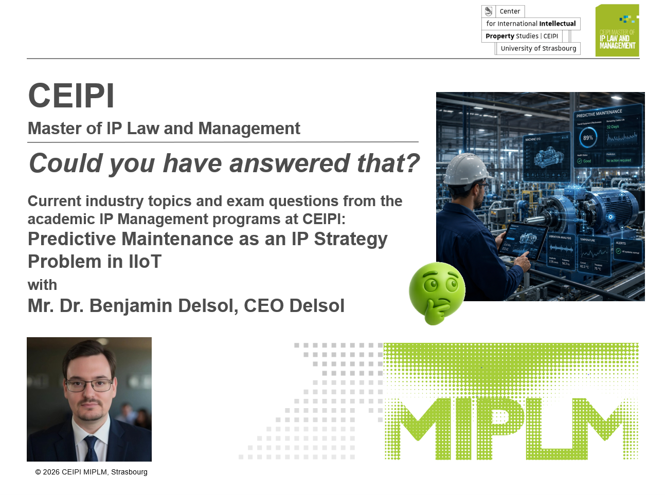
Industrial IoT is increasingly becoming a question of strategic control over connected value creation. In many manufacturing environments, value is no longer created only by a robust machine, a protected component or a service technician’s experience. It is created by the way sensors, edge devices, cloud analytics, AI assisted diagnostics, machine data, service workflows, customer access rights, cybersecurity and contractual structures are combined into a scalable service position.
This creates a demanding strategic challenge for industrial equipment manufacturers. A predictive maintenance service may be highly valuable because it combines installed machine knowledge, sensor configuration, fault pattern recognition, accumulated field data, diagnostic models and service recommendations into a system that can reduce downtime and improve operational performance. Yet the same transition from product sales to availability based services creates pressure to decide what should be patented, what should remain confidential, what must be contractually controlled and how machine data can be accessed, used and protected over time.
This is exactly the type of shift described in the CEIPI IP Business Academy analysis “The IoT Strategy Gap: What Connected Product Companies Need, and What IP Advice Still Often Fails to Integrate”. The analysis shows that IoT companies increasingly operate in a layered control environment where patents, software, data, trade secrets, cybersecurity, contracts, digital platforms, digital twins and service models interact. In this environment, the relevant IP question is no longer only whether a connected device or software function can be protected. The strategic question is what must be controlled in order to scale, collaborate, access data, maintain security, attract investment and preserve room to act.
Against this background, the CEIPI IP Business Academy integrates practice based questions from industry into its teaching. These questions help students understand IP not only as a legal protection tool, but as a management instrument for strategic decision making in connected innovation systems.
We are therefore pleased to include this industry case study with Dr. Benjamin Delsol. His practical question focuses on a central issue for Industrial IoT companies building predictive maintenance services: how to design a layered IP strategy where patents, trade secrets, data governance, contracts and system architecture work together before the service is rolled out to customers and external service partners.
The case shows that predictive maintenance cannot be reduced to a patent filing decision. The technical solution is spread across sensor configuration, data quality, diagnostic logic, AI assisted prediction, service workflows, customer access to machine data and accumulated field knowledge. IP management must therefore clarify where value is created, where it can be copied, what can be observed by competitors, what should be disclosed, what must remain secret and how long term access to operational data can be secured.
Decision Context
A mid sized manufacturer of industrial machines has developed a predictive maintenance service for its installed base. The service combines sensor data from operating machines, edge based condition monitoring, cloud analytics, fault pattern recognition and service recommendations for customers. The business case is attractive because the company can move from selling spare parts and periodic service visits toward recurring revenue based on machine availability, reduced downtime and operational performance.
The technical solution is not a single invention. Value sits across several layers: sensor configuration, data quality, diagnostic logic, AI assisted failure prediction, service workflows, customer access to machine data, and the accumulated field knowledge from many operating environments. Management now asks the IP team how this value should be protected before the service is rolled out to key customers and external service partners.
The Decision
The company must decide which parts of the predictive maintenance system should be patented, which parts should remain protected as trade secrets, and how the underlying data position should be controlled through contracts, system architecture and service design.
One option is to patent selected technical aspects of the monitoring and prediction system, especially where the industrial technical effect can be clearly shown. This may strengthen visibility, support investor confidence, create barriers for competitors, provide a basis for enforcement, and open licensing options. Another option is to keep the diagnostic models, fault libraries, training data and operational know how confidential, in particular as Trade-Secrets, because disclosure could teach competitors how the service actually creates value. A third layer concerns the data itself: without reliable access to machine data over time, neither patents nor trade secrets create a stable service position.
Why This Decision Is Difficult
There is no obvious right answer because the strongest economic value may sit in elements that are hard to patent and risky to disclose. A patent may protect a specific technical method, but it may also reveal enough about the system architecture to help competitors build around it. A trade secret may protect the real service logic more effectively, but only if the company has mature governance, secure workflows, restricted access and clear contractual rules with customers and partners.
The decision also affects portfolio structure. A patent heavy approach may create visible assets, but miss the data and process layers where competitive advantage grows over time, while representing a certain cost. A secrecy heavy approach may preserve operational intelligence, but weaken enforcement and make the position less transparent in financing, partnering or acquisition scenarios. Data access adds further uncertainty because connected machines often involve customers, suppliers, software providers and service partners who may all claim an interest in the generated data.
The long term consequence is business positioning. If the company controls only the machine but not the data, it may lose bargaining power in the service model. If it controls the algorithm but not the customer interface, it may become dependent on platform partners. If it protects the technical invention but ignores service contracts and data governance, the predictive maintenance business may scale technically while losing strategic control.
Practitioner Perspective
From the perspective of an IP strategist such as Dr. Benjamin DELSOL, this is not mainly a patentability question. It is an intangible asset architecture question. The company must understand where value is created, where it can be copied, where it can be observed by competitors, where it depends on accumulated data, and where customer trust and operational access become part of the protectable position.
The practical task is therefore to design a layered IP strategy. The first layer should always be Trade secrets as they may protect fault libraries, model tuning, data cleaning routines, service playbooks and field experience, but also any invention before it becomes a patent. Then, the second layer should be patents as they may be used selectively for technical features that create a measurable industrial effect and are likely to be visible in competing systems.. Finally, the final layer should be contracts and system design as they must secure access to machine data, define permitted uses, protect customer confidentiality and avoid uncontrolled leakage of operational know how into the ecosystem.
Implication for IP Management Education
This case shows why Industrial IoT changes the logic of IP management. Students should not learn to ask only whether a predictive maintenance invention can be patented. They should learn to ask which layer of the business model needs which form of control.
Predictive maintenance makes IP management a strategic coordination task between R&D, product management, service operations, sales, legal, data governance, cybersecurity and business development. The educational lesson is that IP decisions in connected industrial systems shape not only protection, but also portfolio design, enforcement options, customer relationships, data access, partner dependency and future revenue architecture. In Industrial IoT, IP is no longer only a shield for technology. It becomes a management system for controlling industrial data, service scalability and competitive position.
Benjamin Delsol
 Dr. Benjamin DELSOL is a Swiss based intellectual property strategist, Fractional Chief Intellectual Property Officer and Chief Intangible Assets Officer, European Patent Attorney, UPC Representative, founder and CEO of DELSOL Group, and an IAM Strategy 300 Global Leader. With a PhD in Quantum Physics, an LL.M. in IP Law and Management, and additional training in cognitive neuroscience, he combines deep technical expertise with legal, strategic, and business oriented insight. His work focuses on transforming intellectual property and intangible assets into strategic business assets, particularly in quantum technologies, deep tech, artificial intelligence, software inventions, neuroscience, innovation strategy, and IP management.
His professional career spans patent practice, corporate IP counsel work, entrepreneurship, education, mentoring, and strategic advisory roles. He founded and leads DELSOL Group, including HMS DELSOL, DELSOL AI, and DELSOL Academy, and advises companies, startups, investors, and innovation ecosystems on IP strategy, portfolio management, trade secrets, AI systems, intangible asset governance, and value creation. Earlier in his career, he worked as Patent Counsel at SICPA, focusing on digital inventions, cryptography, digital identity, IoT, AI, machine learning, blockchain, computer vision, electronics, mechanics, robotics, and related IP strategy. He also held patent attorney roles at HAUTIER IP, lectured for institutions including CEIPI, the European Patent Office, IP Business Academy, Université de Nice, and I3PM, and continues to contribute as a mentor, board member, advisor, speaker, and author in the fields of intellectual property, deep tech, entrepreneurship, and innovation strategy.