
The Robotics Strategy Gap: What Autonomous Systems Companies Need, and What IP Advice Still Often Fails to Integrate

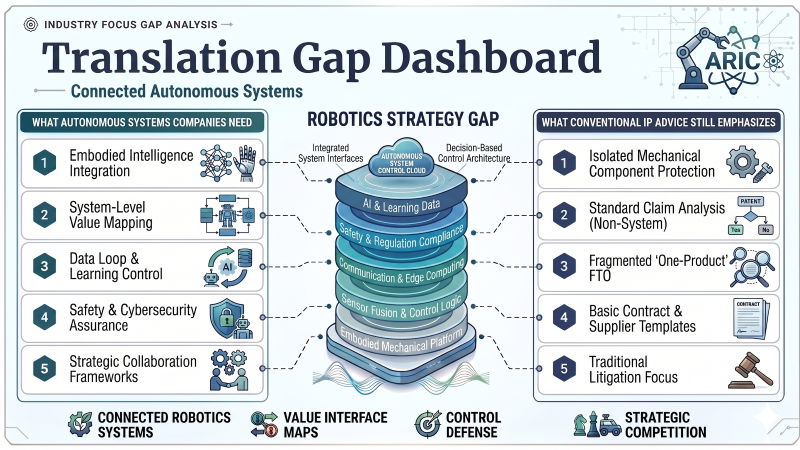
A growing number of signals from the robotics market point to a structural mismatch. Companies are no longer developing isolated machines that execute predefined movements. They are building autonomous systems: robots connected to sensors, AI models, control software, operational data, simulation environments, cloud infrastructure, communication networks and human workflows.
Yet much IP advice is still publicly framed as if the central question was only whether a mechanical component, control method or software function can be patented. This article is not about whether IP matters in robotics. That debate has largely passed. It is about a gap.
On one side, robotics companies are facing a layered innovation environment in which patents, software, data, trade secrets, safety architecture, standards, cybersecurity, contracts, suppliers, regulation and market access increasingly interact. On the other side, much visible IP communication still separates these questions into individual legal categories: patentability, freedom to operate, software protection, trade secrets, data rights, licensing, contracts or enforcement. Each category matters. But robotics companies often need something more integrated. The core thesis is this: robotics is becoming one strategic control environment, and IP is moving from a narrow protection function into a decision system for embodied intelligence.
The demand side: what robotics companies increasingly need
Many robotics companies are not primarily asking whether they can obtain “a patent” for “a robot”. They are facing more complex operational questions. An industrial robotics company may combine mechanical structures, actuators, sensors, machine vision, safety systems, edge computing and adaptive control. A surgical robotics company may depend on navigation, simulation, clinician training, workflow integration, patient-specific planning and regulatory evidence. An agricultural robotics company may combine autonomous machinery, field data, AI processing, positioning systems and operational know-how.
A drone company may depend on navigation algorithms, communications, fleet coordination, on-device processing and the ability to adapt when individual units fail. The strategic question is therefore not only: what can we protect? The better question is: what must we control in order to scale, collaborate, operate safely, attract investment, obtain market access and preserve room to act?
This is where robotics differs from conventional machinery. Value frequently emerges from interactions between technical layers. It may sit between a sensor and an actuator, between perception and movement, between a simulation environment and real-world performance, between an AI model and a safety rule, or between an individual robot and the wider fleet in which it operates.
A company may therefore need to decide which system functions should be patented, which model parameters and process details should remain confidential, which operational data create bargaining power, which interfaces should remain open and which dependencies could later weaken its strategic position. These decisions arise before an individual patent application is drafted. They concern system architecture, portfolio design, collaboration structures, supplier relationships, data governance and the business model around the robot.
From machines to embodied intelligence
The central development in robotics is not simply that machines are becoming more automated. It is that software intelligence is being embodied in systems that sense, interpret, decide and act in the physical world. Software no longer remains on a screen. It moves an instrument, vehicle, prosthesis, drone, mobile platform or robotic arm through a real environment. This changes the IP question.
A robotics invention cannot always be understood by separating mechanical engineering from software. Commercially relevant innovation may arise from the interaction between sensors and actuators, feedback and control, AI models and physical constraints, or autonomous decision-making and safety architecture. The visible hardware may not be the strategically decisive asset. The decisive layer may be the control logic that makes the hardware precise, adaptable, safe or capable of learning.
This is already apparent in prosthetics. The technical and commercial differentiation of an advanced prosthetic device may depend less on the shape of the device than on how user intent is detected, how signals are interpreted, how feedback is generated and how movement is controlled. The same pattern extends far beyond prosthetics. Control systems are central to industrial robots, autonomous vehicles, drones, surgical systems and assistive technologies. They translate information into physical action. For IP Management, this means that protection must reflect system functions rather than only visible components.
The supply side: what IP communication still often emphasizes
When one looks at how robotics-related IP expertise is publicly presented, another picture becomes visible. The dominant signals are often technical credentials and traditional legal services. Public communication may emphasize experience in mechanical engineering, electronics, AI, computer-implemented inventions, medical devices or automotive technology. It may refer to patent drafting, prosecution, opposition, litigation or freedom-to-operate searches. All of these capabilities are relevant. But they can remain fragmented if they are not connected to the strategic control problem faced by the company.
The message is often: we can protect robotics inventions. Much less often, the message becomes: we can help you determine where control, dependency and defensibility arise across an autonomous system. This distinction matters.
A patent on a robotic joint may not protect the control architecture that makes the joint valuable. Protection for an AI-assisted function may not secure access to the operational data needed to improve it. A software module may be difficult to enforce when it is hidden in a remote infrastructure. A proprietary interface may create control but limit ecosystem adoption. An open interface may accelerate scaling but make differentiation more difficult.
A collaboration may provide access to essential training environments while transferring too much ownership of future improvements. A supplier relationship may accelerate development while creating dependence on a sensor, processor or communication technology the robotics company does not control. In robotics, protection choices increasingly become architecture and business model choices.
Where the mismatch becomes visible
The gap becomes clearest when comparing the situations robotics companies face with the way IP expertise is often segmented. A robotics company does not experience its risks in separate legal boxes. It experiences the robotic system as one decision environment.
The engineering logic asks whether the system can perform reliably under real operating conditions. The AI logic asks whether models can interpret changing environments and generate appropriate actions. The safety logic asks how harmful behaviour is prevented and documented. The data logic asks who can access and use information generated during operation.
The patent logic asks which technical functions can be claimed and enforced. The software logic asks how code, modules and interfaces can be protected. The supplier logic asks where technical dependencies arise. The business logic asks where differentiation, scalability and bargaining power will come from. When these logics are treated separately, a company may receive legally correct advice and still remain strategically exposed.
It may patent the mechanical platform but miss the control layer. It may protect a navigation function but overlook the data required to continuously improve it. It may secure ownership of the original product but fail to allocate rights for improvements created through customer deployments. It may use open-source software without understanding the consequences for distribution or confidentiality. It may rely on third-party AI models, chipsets or cloud services that restrict how the product can be commercialised. It may build a technically advanced robot while remaining dependent on infrastructure, data or integration partners it does not control. The company may therefore own valuable IP and still lack strategic control.
Robotics is expanding across industrial systems
Medical robotics makes the transition particularly visible. As robotic surgery matures, innovation increasingly moves beyond constructing the physical robot. Value arises in planning, navigation, simulation, training, workflow integration and the digital systems surrounding the device. Protection must therefore cover more than the robotic platform. It must reflect the technical systems that make the platform clinically useful and operationally scalable.
A similar pattern appears in agriculture. Agricultural robots operate in variable, unstructured environments. Their performance may depend on combining sensors, field data, AI processing, autonomous machinery and specialised operational know-how. The commercially relevant asset may not be a single vehicle or tool. It may be the ability to recognise environmental conditions, make decisions and adapt the system to changing environments.
Drone swarms extend the same logic from individual devices to coordinated systems. In a self-organising fleet, value may lie in communication patterns, distributed decision-making, fault-aware routines, autonomous reconfiguration or the ability of the swarm to continue operating when individual units fail. Here, autonomy no longer resides only in one machine. It emerges from the behaviour of the system.
This creates an important shift for IP strategy. Patent portfolios cannot be limited to individual hardware components. They may need to address fleet coordination, edge AI, communication architectures, adaptive control, safety mechanisms and system-level optimisation. Patents, trade secrets, software protection and contracts must work together.
Freedom to operate becomes system FTO
There is another reason why fragmented IP advice is insufficient: freedom to operate in robotics cannot be reduced to a search for patents covering one product. Robotics requires system FTO.
A meaningful assessment may need to consider mechanical components, sensor technologies, control software, AI models, communication protocols, open-source elements, safety standards, supplier rights, data sources and deployment conditions. The risk may sit in a visible component. But it may also sit in an embedded software library, a licensed dataset, a communication standard, a supplier-controlled chipset or a technical feature activated only during operation.
The relevant question is therefore not simply whether the robot infringes a patent. The company must understand whether the complete technical and commercial architecture can be deployed, maintained, updated and scaled without unacceptable dependencies. This is especially important when robotic systems evolve after market entry. Software updates, model improvements and new data can change system behaviour and potentially change the relevant IP risk. System FTO must therefore be connected to development processes and product lifecycle management rather than treated as a single search completed before launch.
The data and learning layer
Autonomous systems generate data through operation. These data may describe physical environments, user behaviour, system performance, component wear, failure modes, safety events and the consequences of particular decisions. They can be used to improve maintenance, train models, optimise movement and develop future product generations.
This creates a learning loop: Real-world use generates data. The data improve the model. The improved model enhances the system. The improved system generates more valuable data. The company that controls this loop may control the most important strategic asset in the robotics business.
But data control cannot be assumed. A customer may operate the robot. A hospital, factory or agricultural business may generate the operational environment. A technology provider may process the data. A cloud platform may host the model. A partner may contribute improvements.
Contracts must therefore define access, usage, improvement rights and confidentiality. Trade secret governance must identify which datasets, parameters and integration methods create durable competitive advantage. Patent strategy must determine which elements of the software architecture can be disclosed without weakening the wider control position. Data governance is not separate from IP strategy. In autonomous systems, it is one of its central components.
New uncertainty gaps
The uncertainty facing robotics companies is not only legal. It is strategic. Where does value arise: in the physical robot, the control system, the workflow, the model, the data, the simulation environment, the interface or the service surrounding the machine? Where does dependence arise: in sensors, processors, cloud infrastructure, third-party modules, open-source software, communication systems, customer data or regulatory evidence? Where does risk arise: in patent infringement, cybersecurity, safety documentation, supplier lock-in, data access, export controls, dual-use classifications, standardisation or weak trade secret governance? These questions cannot be answered at the end of development.
Early technical choices determine later IP options. The decision to place functionality in the robot or in the cloud affects enforceability, confidentiality, safety and dependency. The decision to use a proprietary or standardised interface affects exclusivity and ecosystem adoption. The decision to collect data centrally or locally affects learning, security and control. A company that treats IP only as a filing step may discover too late that its most important control points were never captured.
Why fragmented advice is not enough
The IP advisory market around robotics often reflects the legal categories from which it developed. One team handles patents. Another handles software and open-source questions. Another addresses data protection. Another deals with product compliance, cybersecurity, commercial contracts or regulatory matters. Each discipline is necessary. But a robotic system is not a collection of unrelated legal tasks. It is a connected architecture of technology, data, safety, collaboration, market access and competitive positioning.
Strategic IP Management must therefore explain how these elements interact. For a start-up, this may determine whether a prototype becomes an investable and defensible business. For an established industrial company, it may determine whether robotics creates new strategic independence or simply introduces dependence on external platforms and technology suppliers. For a research organisation, it may determine whether technical excellence can be transferred into a commercially usable system. For an investor, it may determine whether a company has built a durable control position or only an impressive demonstration.
The role of the IP expert is therefore broader than explaining individual protection rights. It is to create decision capability.
A gap in translation
What appears visible is not primarily a gap in legal or technical expertise. It is a gap in translation. Robotics companies increasingly experience IP through questions of system control, safety, data access, scalability, collaboration, technical dependence and market access. Publicly visible IP expertise often continues to describe the field through separate categories such as patents, software, trade secrets, contracts, data, standards and enforcement.
Those categories are necessary. But they are not the same as the strategic problems experienced by a robotics company. The opportunity for IP experts is therefore not simply to offer more robotics expertise. It is to make existing expertise legible as integrated decision support.
Companies need to understand where the defensible control point lies. In one case, it may be an actuator design. In another, a sensor fusion method. In another, a safety architecture, simulation environment or control algorithm. In another, the strategic position may depend on combining patents, trade secrets, proprietary data and contractual access rights. The next step is to translate this complexity into management choices.
The strategic opportunity
The market opportunity is not simply to tell robotics companies that IP is important. They already know that. The opportunity is to demonstrate how IP can function as a decision system for embodied intelligence. It can help management decide what to protect, what to disclose, what to keep secret, what to license, which interfaces to standardise, which dependencies to reduce, which data to control and where collaboration requires stronger ownership structures. That is where the next stage of differentiation in robotics IP advice may begin.
Companies that understand this early gain room to act. They can shape portfolios around system control points rather than individual components alone. They can align patent filings with software architecture, safety systems, supplier choices and commercial deployment. They can use IP not only to protect what has already been invented, but to clarify how the autonomous system and the business surrounding it should compete.
Companies that treat IP reactively face a different risk. They may become technically advanced but strategically dependent. Data-rich but unable to control the learning loop. Patent-active but exposed at the system level. Collaborative but weak in negotiations. Autonomous in operation but dependent in the layers that determine commercial value.
The robotics gap is therefore not a gap between machines and intellectual property. It is a gap between connected autonomous systems and fragmented IP advisory narratives. Closing that gap means translating IP expertise into the language of strategic control over embodied intelligence.