
IP Decision Case Carsten Herzhoff: Predictive Quality Control in Adhesive and Coating Production

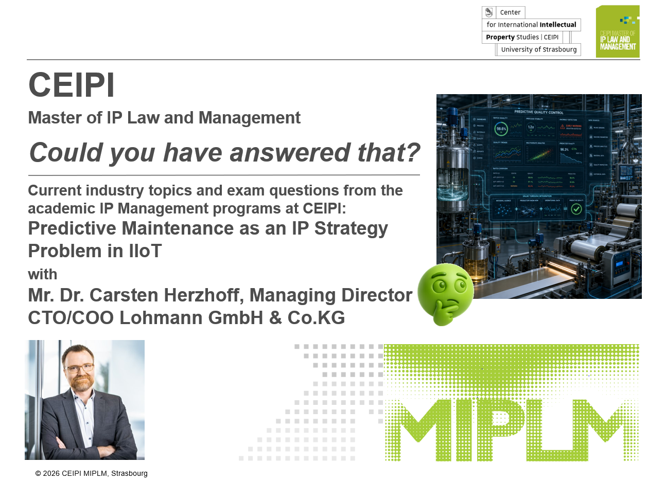
Industrial IoT is no longer only about connecting machines or collecting operational data. It is increasingly changing how industrial companies understand, stabilize and improve complex production systems. In adhesive, coating and functional material production, value is not created by one sensor, one algorithm or one isolated process parameter alone. It emerges from the way material science, production experience, machine data, quality inspection results, process windows, operator knowledge and predictive analytics are combined into a system that can influence manufacturing decisions at scale.
This creates a strategic IP challenge for companies using Industrial IoT in smart manufacturing. A predictive quality control system may become valuable because it helps detect deviations earlier, reduce scrap, improve batch consistency, support maintenance decisions and make production more robust across sites. Yet the same integration that is needed for implementation, supplier cooperation, platform connectivity and operational scaling can also expose the process logic, data correlations, defect indicators, optimization routines and plant specific know how that make the system defensible. In such environments, the decisive IP question is often not whether one technical feature can be patented, but how the architecture of industrial learning can be controlled. The Carsten Herzhoff case highlights exactly this tension in the context of adhesives, coatings and functional materials, where predictive quality control depends on the interaction between chemistry, equipment, process parameters, human expertise and operational data.
This is closely connected to the shift described in the CEIPI IP Business Academy analysis “The IoT Strategy Gap”. The article shows that IoT is becoming a strategic control environment in which IP can no longer be reduced to patents or software rights alone. Connected product and smart manufacturing companies need to decide what to protect, what to disclose, what to keep secret, what to contractually control and where the technical architecture creates future bargaining power.
Here you find the findings of this study: “The IoT Strategy Gap: What Connected Product Companies Need, and What IP Advice Still Often Fails to Integrate”
Against this background, the CEIPI IP Business Academy integrates practice based questions from industry into its teaching. These questions help students understand IP not only as a legal protection tool, but as a management instrument for strategic decision making in digital production systems. In Industrial IoT, this means looking beyond isolated inventions and asking where the value bearing layers of a connected manufacturing environment actually lie.
We are therefore pleased to include this industry case study with Carsten Herzhoff, who brings a practitioner perspective from the field of adhesives, coatings, functional materials and smart production systems. His practical question focuses on a central issue for Industrial IoT in manufacturing: how to structure IP protection for predictive quality control when the most valuable knowledge may sit in process windows, data selection, measurement protocols, defect signals, supplier interfaces, shop floor skills and the orchestration of the overall production ecosystem. The case shows why Industrial IoT requires a hybrid IP management approach that connects patents, trade secrets, contracts, data governance and operational knowledge management into one coherent strategy.
Decision Context
A manufacturer of high-performance adhesives, coatings and functional materials is modernizing its production network. The company serves demanding industries such as automotive, industrial equipment, domestic appliances and advanced manufacturing, where product performance depends not only on the chemical formulation, but also on process stability, application conditions and consistent quality at scale.
To reduce scrap, improve batch consistency and support new service models, the company plans to introduce Industrial IoT-based predictive quality control. Sensors in production lines, process analytics, machine parameters, material behaviour data and quality inspection results will be combined to identify deviations before a batch fails. Over time, the system could become a decisive source of competitive advantage: not because of one isolated invention, but because it captures the interaction between material science, production know-how and operational data.
Comprehensive and coordinated quality control, consolidated within a smart cockpit, will increasingly become the new normal. At Lohmann, too, we are already operating fully automated, smart, IoT-enabled production lines which are increasingly supporting process stability and product quality through predictive quality control and maintenance. However, one must not underestimate how sensitive and prone to faults such a system can be, particularly when multiple components from different suppliers need to be fully integrated and harmonized like a well-oiled gearbox. Whereas in the past, production could still continue (albeit with restrictions) in the event of a failure in individual process, measurement or operational steps, today a broken sensor in highly interconnected systems can bring everything to a complete shutdown. The skilful combination of the various tools is therefore of crucial importance in avoiding or reducing downtime.
The selection or restriction of quality parameters is also critical knowledge. Before data can be transformed into information, long series of measurements must be recorded; every real fault must have been captured as a signal to ensure accurate digital representation; and artefacts, noise and other interfering signals must have been deliberately identified. This is not just about big data, but about smart data. How can I achieve the desired result whilst adhering as closely as possible to the lean principle? A manageable data architecture and governance are of crucial importance.
After all, the cost structure on the shop floor also depends on this. Managing IoT-compatible systems in a way that is both controllable and adds value requires entirely different skills on the shop floor. Data engineers, big data analysts, AI experts, etc. are paid very differently from long-serving quality staff.
The Decision
Management must decide how to structure IP protection for the predictive quality control system.
One option is to file patents around selected technical features, such as sensor-based process monitoring, adaptive parameter control or quality prediction methods for adhesive and coating production. This could create visible portfolio assets, support investor and customer confidence and make the innovation easier to explain externally.
From the perspective of Lohmann this is a challenging question. As mentioned above, a large part of the know-how – and indeed the success – of the business case lies in designing and orchestrating the entire ecosystem effectively, encompassing not only the hardware but also the ‘software’ (data points, skills, and a lean yet robust system architecture). This is something that is difficult to achieve by IP.
The alternative is to keep the most valuable elements as trade secrets, especially process windows, data correlations, model-training logic, defect indicators and plant-specific optimization routines. This could preserve the deeper operational knowledge that competitors would struggle to reconstruct, but it may also be harder to enforce and harder to use as a visible strategic asset.
A third path is a hybrid architecture: patent selected system-level features, protect key data and process logic as trade secrets, define strict access rights in supplier and customer contracts and design the IIoT architecture so that valuable data is not unintentionally transferred to machine vendors, platform providers or customers.
Contracts with customers and suppliers (particularly those that also offer remote control and support services) are of crucial importance. Where is the data stored, and where are the servers located? This question is particularly relevant in the context of popular ‘cloud-first’ strategies. Who has access to data and information? What happens in the event of data loss? All these questions have to be settled.
Why This Decision Is Difficult
There is no obvious right answer because each protection route creates a different business position. Patenting may strengthen the formal portfolio, but it also requires disclosure. In a production environment where small process details, data correlations and operational routines create most of the economic value, disclosure can weaken the very advantage the company wants to protect.
The question raised regarding the value of data and information also helps to define the role of internal knowledge management. Very often, data resides primarily in the minds of staff and machine operators. It is not codified, not objectified and may be lost when a member of staff leaves the organisation. The collection, documentation and, consequently, the provision of data to appropriate parties are fundamental issues, quite apart from intellectual property.
Trade secret protection seems attractive, but it depends on organizational discipline. If production teams, external equipment suppliers, software providers and quality partners all need access to parts of the system, secrecy becomes a management challenge rather than a legal label. The company must know which information is truly secret, who needs access and how the knowledge can be used across sites without losing control.
The ‘need-to-know’ principle is very important and really does need to be managed effectively.
The IIoT layer adds another difficulty. Predictive quality control depends on data flows across machines, sensors, software and human decision-making. If the company relies too heavily on an external platform, the most valuable learning may migrate outside the company. If it keeps the system too closed, it may limit interoperability, slow scaling and reduce the ability to collaborate with customers and suppliers.
Due to increasing standardisation of machinery and global competition in terms of costs and throughput, internal production, material and process data are becoming an increasingly important source of value.
The decision also affects enforcement. A patent may be enforceable if a competitor copies a visible technical method. A trade secret may be more useful where the advantage is hidden inside production routines. Contractual control may be essential where data access, service obligations and platform dependencies determine who can use the learning generated by the system.
It is also a question of bargaining power. Particularly in the case of companies dominated by SME, it is essential to adopt a realistic stance when negotiating contracts with large players, who are often based in the US.
Practitioner Perspective
From a CTO perspective in adhesives, coatings and functional materials, the question is not simply whether an algorithm or sensor arrangement is protectable. The more relevant question is where the company’s bargaining power actually sits.
In this type of industry, quality is often created through the combination of chemistry, equipment, process parameters, operator experience, application know-how and customer-specific performance requirements. A predictive quality control system can therefore become a strategic asset only if the company understands which layer creates differentiation and which layer must remain open enough for industrial scaling.
In such a case, it appears wise to think in terms of value streams, not just information flows. Stakeholder management will also be important. Alongside the CTO, the COO – as the operator and the person with ultimate responsibility for the system – must give his buy-in.
The practitioner’s perspective would likely focus on robustness, manufacturability and business usefulness. A technically elegant IIoT system has little strategic value if it cannot be implemented across plants, integrated into existing quality systems or defended against dependency on external technology providers. Conversely, a strong patent portfolio may remain commercially weak if it does not protect the data logic and process knowledge that make the system work in practice.
Ease of use, the scalability of a system solution, and the robustness and clarity of the measurement and analysis protocols are of crucial importance, particularly for managers and decision-makers in operations roles. ‘Fit-for-purpose’ is the order of the day, and selecting the right solution from the multitude of offerings available today is a challenging task.
Implication for IP Management Education
This case shows why Industrial IoT requires IP management education beyond classic patentability analysis. Students and practitioners must learn to identify the value-bearing layers of a smart manufacturing system: materials, machines, sensors, software, data, process know-how, interfaces, contracts and service models.
This asks for an entrepreneurial or intrapreneurial mindset.
The educational challenge is to train decision-making under uncertainty. IP managers must be able to ask which knowledge should be disclosed, which knowledge should remain secret, which data access rights must be negotiated and which technical interfaces should be controlled or standardized. They also need to understand how IP choices influence portfolio structure, enforcement options, operational maturity and long-term business positioning.
For the IP Business Academy, the key lesson is clear: In Industrial IoT, IP is not only about protecting inventions. It is about controlling the architecture of industrial learning. The companies that manage this well can turn production data, material expertise and process intelligence into a durable strategic position.
Carsten Herzhoff
 Dr. Carsten L. Herzhoff, MBA, ist Managing Director und CTO/COO sowie Mitglied des Executive Board der Lohmann GmbH & Co. KG in Neuwied. Er verfügt über mehr als 20 Jahre internationale Erfahrung in der chemischen Industrie mit Schwerpunkt auf Coatings, Adhesives und Functional Materials. Sein Profil verbindet tiefes technisches Verständnis in Bereichen wie industrielle Beschichtungen, Pulver und Flüssigbeschichtungen, Sol Gel Processing, Nanotechnologie, High Performance Adhesives sowie Additive Manufacturing mit Managementerfahrung in R&D, Innovation Management, Product Management, Supply Chain, Operations, Process Engineering, IP Management und Business Model Innovation.
Vor seiner aktuellen Position bei Lohmann war Carsten Herzhoff unter anderem Head of Technical Management Industrial Coatings EMEA bei AkzoNobel, Global Technical Director und Global VP Technology bei TIGER Coatings sowie Technical Director bei EPG AG in Frankreich. Dort sammelte er umfassende Erfahrung in technischer Führung, Produktportfoliomanagement, Business Transformation, Lean Development, New Business Development und industrieller Anwendungstechnologie. Akademisch ist er Chemiker mit einem Diplom in anorganischer Chemie und Materialchemie der Universität des Saarlandes, einem Dr. rer. nat. in Chemistry, Materials Chemistry, aus dem Umfeld der Max Planck Society sowie einem MBA in Innovation and Product Management der Johannes Kepler Universität Linz.