Practical IP Question IIoT Achim Tappe: When Smart Factory Platforms Become Industrial Control Points

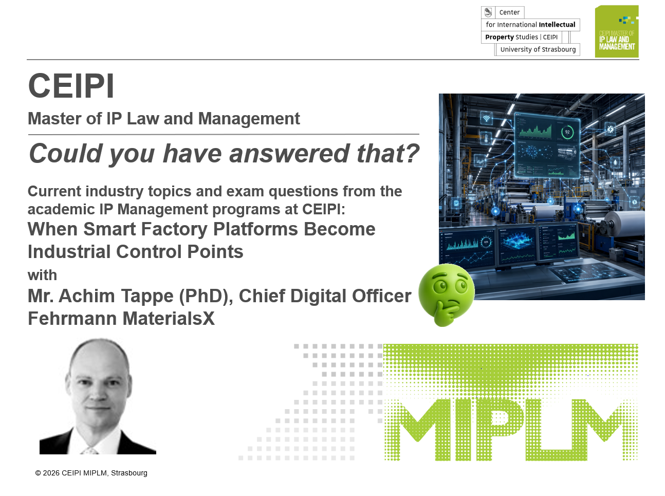
Industrial IoT is increasingly becoming a question of platform control. In many connected manufacturing systems, value is no longer created only by a machine, a sensor, a software function, or one protected technical feature. It is created by the way operational data, AI models, production know-how, interfaces, benchmarking logic, service workflows, and customer integration capabilities are combined into systems that help manufacturers improve performance at scale.
This creates a new strategic challenge for Industrial IoT companies. An AI-enabled production optimization platform may be highly valuable because it connects machine data, process parameters, quality-control information, and manufacturing expertise to reduce scrap, improve energy efficiency, and stabilize output quality. Yet the same openness that customers need for integration, trust, benchmarking, and operational use can also expose the data architecture, model outputs, API structures, process logic, and service layer that give the platform provider its strategic position.
This is exactly the type of shift described in the CEIPI IP Business Academy analysis “The IoT Strategy Gap”. The article argues that IoT is becoming one strategic control environment, where IP is moving from a narrow protection function into a decision system for control, collaboration, market access, risk management, and competitive positioning. It also shows that connected-product companies increasingly need to decide what to protect, what to disclose, what to keep secret, what to license, what to standardize, what to open to the ecosystem, and where technical architecture creates future bargaining power. (IP Business Academy)
Here you find the findings of this study:
“The IoT Strategy Gap: What Connected Product Companies Need, and What IP Advice Still Often Fails to Integrate”
Against this background, the CEIPI IP Business Academy integrates practice-based questions from industry into its teaching. These questions help students understand IP not only as a legal protection tool, but as a management instrument for strategic decision making in complex digital innovation systems. In Industrial IoT, this means looking beyond isolated patents or software rights and asking where the defensible control points of a connected business model actually lie.
We are therefore pleased to include this industry case study with Achim Tappe, PhD, Chief Digital Officer and AI strategist. His practical question focuses on a central issue for Industrial IoT platform providers: how to scale an AI-enabled production optimization system through customer adoption, integration, interoperability, and data access without losing control over the layers that create lasting business value. Here is Achim Tappe’s assessment of this case:
“This case is highly relevant right now because AI-enabled IIoT platforms are a key ingredient of scalable industrial business models, where the decisive question is no longer the AI algorithm alone but who controls the interfaces, data architecture, governance layer, and customer integration points. As agentic AI becomes embedded in production optimization, access to trusted industrial data and interoperable APIs across the industrial value chain will determine whether companies capture value themselves or become dependent on cloud providers, machine vendors, and external data spaces.”
Mini Case Study
A medium-sized industrial materials company has developed an AI-enabled Industrial IoT platform for production optimization. The system connects sensor data from production lines, machine parameters, quality-control data, and process knowledge to recommend adjustments that reduce scrap, improve energy efficiency, and stabilize output quality.
The first customer pilots are commercially promising. Several manufacturing customers report measurable performance gains and ask whether the platform can be integrated more deeply into their own production environments. At the same time, they request access to operational data, API documentation, model outputs, and benchmarking functions across sites.
The company now faces a strategic decision. Keeping the full system closed may protect its know-how, but it could slow adoption and make integration difficult. Opening interfaces and sharing selected data may accelerate scaling, but it could also make the company dependent on customer-controlled data spaces, machine vendors, cloud providers, or emerging industrial standards.
The question is no longer simply whether individual software features, sensor methods, or AI models can be protected. The business-critical issue is where control should sit in the future value chain: in the algorithms, the data architecture, the customer interface, the process knowledge, the benchmarking layer, the service model, or the trusted integration capability.
Practical Question
How should an Industrial IoT platform provider decide which parts of its AI-enabled production optimization system to protect, share, standardize, or license so that it can scale customer adoption without losing control over the value-creating layers of the business model?
Why This Question Matters in Practice
This question becomes relevant when an Industrial IoT solution moves from technical pilot to commercial scaling. At this point, the decisive challenge is no longer proving that the technology works, but defining which parts of the system create lasting bargaining power once customers, machine suppliers, cloud providers, and data-space infrastructures become involved.
It matters especially for industrial software companies, machine builders, materials companies, automation providers, and manufacturing technology scale-ups that want to turn internal AI capabilities into repeatable platform or SaaS offerings. The key roles affected are product strategy, R&D, digital business leadership, IP management, sales, partnerships, IT and OT security, and executive management.
The question becomes critical under three conditions. First, customer value depends on access to operational data that may not be fully controlled by the platform provider. Second, interoperability is necessary for adoption, which means that some interfaces, data formats, or standards cannot remain entirely closed. Third, the economic value lies in the combination of software, data, process expertise, trust, and service performance, not in one isolated patent or copyright position.
A weak IP strategy can lead to a commercially attractive but strategically fragile platform. Customers may benefit from the insights, competitors may imitate the service logic, and ecosystem partners may capture the data position. A strong IP management approach, by contrast, identifies the layers that must remain proprietary, the interfaces that should support adoption, the data rights that need contractual control, and the know-how that must be protected through architecture, trade secrets, and service design.
In Industrial IoT, IP is therefore not only a protection tool. It is a business architecture question: how to create openness where scaling requires it, and control where economic value depends on it.
Achim Tappe
 Achim Tappe, PhD, is a Chief Digital Officer and AI strategist based in the Greater Hamburg Area, with a strong track record in turning AI, data science, and digital strategy into measurable business value. As Chief Digital Officer at FEHRMANN MaterialsX, he has built and led a 10 plus person AI software engineering team, shaped AI product strategy for industrial digital transformation, and advised industry customers and executive stakeholders on digital ROI, agentic AI deployment, and data strategy. He also serves as Associated Senior Partner AI and Strategy at ECODYNAMICS GmbH and represents the Artificial Intelligence Center Hamburg as an AI Ambassador, supporting responsible AI adoption, innovation frameworks, and ecosystem development.
Before moving into industrial AI leadership, Achim Tappe built an international career in data science, astrophysics, and applied analytics. He held senior data science and strategy roles at Aurubis AG, Akka Technologies, Blue Yonder, WordStream, the SETI Institute, and the Universities Space Research Association, and previously worked as a research scientist at the Center for Astrophysics, Harvard and Smithsonian, and as a research associate at NASA Jet Propulsion Laboratory. His academic background includes postdoctoral research at Harvard University and Caltech, a PhD in Radio and Space Science and Astrophysics from Chalmers University of Technology, and a Diplom in Chemistry with a specialization in Physical Chemistry from Technische Universität Clausthal. He has published more than 30 scientific research articles and conference contributions.