
Two Ways to Frame MedTech IP: Kilburn & Strode and Acapo Onsagers on Digital Healthcare

MedTech used to be a comparatively easy word to understand. A medical device had a physical form. It could be inspected, described in mechanical, electrical or material terms, compared with prior art, patented, challenged, cleared for launch and monitored in the market. That world has not disappeared, but it is no longer sufficient to describe what is happening in MedTech today.
Many of the most strategically relevant MedTech innovations now sit at the intersection of devices, sensors, software, artificial intelligence, clinical workflows, connectivity, data flows, cybersecurity, regulatory evidence and user interfaces. A product may still look like a device, but the competitive control point may sit somewhere else: in the algorithm, the data architecture, the training process, the interface, the communication protocol, the diagnostic workflow or the way the system interacts with the patient, clinician or hospital environment.
That creates a communication challenge for IP practice groups. It is no longer enough to say that a firm advises on medical device patents. The more important question is which part of the new MedTech system the IP strategy needs to make visible, protectable and commercially meaningful. This is where the public communication of IP practice groups becomes interesting.
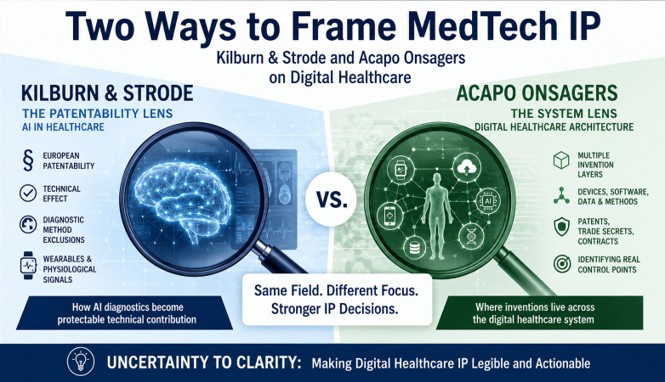
Kilburn & Strode and Acapo Onsagers both address the shift from traditional MedTech to digital healthcare. But they do so through different communication logics. Kilburn & Strode makes the field legible through a strong AI-in-healthcare and patentability lens. Acapo Onsagers makes the field legible through a system-architecture lens, showing how digital healthcare inventions can appear across devices, software, data transfer, methods, manufacturing, AI and trade secrets.
This is not a ranking of which firm has the stronger practice. Public communication cannot establish that. It is instead an examination of how two IP practice groups make the same emerging field understandable, relevant and commercially meaningful for potential clients. The most interesting MedTech IP communication today does not merely describe legal services. It explains where uncertainty arises inside digital healthcare systems and how IP expertise can help companies turn that uncertainty into decisions.
The shared field: MedTech is becoming digital healthcare
Both firms start from the same structural reality: MedTech is no longer only about the physical product. Kilburn & Strode’s healthcare technology communication frames the field broadly by connecting medical devices with imaging, diagnostic tools, bioinformatics, digital health, IoT, mobile applications, AI in healthcare, implants, prostheses, wearable technologies and sensors. The public message is clear: healthcare technology is not a narrow device category. It is a broad technical and commercial field in which digital layers increasingly shape the value of the product.
Acapo Onsagers approaches the same shift through a different route. Its communication on digital healthcare inventions describes the field as the point where MedTech meets digital technology. The examples include wearable or implantable smart medical devices, digital pills, telemedicine, bioinformatics, genomics and robotic surgical or diagnostic devices. That framing matters because it makes one thing visible: digital healthcare products are rarely single-invention products. They may include software features, operate across connected devices, rely on data transfer, cloud infrastructure, cybersecurity, AI models, user interfaces and clinical workflows, and contain several different invention layers at the same time.
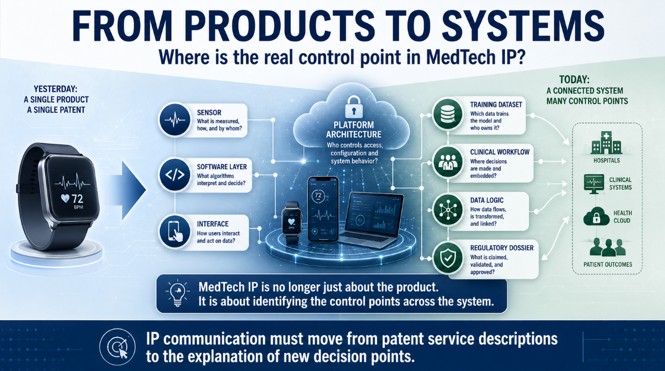
The common insight is important. MedTech IP is becoming a translation problem. Companies do not only need to know whether something can be patented. They need to understand where the protectable contribution sits in a distributed digital healthcare system. That is also the central conclusion of the IP Market Study MedTech 2026: the European MedTech IP market does not primarily suffer from a lack of patent expertise. The gap lies between what connected healthcare companies need and what IP experts visibly communicate.
Companies experience IP questions as business questions. They need to understand whether the relevant control point sits in the sensor, the software layer, the training dataset, the clinical workflow integration, the interface, the regulatory dossier, the platform architecture or the data logic. The key insight is therefore that both firms communicate from the same market shift. MedTech is moving from products to systems, and IP communication must move from patent service descriptions to the explanation of new decision points.
Kilburn & Strode: making AI in healthcare patentable
Kilburn & Strode’s communication is particularly strong where digital healthcare meets AI, software and European patentability. The firm does not only present healthcare technology as a broad sector. It also uses thought leadership to make specific legal uncertainty understandable. This is especially visible in the way Kilburn & Strode discusses AI diagnostics and digital healthcare.
The communication takes a difficult issue and makes it accessible: how can AI-related diagnostic inventions be protected in Europe when computer programs, mathematical methods and diagnostic methods face particular exclusions under the European patent framework? This is a good example of IP communication because it does not remain at the level of a trend statement. It does not simply say that AI is important in healthcare. It explains where the legal uncertainty appears.
The communication moves from AI and machine learning to technical effect, then to diagnostic-method exclusions, and then to concrete examples of digital healthcare technologies such as wearable monitoring systems and the processing of physiological signals. That matters because the legal problem is not abstract. A digital healthcare company may have a highly valuable AI-enabled diagnostic tool, but still face uncertainty about whether the invention can be claimed in a way that avoids exclusion. The commercial value may lie in the processing logic, the model implementation, the signal analysis or the interaction between hardware and software.
The IP question therefore becomes more precise. How can the invention be framed as a technical contribution? How can claims be drafted so that the innovation is not reduced to an excluded mathematical method, computer program or diagnostic method? How can the application reflect the real technical value of the product? From a business-development perspective, this is powerful communication because it speaks to a very specific client anxiety. Many AI healthcare companies do not merely ask whether they can get a patent. They ask how they can describe their AI-enabled medical innovation so that it is understood as technical, protectable and commercially relevant.
The implicit message of the Kilburn & Strode communication can be read as follows: the firm helps AI and digital healthcare innovators navigate the patentability boundary in Europe and turn difficult eligibility questions into commercially useful protection strategies. The key insight is that Kilburn & Strode makes MedTech IP legible by starting with patentability uncertainty. Its communication helps the market understand how AI-enabled healthcare inventions can cross the boundary from digital complexity into protectable technical contribution.
Acapo Onsagers: making digital healthcare visible as a system
Acapo Onsagers uses a different communication strategy. Its communication on digital healthcare inventions does not begin primarily with AI patentability as the central issue. It begins with the complexity of the product system. That is an important difference. The starting point is not only whether a software or AI invention can be patented. The starting point is where the inventions are located inside the digital healthcare system.
This system view is especially helpful because connected healthcare products often contain several protectable layers. A smart medical device may include a physical sensor, a wireless interface, a smartphone connection, a software application, a data-processing method, a cybersecurity solution, a diagnostic workflow, a user interface, a manufacturing feature and possibly an AI or machine-learning element. Each of these layers may raise a different IP question. Some may be suitable for patent protection. Some may require careful claim framing. Some may be better protected as trade secrets. Some may need contractual control. Some may create freedom-to-operate issues. Some may only become commercially important when the product scales across healthcare environments.
This is why Acapo Onsagers’ communication is valuable. It does not present digital healthcare as one patent category. It decomposes the product into invention layers. That helps innovators avoid a common strategic mistake: protecting only the visible device while missing the commercially decisive digital control points. A founder may think the invention is the device. An engineer may think the invention is the software. An investor may focus on the data. A clinician may care about workflow integration. A regulator may look at safety, performance and evidence. An IP adviser needs to help translate all of this into a protection architecture.
Acapo Onsagers’ communication therefore speaks to a different client anxiety. The anxiety is not only whether an AI diagnostic invention can be patented. It is whether the company has even correctly identified what its inventions are. The implicit message can be read as follows: the firm helps digital healthcare innovators identify where inventions are located across the system and frame them in a way that avoids unnecessary patent restrictions.
The key insight is that Acapo Onsagers makes MedTech IP legible by starting with system architecture. Its communication helps the market see that digital healthcare inventions are distributed across devices, software, data flows, methods, AI and secrecy decisions.
The connecting element
The connecting element between the two firms is the same market shift. MedTech is becoming system-based. A connected medical product is no longer just a device. It may be a device plus software, a sensor plus cloud analytics, a wearable plus smartphone, a diagnostic signal plus AI processing, a clinical workflow plus data transfer, a regulated product plus cybersecurity obligations, or a hardware platform plus algorithmic service layer.
This shift creates new IP decision points. Should the invention be claimed as a device, as a system, as a computer-implemented method, as a method of processing data, as a manufacturing method, as a user interface, as a diagnostic tool or as a technical implementation of AI? Or should certain elements not be patented at all, but instead kept secret, protected contractually or managed through governance and access control?
The IP Expertise Demand Index 2026 is built around precisely this type of question. It does not treat emerging technologies as broad buzzwords. It decomposes them into concrete expertise markets, including MedTech and Digital Health fields such as AI-based diagnostics, connected and surgical devices, digital health data platforms, implants and 3D printing. That is why both communication approaches are relevant. Kilburn & Strode shows how one demand field becomes visible through patentability analysis in AI diagnostics and digital healthcare. Acapo Onsagers shows how another demand field becomes visible through system mapping in connected digital healthcare products.
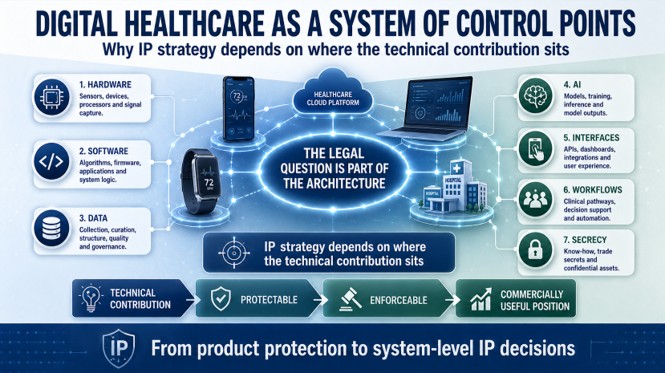
Both approaches help potential clients understand that the legal question is not separate from the technology architecture. The IP strategy depends on where the technical contribution sits and how it can be translated into a protectable, enforceable and commercially useful position. The key insight is that the connecting element is not simply MedTech. It is the emergence of digital healthcare as a system of control points, where IP decisions must be made across hardware, software, data, AI, interfaces, workflows and secrecy.
The difference
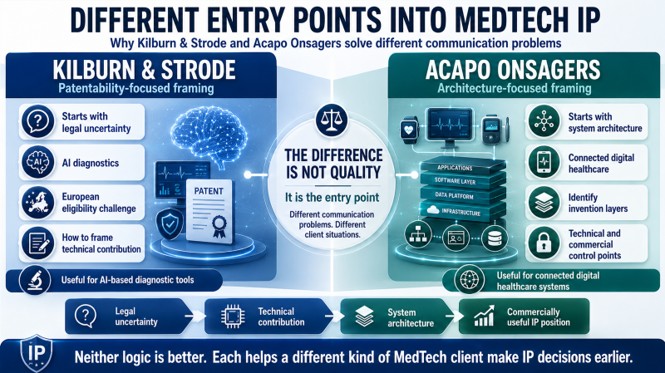
The central difference can be expressed clearly: Kilburn & Strode uses an AI-in-healthcare patentability framing. Acapo Onsagers uses a digital-healthcare system-architecture framing. Kilburn & Strode’s communication is strongest where it takes a difficult European patentability issue and makes it understandable through AI diagnostics and digital healthcare examples. It shows how legal exclusions can be navigated if the invention is tied to technical effect, technical purpose and the correct claim framing.
Acapo Onsagers’ communication is strongest where it decomposes the digital healthcare product into multiple invention layers. It helps the reader see that a smart medical product may contain many different protectable contributions, each requiring a different filing, secrecy, contractual or strategic decision. One starts with the boundary of patent law. The other starts with the architecture of the product. One asks how AI diagnostics can be framed so they are patentable in Europe. The other asks where the inventions inside a distributed digital healthcare system are located and how they should be framed.
Neither logic is better. They solve different communication problems. For companies developing AI-based diagnostic tools, Kilburn & Strode’s patentability-focused framing may be especially useful because it clarifies the European eligibility challenge. For companies building connected digital healthcare systems, Acapo Onsagers’ architecture-focused framing may be especially useful because it helps them identify invention layers they might otherwise overlook.
The key insight is that the difference is not quality, but entry point. Kilburn & Strode begins with legal uncertainty around AI and patentability. Acapo Onsagers begins with the technical and commercial architecture of the digital healthcare system.
What IP practice groups can learn from this
The first lesson is that a technology label is not a positioning strategy. “MedTech” is too broad. “Digital health” is still too broad. Even “AI in healthcare” can remain vague if it is not translated into specific IP questions. The value of communication begins when the practice group shows which uncertainty it helps the market understand.
The second lesson is that technical specificity creates trust. Kilburn & Strode’s discussion of AI diagnostics, European patentability and digital healthcare examples gives the reader a concrete sense of the legal and technical problem. Acapo Onsagers’ system-based examples give the reader a concrete map of where inventions may sit inside a digital healthcare product.
The third lesson is that good IP communication should reveal decision points. The relevant client question is not merely whether an invention can be protected. It is what exactly the invention is, where it sits in the system, which part creates value, which part can be claimed, which part should remain confidential and which part creates freedom-to-operate or regulatory exposure.
The fourth lesson is that practice group communication becomes more powerful when it moves from capability statements to market interpretation. A capability statement says that a firm advises clients in a sector. A positioning statement says how the sector is changing and which IP decisions companies will need to make. That is the difference between being visible as an adviser and being recognizable as a subject-matter expert.
The key insight is that strong practice group communication does not only say what the firm can do. It gives the market a language for understanding a problem before the client has fully formulated the legal question.
Why this matters for IP business development
Emerging MedTech fields create a timing problem. Companies often need IP advice before they know how to formulate the legal question. A founder may not ask for advice on technical effect under European patent law. A product team may not ask about claim categories for distributed systems. A digital health company may not immediately ask whether training phases should be patented or protected as trade secrets. They first experience uncertainty.
That uncertainty can take many forms. Can we protect this? Is the algorithm the invention? Is the data the asset? Is the device still the control point? Does the clinical workflow matter? Will regulatory disclosure undermine secrecy? Can the software layer support a patent position? How do we avoid filing too narrowly around the visible device while missing the commercially valuable digital layer?
The practice group that gives language to that uncertainty becomes relevant earlier. That is why communication is not only marketing. In emerging fields, communication is part of market formation. It helps potential clients recognize the problem before they are ready to instruct on the solution.
The IP Market Study MedTech 2026 makes this point directly. It identifies AI-enabled medical devices, Software as a Medical Device, connected MedTech and diagnostics as key growth areas. It also emphasizes that AI MedTech advice increasingly starts with protection architecture rather than only with the patent application.
That is the business-development opportunity. The question is not only whether a firm has MedTech expertise. The more strategic question is which MedTech uncertainty the firm helps the market understand. The key insight is that in emerging MedTech fields, business development starts before the mandate. The practice group that structures uncertainty becomes visible before the client knows exactly which IP service to request.