
Upcoming OFB Fireside Chat: The Use of AI for IP Issues

From industry signals to focused conversations
Corporate IP management is changing under pressure from several directions at once. Technological acceleration, increasing information volumes, tighter resources, and rising expectations from business functions are reshaping what IP teams are expected to deliver inside organizations.
Within the Open Foresight Board, we work with industry IP professionals to identify which topics are becoming practically relevant for corporate IP management. The objective is not to discuss trends in the abstract, but to understand where companies are already experiencing friction, uncertainty, and the need for new approaches.
Why AI has become a cross-industry IP management topic
One of the topics that stands out across industries is the use of AI for IP issues. This is no longer a distant future topic or a purely technological discussion, but an operational question for IP departments, patent teams, service providers, and the business functions that depend on IP-related decisions. Recent Open Foresight Board trend work has shown that AI is increasingly seen as part of everyday IP practice. Applications such as prior-art search, patent analysis, classification, drafting support, and workflow acceleration are already being explored, tested, or implemented in many organizations.
Beyond efficiency: the real question for IP teams
Much of the current discussion around AI in IP focuses on productivity. Can AI draft faster, summarize faster, search faster, or reduce manual workload in repetitive tasks?
These questions matter, but they are not enough. The deeper issue is whether AI can help IP management solve structural problems that have grown beyond the capacity of existing processes and human resources. Patent information is a good example. IP teams operate in an environment where patent publications, search results, monitoring hits, office actions, prior-art documents, invention disclosures, portfolio data, and competitor filings continue to increase in volume and complexity. In many organizations, relevant information is available, but it is not usable at the point where decisions need to be made. The problem is not only access to information, but the ability to process, interpret, prioritize, and translate it into action.
The patent information flood
The growing flood of patent information affects several core areas of IP management. Monitoring, FTO analysis, competitive intelligence, portfolio review, invention evaluation, and strategic IP communication all depend on the ability to make sense of large volumes of technical, legal, and commercial information. In practice, many monitoring processes exist formally, but do not always create the intended value. Search results may be collected, filtered, and forwarded to technical departments, but the recipients often lack the patent-specific expertise needed to assess relevance, infringement risk, or strategic intelligence. This creates a gap between the existence of an IP process and its actual business impact. AI can potentially help close that gap, but only if it is applied to the right problem in the right way.
Why tools alone are not enough
A central question for the upcoming OFB Fireside Chat will therefore be how AI should be integrated into IP management workflows. Buying a tool, launching a pilot, or adding AI to an existing process does not automatically create meaningful transformation. The real value of AI depends on process design, domain expertise, and a clear understanding of what the system is supposed to do at each step. In IP management, this is particularly important because many tasks depend on implicit expert knowledge, including legal criteria, technical interpretation, procedural rules, and commercial judgment. AI can read, summarize, compare, classify, and structure large volumes of text. But the legal and strategic meaning of the output still depends on the criteria applied, the context provided, and the human expertise involved in reviewing and using the result.
Human judgment in AI-enabled IP workflows
Another important question is not whether humans should remain involved, but where human judgment is actually required. Treating every AI output as equally risky is inefficient, but treating AI-supported outputs as final conclusions is irresponsible. Different tasks require different levels of human involvement. Extraction, structuring, pre-screening, recommendation, and final decision-making are not the same thing, and they should not be governed by the same review logic. This distinction is especially important in IP because the consequences of weak decisions may appear only years later. A missed FTO issue, an incorrect claim scope assessment, or a low-quality patent application may only become visible when a product is launched, a patent is enforced, a portfolio is valued, or a dispute arises.
From prompt engineering to workflow design
The discussion also needs to move beyond prompt engineering. Individual prompts can produce useful individual outputs, but they rarely create systematic improvements in quality, consistency, or decision support. Sustainable value comes from well-designed workflows in which AI operates within defined parameters. This requires explicit process knowledge, clear review points, defined responsibilities, and an understanding of where uncertainty remains. For IP management, this means making expert knowledge operational. The criteria used to assess a monitoring hit, the logic behind an FTO pre-screening, the structure of an invention disclosure, or the decision rules in prosecution workflows need to be made explicit enough for AI-supported systems to work reliably.
AI and the service role of IP management
The use of AI also raises a broader organizational question. What is the role of IP management inside the company, and who are the users of the IP system?
Inventors, engineers, product managers, commercial teams, executives, and marketing functions often experience IP as a source of procedures, documents, risks, and administrative burden. AI creates an opportunity to redesign IP services around the needs of these users. Monitoring results could become actionable questions rather than document collections. Invention capture could become a guided conversation rather than a static form. Patent content could be translated into language that sales, marketing, management, and HR teams can actually use.
The topic of the upcoming Fireside Chat
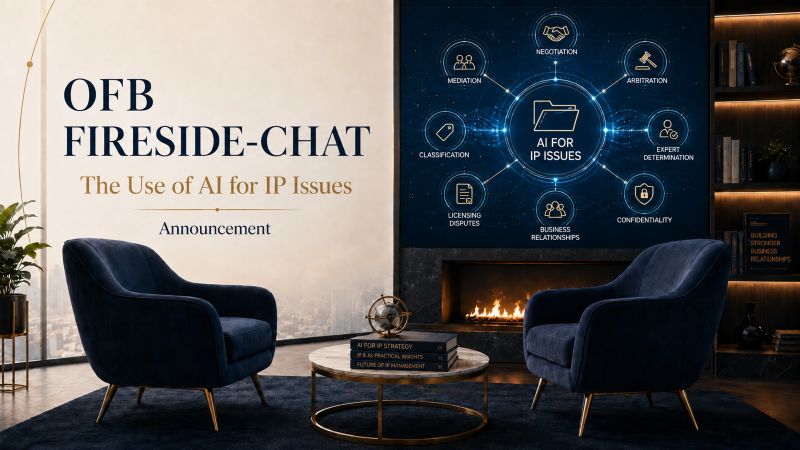
This is why we are preparing an upcoming OFB Fireside Chat on the use of AI for IP issues. The conversation will focus on the practical implications of AI for IP management, with particular attention to where AI can create real value, where risks remain, and what organizations need to change in order to use AI responsibly. The aim is not to produce another general discussion about AI. The aim is to create a structured exchange around the questions that industry IP professionals are already facing in practice.
A demand-led conversation
OFB Fireside Chats are designed as demand-led conversations. They start from topics that emerge through industry interaction, not from a predefined presentation agenda. For the topic of AI in IP management, this distinction is important. The relevant question is not simply what AI technology can do, but what IP organizations need from AI in order to support better decisions, better services, and better value creation.
Further reading and contact
For readers who would like to explore the topic in more depth, the related dIPlex Deep Dive AI in Operational IP Management provides a structured perspective on how AI changes IP workflows, decision support, responsibilities and the organization of IP work:
👉 https://profwurzer.com/diplex/docs/ip-and-organization/ai-in-operational-ip-management/
The Deep Dive complements the upcoming OFB Fireside Chat by looking beyond individual AI tools and focusing on the organizational conditions required to use AI responsibly and effectively in IP management.
For questions regarding the Open Foresight Board or the upcoming OFB Fireside Chat, please contact:
Theo Grünewald
Secretary of the CEIPI IP Business Academy’s Open Foresight Board
theo.gruenewald@ipbaportal.com
More details on the upcoming OFB Fireside Chat will follow soon.