
Two Ways to Make Quantum IP Legible: Market Translation at Mewburn Ellis and Patent-Practice Evidence at Venner Shipley

Quantum technology presents a special communication challenge for IP practice groups. It is scientifically demanding, commercially promising and still marked by uncertainty about which architectures, applications and business models will become dominant. The field includes quantum computing, sensing, communication, cryptography, metrology, software, algorithms, materials, error correction, control systems and enabling infrastructure. That already makes it difficult to describe as a single “sector”.
For IP advisers, the communication challenge is even harder. The relevant questions do not arise only in patent drafting or prosecution. They appear at the interfaces between patents, software, data, trade secrets, freedom to operate, licensing, litigation, standards, regulation, public funding and research collaboration. A quantum company may need to decide whether to patent an invention now, keep know-how confidential, disclose selectively to investors, share technology in a consortium, or build a portfolio narrative that supports long-term valuation. The Quantum IP Gap analysis by IP Business Academy describes this as a mismatch between what quantum companies need and what much of the public-facing IP market still communicates.
This is why conventional sector language is no longer enough. A statement such as “we advise clients on patents in quantum technologies” may be factually correct, but it does not yet show which uncertainty the practice group helps the market understand. Good communication in this field must do more. It must make technological complexity legible, show where IP decisions arise, and explain how legal instruments connect to business timing, investment readiness, collaboration risk and future control points.
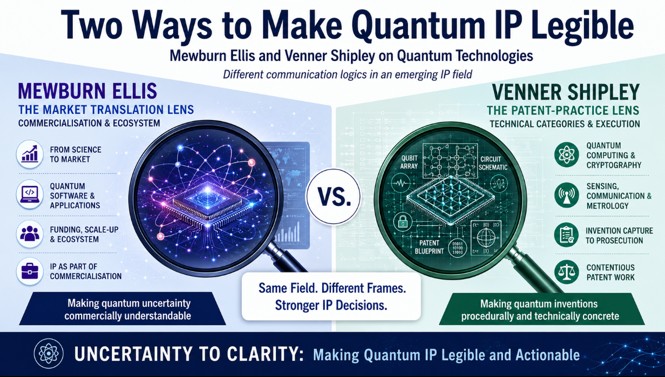
This is not a ranking of which firm has the stronger practice. Public communication cannot establish that. It is instead an examination of how two IP practice groups make the same emerging field understandable, relevant and commercially meaningful for potential clients.
Quantum is difficult to communicate because the IP problem is not one legal question. It is a moving decision environment in which technology, business models, collaboration structures and protection choices develop at the same time.
The Common Field
Mewburn Ellis and Venner Shipley are both useful examples because both have made quantum technology visible in their public communication. Both avoid treating the subject merely as a generic physics subfield. Both show, in different ways, that quantum IP is not only a matter of filing patent applications.
Mewburn Ellis presents quantum technology through a broad “Spotlight” format that combines technology explanation, reports, event activity, founder and ecosystem perspectives, and commentary on commercialisation. Its public materials explain the move from classical to quantum computing, discuss the likely role of quantum processor units as co-processors, and identify architectures and control software at the classical/QPU interface as fertile ground for future innovation and commercialisation.
Venner Shipley presents quantum technology through a dedicated sector page within electronics, software and communications. Its page defines quantum technologies, lists several technical subfields, refers to specialists with master’s degrees and doctorates in relevant areas, and states that the team handles invention capture, original drafting, patent prosecution and contentious matters such as oppositions.
Both approaches therefore signal IP Subject Matter Expert Positioning. They do not simply say: “We know patents.” They connect the sector label “quantum” with a more specific advisory proposition. Mewburn Ellis makes the field intelligible as a commercialising deep-tech ecosystem. Venner Shipley makes it concrete as a patent-practice field with technical breadth and procedural experience.
The commonality is not that both firms use the same quantum vocabulary. It is that both recognise quantum as a field where potential clients need orientation before a conventional mandate is fully formulated.
Mewburn Ellis: Positioning Quantum Through Market Translation
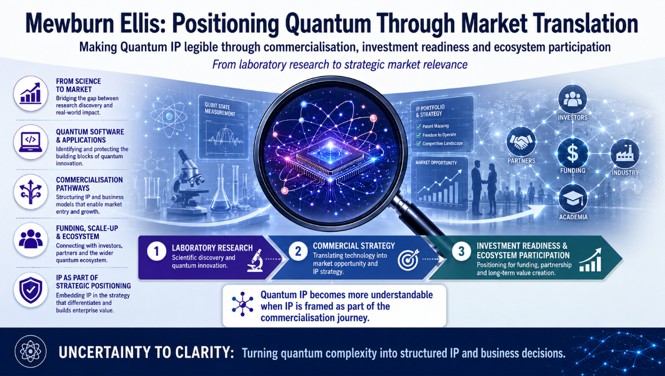
The public communication of Mewburn Ellis suggests an organising principle of market translation. The practice group does not begin only with the act of patenting. It begins with the question of how quantum technology moves from complex science into commercial, investable and protectable innovation.
This is visible in the structure of the “Spotlight on Quantum Technology” page. It starts by explaining what distinguishes quantum technology from earlier technologies that merely rely on macroscopic quantum effects. It then moves into the relationship between classical and quantum computing, the role of quantum processors, and the likely commercial importance of architectures and control software at the interface between classical computing and QPUs.
This sequence is important from a communication perspective. The reader is not immediately taken into a list of services. The reader is first helped to understand why the technology is difficult, why it matters, and where future innovation may arise. The public communication suggests that Mewburn Ellis wants to be seen not only as a patent adviser for quantum inventions, but as an interpreter of the field’s transition from science to market.
The same logic appears in the “Quantum and the law” special report announcement. The report is described as examining the potential of quantum technologies across several fields, while also highlighting the challenges of commercialising quantum physics and protecting innovations in a rapidly growing industry. The announcement refers to quantum computing, communication and sensing, to investment momentum, and to the difficulty of patenting these innovations in light of technological complexity.
Mewburn’s event communication reinforces this positioning. Its “Quantum Tech Scale-Up: Lessons from Founders, Funders & Experts” event brought together founders, investors and ecosystem actors, and the panel discussed themes such as “from lab to market”, funding and investment, government and ecosystem support, IP and competitive advantage, and lessons learned along the way. This is not merely a patent-law signal. It is a business-development signal: the firm positions itself in the conversation where technology, funding, ecosystem development and IP strategy meet.
The public communication also uses concrete market examples. The article on Phasecraft, for example, presents quantum software not as an abstract patent category, but as a commercial and technical timing problem: algorithms are being developed for imperfect quantum computers while fault-tolerant machines are still emerging. The article discusses near-term devices, noise, quantum resources and the effort to find useful applications before mature hardware is available. Similarly, the article on quantum navigation connects quantum inertial sensors to GPS vulnerability, autonomous vessels, maritime navigation and commercial deployment.
From a business-development perspective, this communication likely speaks strongly to founders, investors, research organisations, university spin-outs, deep-tech scale-ups and corporate innovation teams that are still translating technological potential into business options. The implicit message can be read as: “We understand the commercialisation journey of quantum technology, and we can help connect IP decisions to that journey.”
This does not mean that Mewburn Ellis lacks technical or patent-practice depth. That would be an inappropriate conclusion from public communication alone. The point is narrower and more useful: its public positioning appears to lead with ecosystem understanding, commercialisation logic and explanatory thought leadership. Technical
Mewburn Ellis makes quantum IP legible by placing IP inside the broader movement from laboratory research to commercial strategy, investment readiness and ecosystem participation.
Venner Shipley: Positioning Quantum Through Patent-Practice Evidence
Venner Shipley uses a different communication logic. Its quantum page begins by defining quantum technologies and explaining that the next wave exploits atomic-scale phenomena such as superposition, entanglement and correlation. It then moves quickly to practice evidence: the firm states that in 2001 it was one of the first Europe-based firms to draft and file a European patent application mentioning “qubit”, and that its team includes specialists with advanced degrees in condensed matter physics, quantum physics and quantum computing.
The positioning appears to be built around demonstrable patent-practice credibility. Venner Shipley also states that EPO data show it has handled more than twice as many European patent applications relating to quantum computing as any other European firm. Because this is a claim made in the firm’s own public communication, it should be cited as such rather than treated here as an independently verified ranking. As a communication signal, however, it is powerful: the reader is invited to see quantum IP not only as a future advisory opportunity, but as a field in which the firm has already handled a substantial body of patent work.
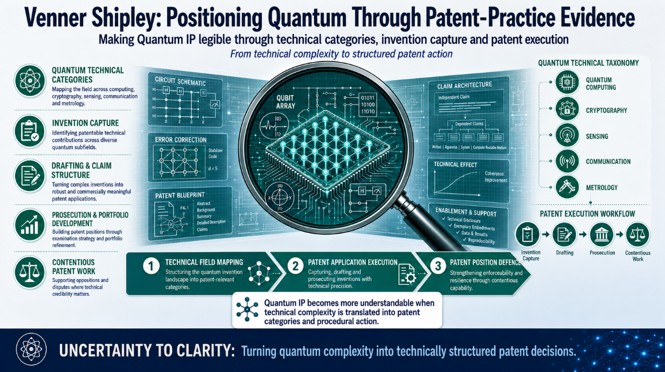
The page then lists technical areas: quantum computing, cryptography, sensing, communication, metrology, software and algorithms, materials and error correction. This list is not merely descriptive. It performs a positioning function. It tells the reader that quantum is not one homogeneous topic. It is a set of technical subfields that may generate different kinds of invention disclosures, claim strategies, FTO questions and prosecution challenges.
The final sentence of the sector page is also important: the team handles invention capture, original drafting, patent prosecution and contentious matters such as oppositions. The sequence moves the reader from technology to patent lifecycle. The implicit problem is not primarily: “How do we understand the quantum market?” It is: “How do we capture, draft, prosecute and defend quantum-related inventions in a technically credible way?”
Venner Shipley’s article “Quantum technologies for the Quantum 2.0 era” extends this communication logic. It begins with mainstream attention around quantum computing, then clarifies that quantum technologies include communication, cryptography, sensing, timing and imaging. It places the field in the context of UK public funding and EPO patent insight reports, then examines patent application trends in quantum communication and quantum computing.
This is a different route into business relevance. The reader is not first taken through founder narratives or commercialisation events. The reader is taken through technical definition, patent data, filing history and application growth. That approach likely resonates with in-house patent teams, R&D-intensive companies, universities, research organisations and spin-outs that already have inventions or disclosures and need confidence that the adviser can translate them into robust patent positions.
The implicit message can be read as: “We have practical experience in turning quantum inventions into patent assets across the relevant technical subfields and procedural stages.” Again, this is not a quality judgment. It is a communication analysis. Venner Shipley’s public framing appears to make quantum IP legible through patent-practice evidence, technical categorisation and lifecycle capability.
Venner Shipley makes quantum IP legible by translating the field into patent-relevant technical categories and by foregrounding evidence of experience in invention capture, drafting, prosecution and contentious patent work.
The Connecting Element
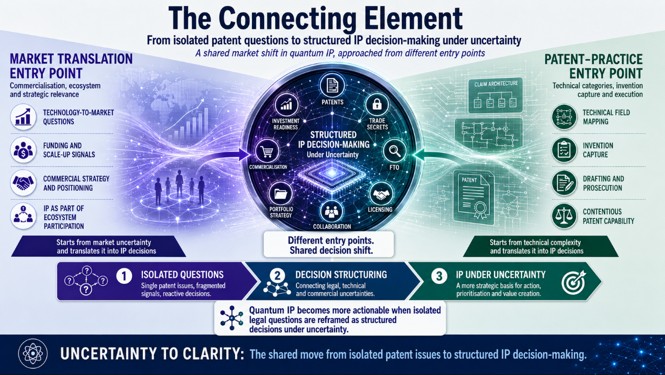
The connecting element between both firms is a larger market shift. Quantum technology can no longer be treated as a single technology label or a narrow patent category. It is becoming an interdependent innovation environment in which value may sit in hardware architectures, software layers, error correction methods, control systems, calibration routines, sensing applications, cryptographic protocols, data interpretation, manufacturing know-how, collaboration structures and ecosystem access.
The dIPlex analysis on Quantum Technology & IP Decision-Making describes this as a structural lag in IP decision-making. Quantum is widely recognised as transformative, but many organisations have not yet translated that recognition into structured IP strategy. Companies already active in the field face a different reality: for them, quantum is an immediate decision environment involving protection, commercialisation, ecosystem positioning and long-term value capture.
👉 Quantum Technology & IP Decision-Making | dIPlex
This is why both communication strategies matter. Mewburn Ellis addresses the uncertainty of market formation and commercialisation. Venner Shipley addresses the uncertainty of patent capture, classification and procedural execution. Both respond to the same underlying change: quantum companies need IP advice earlier, more strategically and with a clearer connection to business decisions.
The modern IP practice group is therefore not only communicating legal services. It is helping potential clients construct decision anchors in a field where markets, applications and technical trajectories have not fully stabilised. The dIPlex analysis describes this as a need for frameworks that allow action under uncertainty, especially where IP decisions must be made before stable external signals exist.
The shared market shift is the move from isolated patent questions to structured IP decision-making under uncertainty. Both firms address that shift, but from different entry points.
The Difference
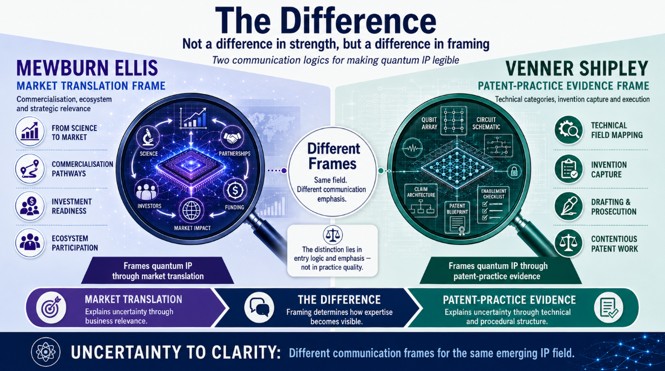
The central difference can be described as market translation vs patent-practice evidence.
Mewburn Ellis appears to lead the reader from technology and ecosystem uncertainty toward IP and commercialisation. Its communication helps the market understand why quantum matters, where applications may emerge, how commercialisation challenges arise and why IP must be connected to business development. The public materials create relevance by explaining the field.
Venner Shipley appears to lead the reader from technical classification and patent-practice experience toward confidence in execution. Its communication helps the market understand that quantum inventions can be mapped across subfields and handled through invention capture, drafting, prosecution and contentious patent work. The public materials create relevance by evidencing the practice.
Neither approach excludes the other. Mewburn Ellis also communicates technical expertise and patent strategy. Venner Shipley also explains the technology and market context. The difference lies in emphasis, sequence and editorial centre of gravity. Mewburn Ellis makes uncertainty commercially understandable. Venner Shipley makes patent practice in the field visibly concrete.
The difference is not one of strength, but one of framing. Mewburn Ellis emphasises market translation; Venner Shipley emphasises patent-practice evidence.
What IP Practice Groups Can Learn from This
The first lesson is that a technology label is not a positioning strategy. “Quantum” is too broad to create differentiation by itself. A practice group needs an organising lens. It may be market translation, patent data, protection architecture, FTO, collaboration governance, licensing, standards, post-quantum security, trade secrets or litigation readiness. Without such a lens, communication remains generic.
The second lesson is that technical specificity is a trust signal. Venner Shipley’s naming of quantum computing, cryptography, sensing, communication, metrology, software, algorithms, materials and error correction helps potential clients recognise the field’s internal structure. Mewburn Ellis’s discussion of QPUs, classical/quantum interfaces, quantum navigation and quantum software performs a similar function in a different format. In both cases, specificity turns expertise into something visible.
The third lesson is that good communication translates uncertainty into decisions. The relevant question is not simply whether an adviser “knows quantum”. It is whether the adviser helps clients understand what to do with uncertainty: when to file, what to keep secret, how to handle collaboration, how to build investable portfolios, how to manage software and algorithms, how to assess FTO, and how to align IP with commercialisation timelines.
The fourth lesson is that different target groups need different entry logics. A founder or investor may respond to ecosystem and commercialisation framing. An in-house patent team may respond to technical categories and procedural experience. A university spin-out may need both. The best practice-group communication does not try to say everything at once. It creates a recognisable path into the problem.
Visible expertise emerges when a practice group consistently shows not only what it knows, but how it interprets the market’s uncertainty.
Why This Matters for IP Business Development
Emerging technologies create a temporary window in which IP practice groups can help shape the language of the market. In mature fields, many clients already know which legal service they need. In quantum technology, many potential clients are still trying to understand the problem itself.
That matters for business development. A company may not begin by searching for a patent attorney. It may begin by asking whether an invention should be published, patented or kept confidential. It may ask whether investor-facing portfolio narratives create disclosure risk. It may ask how university background IP interacts with future foreground IP. It may ask how to protect value when the real control point sits in calibration, software, data interpretation or implementation know-how rather than a visible device.
The practice group that structures these questions becomes relevant earlier. It is not simply selling a service. It is creating orientation. That orientation becomes a business-development asset because it reduces the client’s cognitive burden before a mandate exists.
This changes the central question for practice-group marketing. The question is not: “Do we have expertise?” Many firms do. The more demanding question is: “Which uncertainty do we help the market understand?” Mewburn Ellis and Venner Shipley offer two credible answers. One answer is to translate the quantum ecosystem into commercial and IP decision points. The other is to evidence patent-practice capability across technical subfields and procedural stages.
IP Expertise Demand Index 2026
The two firms show, in their public communication, why quantum technology is becoming a structurally growing IP field. This is exactly the type of development addressed by the IP Expertise Demand Index 2026. The Index starts earlier than classical patent indicators. It asks where decision pressure is emerging, where users of the IP system need orientation, and where demand for IP expertise appears before the advisory market has fully organised its language and services.
For quantum technology, the demand signals are especially visible in fields such as quantum software and algorithms, QPU/classical interface architectures, quantum sensing and navigation, quantum communication and cryptography, post-quantum migration, error correction, hardware control systems, trade secret architecture, collaboration governance, FTO, licensing ecosystems and portfolio signalling under ambiguity.
The IP Expertise Demand Index 2026 treats IP expertise as part of Europe’s innovation infrastructure. Its message is that technological strength does not automatically become economic control. Research must be translated into assets, positions, partnerships, standards, licensing models, enforceable rights, data governance and scalable business models.
Seen in this light, the comparison between Mewburn Ellis and Venner Shipley is not only an analysis of good communication. It is a signal of a larger market movement. Quantum companies are not merely looking for someone who understands quantum physics. They need advisers who can translate technical uncertainty into structured IP decisions.
The strongest practice-group communication does not merely state that expertise exists. It shows how that expertise interprets uncertainty and turns it into a structured basis for business and IP decisions.
Sources used
Mewburn Ellis
- Spotlight on Quantum Technology
https://www.mewburn.com/spotlight-on-quantum-technology - Quantum and the law – a new special report
https://www.mewburn.com/forward/quantum-and-the-law-a-new-special-report - Quantum Tech Scale-Up: Lessons from Founders, Funders & Experts
https://www.mewburn.com/forward/quantum-tech-scale-up-lessons-from-founders-funders-experts - Phasecraft: the pioneer in quantum software
https://www.mewburn.com/forward/phasecraft-the-pioneer-in-quantum-software - Quantum Navigation: Revolutionising Maritime and Autonomous Vessel Technology
https://www.mewburn.com/forward/quantum-navigation-revolutionising-maritime-and-autonomous-vessel-technology
Venner Shipley
- Quantum technologies
https://www.vennershipley.com/sectors/electronics-software-and-communications/quantum-technologies/ - Quantum technologies for the Quantum 2.0 era
https://www.vennershipley.com/insights-events/quantum-technologies-for-the-quantum-2-0-era/
IP Business Academy / dIPlex
- The Quantum IP Gap in Germany: What Quantum Companies Need, and What the Public Market Still Fails to Address
https://ipbusinessacademy.org/the-quantum-ip-gap-in-germany-what-quantum-companies-need-and-what-the-public-market-still-fails-to-address - Quantum Technology & IP Decision-Making | dIPlex
https://profwurzer.com/diplex/docs/quantum-technology-and-the-structural-lag-of-ip-decision-making/ - IP Expertise Demand Index 2026
https://ipbusinessacademy.org/ip-expertise-demand-index-2026