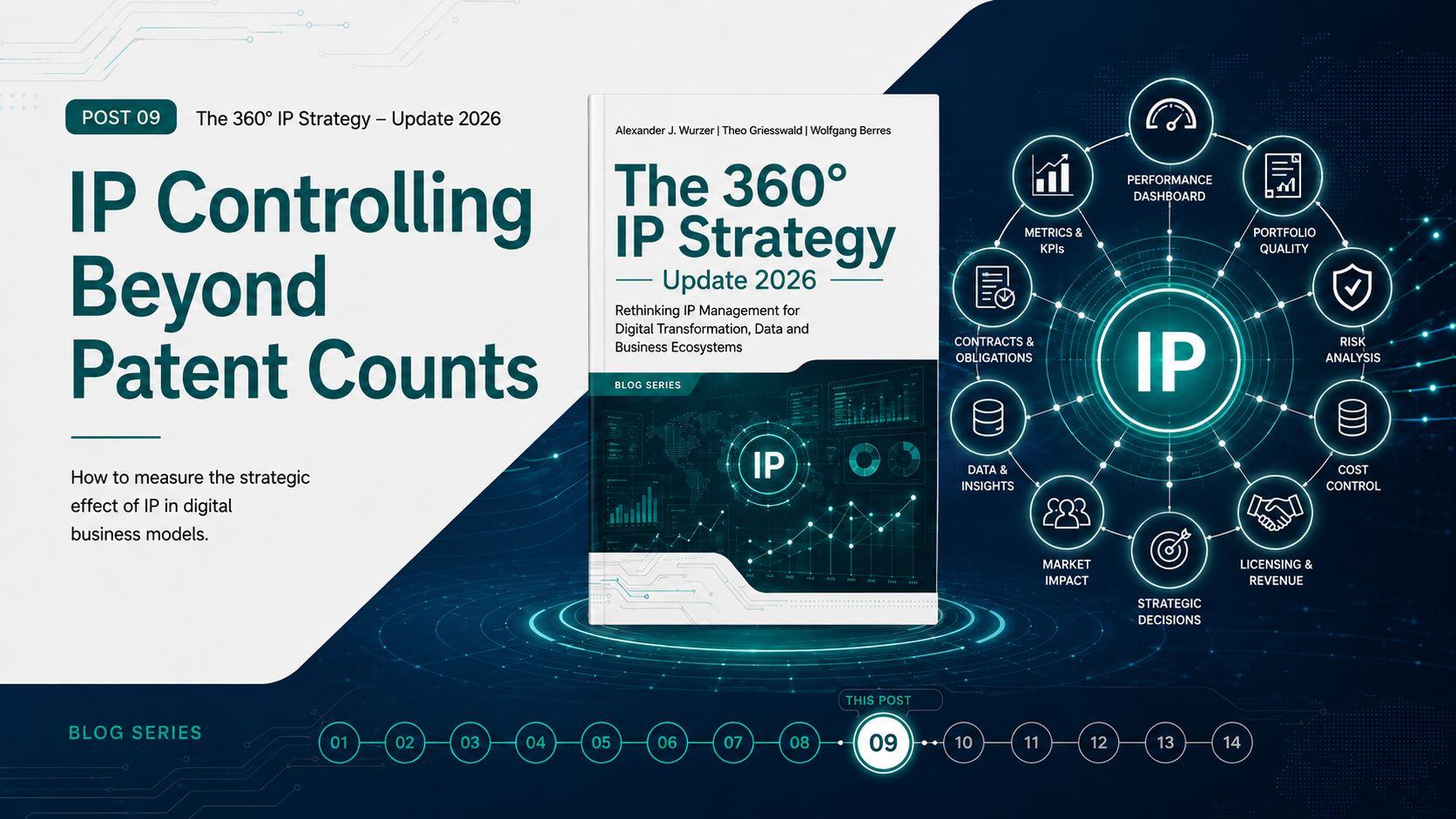
Transferring Engineering Know-how at Ford 🎯 IP Management Pulse #64


Subscribe for compact, in-depth IP intelligence: trends, cases, and research curated by the team of the IP Business Academy and the IPBA Connect Platform. Get practical playbooks for positioning, LinkedIn, and business development. Learn from leading experts in the context of business models and R&D. Join the IPBA Connect community and turn IP knowledge into results — with dIPlex, live formats, IPBA Connect, and white papers as your launchpad.
Here you can find the latest issues in the archive and also subscribe. A fresh read with all important IP Management content will be sent to the subscribers every second Thursday at 7:00 (CET), so that they can start the day informed.
The next newsletter will cover the following topics:
Transferring Engineering Know-how at Ford
A current example can be seen at Ford. The company hired, promoted or brought back around 350 experienced technical specialists to help improve vehicle quality. These veteran engineers mentor younger employees, lead design reviews and contribute to the development of AI-assisted and automated quality tools. Ford acknowledged that AI alone was insufficient because its results depend on the quality of the knowledge and data used to train it.
A Central IP Hub
A current example can be seen at Prosus. Together with DLA Piper and Von Seidels, the company created a central hub containing almost 50,000 IP records across more than 300 jurisdictions. Instead of requesting information from different providers, its IP team can combine the globally fragmented data in one dashboard and query it using natural language.
Three Years of the UPC
A current analysis by Bird & Bird shows that UPC proceedings are genuinely contested. Patent holders won 45% of the infringement actions assessed, while 64% of provisional-measures applications were granted. The firm also highlights that division selection can affect timing and that lack of urgency is the most common reason why provisional measures fail.
Miso Robotics Acquires Zume’s Patent Portfolio
A current example can be seen at Miso Robotics. After Zume Pizza ceased operations, Miso acquired its technology and more than 300 patents relating to robotic food preparation, delivery systems, sustainable solutions and packaging. Miso expects the portfolio to support new features, expansion into adjacent products and a stronger position through licensing and enforcement.
OFB Fireside Chat: Use of AI for IP Issues
AI is no longer an abstract future topic for IP management. Across industries, in-house IP teams are already asking a more practical question: how can AI help us deal with growing information volumes, support better decisions, and create measurable value for the business?
This is why we are preparing an upcoming Open Foresight Board Fireside Chat on the “Use of AI for IP Issues.” The topic emerged from our ongoing work with corporate IP professionals and from the signals identified in the Open Foresight Board Trend Radar. One message is becoming clear: the relevant question is no longer whether AI will be used in IP management, but where it can create real value beyond isolated efficiency gains.
What clients really expect from senior IP experts today

Senior IP experts are increasingly expected to offer more than technical knowledge, legal precision and analytical depth. Clients value advisors who provide orientation, sound judgment and narrative coherence when facing uncertain commercial decisions. This means identifying what matters, connecting IP issues to business consequences, and explaining recommendations clearly across management, investors, R&D and business units. Communication is therefore part of the expert’s value, not an afterthought. For senior partners, the positioning challenge is to make this strategic contribution visible externally. Expertise remains essential, but differentiation increasingly depends on showing how that expertise helps clients navigate uncertainty and make better decisions.
IP Decision Case: Predictive Quality Control in Adhesive and Coating Production
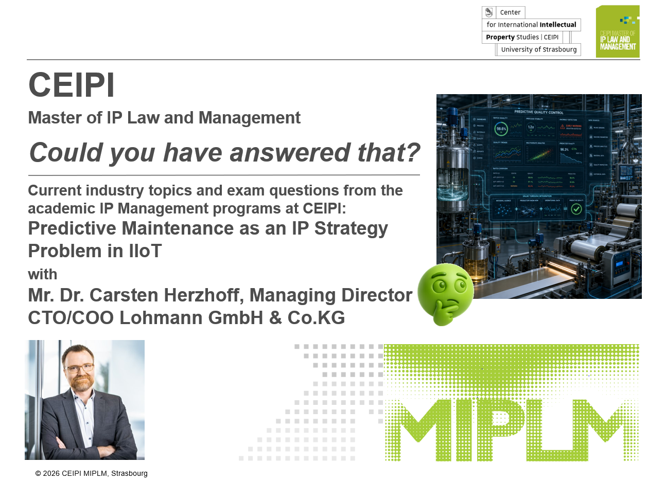
This IP decision case examines how manufacturers of adhesives, coatings and functional materials should protect predictive quality-control systems built on Industrial IoT. Their value lies not in one sensor or algorithm, but in combining chemistry, machine data, process parameters, operator knowledge and analytics. Management must choose between patents, trade secrets and contractual controls, or adopt a hybrid approach. The case highlights risks around disclosure, supplier access, cloud platforms, data governance and tacit knowledge loss. Its central lesson is that competitive advantage depends on controlling the architecture of industrial learning while keeping systems scalable, robust and operationally useful across production sites.
Models for AI robotics adoption
 This podcast episode examines how innovative SMEs adopt AI robotics through “make, buy or ally” strategies. Drawing on research covering more than 15,000 UK firms, it argues that internal R&D alone rarely drives adoption. Instead, external R&D acquisition, licensing and structured collaboration provide the strongest acceleration, while internal capabilities remain essential for evaluating and integrating outside technologies. Successful implementation also depends on operational and managerial skills, not only STEM expertise. For IP managers, the implication is clear: adoption requires coordinated licensing, freedom-to-operate analysis, ownership rules, background and foreground IP management, contractual safeguards, trade-secret protection and governance of knowledge spillovers across ecosystems.
Project Cypress and the New IP Logic of Green Technology Funding
Project Cypress shows that green technology funding and IP strategy must be designed together. Public support helps carbon-removal technologies cross the gap from research to industrial scale, while patents, trade secrets, data, contracts and operational know-how preserve value. Integrated planning enables startups to attract investment, manage disclosure and build their business.