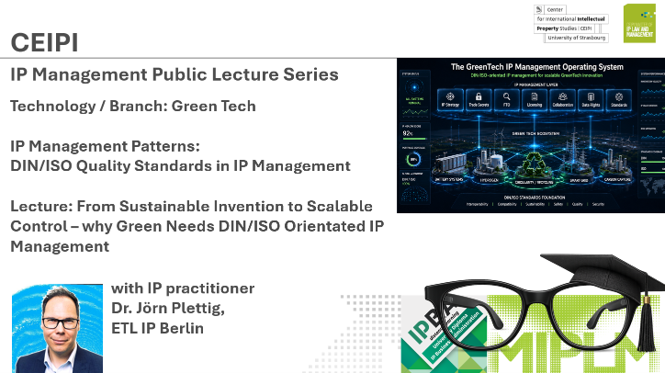
Controlled Openness Needs an IP Management System: Applying DIN 77006 and ISO 56005 in GreenTech with Dr. Jörn Plettig

GreenTech is often described through technologies: batteries, hydrogen systems, recycling processes, clean mobility, smart grids, carbon capture, low-carbon materials or digital energy platforms. But this picture is incomplete. The decisive question is no longer only whether a company can invent a sustainable technology. The harder question is whether it can scale that technology across partners, supply chains, regulation, infrastructure, financing and markets without losing control over the knowledge that creates business value.
This is where DIN/ISO-oriented IP management becomes highly relevant. DIN 77006 and ISO 56005 represent a shift from IP as an isolated legal activity to IP as a managed business discipline. They help companies define responsibilities, structure processes, document decisions, manage risks and connect IP with innovation strategy. For GreenTech, this is a precondition for turning sustainable invention into sustainable industrial impact.
GreenTech has become a system challenge
Many GreenTech fields are system markets. A battery technology is linked to raw materials, cell chemistry, production processes, thermal management, software, charging behaviour, recycling, safety requirements, data and supply relationships. Hydrogen technologies depend on catalysts, equipment, storage, infrastructure, standards and use cases. Recycling depends on machinery, sorting data, process know-how, access to waste streams and regulatory compliance.
In such environments, IP value rarely sits in one patent alone. It is distributed across patents, trade secrets, data access, design choices, software, contracts, regulatory knowledge, standards positions, supplier interfaces and brand trust. A company may own a strong invention and still fail commercially because key process parameters are not protected, a collaboration agreement gives away improvement rights, a supplier controls critical data, or a freedom-to-operate risk appears too late.
This is why GreenTech requires more than traditional filing activity. Companies need an IP management system that can identify where value is created, where risks arise and where future control points will emerge. Patent data becomes market intelligence. Trade secret management becomes operational discipline. Licensing becomes a scaling instrument. Contract design becomes part of innovation architecture. IP management becomes a way to make the system visible.
Why DIN/ISO-oriented IP management changes the role of IP
The importance of DIN 77006 lies in its management-system logic. It does not treat IP as a series of legal events. It treats IP as a repeatable, documented and continuously improved process within the company. This is especially valuable in GreenTech, where different departments must act together: R&D, engineering, sustainability, business development, procurement, legal, data governance, production, finance and top management.
ISO 56005 complements this logic by placing IP directly inside innovation management. It supports the creation of an IP strategy for innovation, systematic IP management within innovation processes and consistent IP tools and methods. This is important because GreenTech companies often operate under intense innovation pressure. They must develop, test, partner, certify, finance and scale at the same time. IP decisions cannot be postponed until a patentable invention appears. They must be embedded in the innovation process from the beginning.
The practical benefit is clarity. A DIN/ISO-oriented approach forces the organization to ask structured questions. Which innovation projects are strategically relevant? Which assets are patents, trade secrets, data, software or contractual rights? Which assets must be protected before disclosure? Which external rights could block market entry? Which partners need access to what knowledge? Which decisions must be documented? Which management level owns the IP strategy?
The result is not bureaucracy for its own sake. The result is a more reliable decision system. A company can see whether its IP position actually supports its roadmap. It can align IP activity with market priorities, reduce accidental disclosure and fragmented ownership, and make IP understandable outside the IP department.
Controlled openness as a practical management task
GreenTech rarely scales through closed innovation alone. Valuable knowledge is distributed across universities, start-ups, suppliers, engineering partners, infrastructure operators, customers, public bodies and sometimes competitors. A company developing a new sustainable technology often needs external testing capabilities, pilot customers, manufacturing partners, certification expertise, software interfaces and market access. Openness is therefore not optional. But openness without control is dangerous.
Controlled openness means designing what is shared, what is protected, what is licensed, what remains confidential and what is jointly developed. It means that collaboration is not handled as a collection of ad hoc NDAs and project agreements, but as a strategic IP architecture. This is where DIN/ISO-oriented IP management creates real value. It provides the routines for identifying background IP, defining access rights, documenting contributions, managing improvements, deciding on publication or secrecy and aligning collaboration rules with the business model.
For example, a battery start-up may need to disclose performance data to investors and industrial partners, while keeping production parameters secret. A recycling technology provider may patent the machine architecture but protect sorting logic and process settings as know-how. A smart grid company may need to manage software rights, data access, interoperability standards and cybersecurity knowledge in one integrated framework.
In all these cases, IP is not a wall against collaboration. It is the coordination mechanism that makes collaboration investable. Partners need to know what they can use. Investors need to know what the company controls. Customers need confidence that the solution can be deployed without unresolved ownership or infringement issues. The more open the innovation model becomes, the more professional the IP governance must be.
How companies can implement the system step by step
A GreenTech company does not have to start with a perfect IP management system. The practical path begins with an honest assessment of the current situation. Which IP processes already exist? Where are invention disclosures handled? How are trade secrets identified? Who reviews collaboration contracts? How are freedom-to-operate analyses triggered? Where is patent monitoring performed? How are data rights considered? Which decisions are documented, and which depend on individual experience?
This actual-state analysis should then be compared with DIN 77006 and ISO 56005. The purpose is not to copy a standard mechanically. The purpose is to identify gaps that matter for the company’s strategy. A GreenTech start-up preparing a financing round may need stronger asset documentation and a credible portfolio roadmap. A scale-up entering industrial partnerships may need improved trade secret processes, collaboration templates and FTO routines. An established industrial company moving into hydrogen, circularity or digital energy may need cross-departmental governance and portfolio alignment with the transformation roadmap.
The next step is the target state. Management must define what good IP management should look like for the company. This includes roles, responsibilities, process triggers, reporting lines, decision criteria and documentation requirements. It also includes training and IP awareness. In GreenTech, IP awareness should not be limited to inventors. Engineers, sustainability teams, project managers, procurement, sales, data teams and business development all touch IP-relevant information.
Finally, the company needs continuous improvement. PDCA logic is particularly useful: plan the IP process, do the work, check whether it functions and act on deviations. This creates learning loops. A late FTO issue leads to earlier project checkpoints. A collaboration conflict leads to better background IP documentation. Over time, the IP management system becomes part of daily management rather than a separate legal layer.
From legal protection to strategic trust
The strongest business benefit of DIN/ISO-oriented IP management in GreenTech is trust. GreenTech companies often need external capital, public funding, partnerships, pilot projects, infrastructure access and customer confidence. All of these stakeholders ask, directly or indirectly, whether the company controls a defendable position and whether it can collaborate without creating unacceptable risk.
A documented IP management system helps answer that question. It shows that IP decisions are not random, personal or reactive. It demonstrates that the company understands its assets, monitors risks, manages confidentiality, aligns protection with strategy and treats IP as part of governance. This can support due diligence, financing discussions, partner negotiations and internal decision-making.
It also helps avoid a common GreenTech trap. Many companies focus heavily on purpose, technology and market urgency. That is understandable, but not sufficient. A sustainable technology does not scale because it is morally desirable. It scales when it can be manufactured, financed, integrated, regulated, trusted and commercially controlled. IP management is one of the disciplines that connects these dimensions.
DIN 77006 and ISO 56005 therefore matter because they translate strategic intent into organizational capability. They help GreenTech companies move from invention to process, from process to governance and from governance to scalable control. They make it possible to combine openness with protection, collaboration with ownership and sustainability with competitive strength.
For GreenTech, this is the decisive point. The future will not be built by isolated inventions alone. It will be built by systems of innovation that are open enough to mobilize knowledge and controlled enough to capture value. DIN/ISO-oriented IP management provides the operating discipline for exactly this balance.