CEIPI IP Business Talk with Dr. Urs Ferber: Why Quantum Technology Requires a New Level of IP Decision-Making

Quantum technology is no longer only a topic for research programmes, scientific roadmaps and long-term technology foresight. It is moving rapidly into the world of commercialisation, investment, industrial application and strategic positioning. That is precisely why it is becoming one of the most important fields for modern IP management.
———————————————————————————————————————————
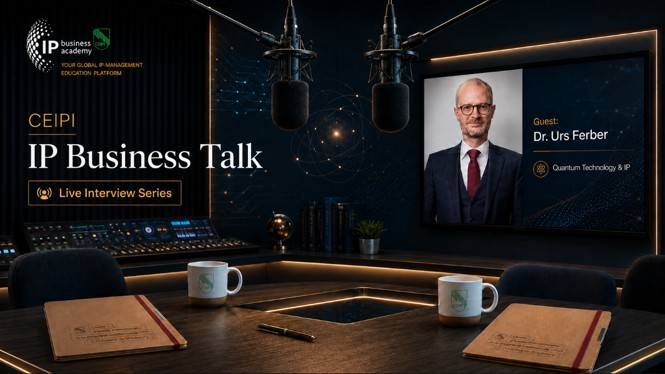
On Wednesday, 8 July 2026, at 12:00 CEST, Dr. Urs Ferber, Partner and Patent Attorney at Mewburn Ellis in Munich, will join us for the next CEIPI IP Business Talk.
———————————————————————————————————————————
Together, we will discuss how companies, start-ups, scale-ups, research institutions and investors can make better IP decisions in a field where dominant architectures, applications and markets are still emerging. The conversation will focus on the changing IP needs in quantum technology, the role of commercially relevant patent portfolios, the alignment of IP with business development, and the importance of freedom-to-operate and competitor intelligence when quantum companies move into new application fields.
The discussion comes at a crucial moment. Quantum technology is increasingly understood as a strategic technology field for Europe. It is connected to computing, communication, sensing, security, simulation, materials, industrial optimisation and many other areas where future competitive advantage may depend on access to quantum-enabled capabilities.
For the IP community, this is more than a new technology trend. Quantum technology challenges many traditional assumptions about how IP value is created, managed and communicated. It is not enough to ask whether a single technical invention can be patented. The more important question is how companies can identify, protect and control those parts of their technology stack that may become commercially decisive in the future.
Quantum technology is becoming a business field — but not yet a settled one
One of the defining characteristics of quantum technology is that it is developing under conditions of uncertainty. There is strong scientific momentum, increasing investment and growing political attention. At the same time, many core questions remain open.
Which hardware architectures will become dominant? Which applications will scale first? Which markets will adopt quantum-enabled solutions early? Which parts of the technology stack will become critical bottlenecks? Which capabilities will remain in-house, and which will be provided through platforms, partnerships or specialised infrastructure?
This uncertainty does not make IP less important. It makes IP more important.
In mature industries, IP strategies can often be built around visible products, established markets and relatively stable competitive landscapes. In quantum technology, by contrast, companies often need to make IP decisions before markets are clearly defined. They need to protect innovation before product architectures are final. They need to convince investors before commercial use cases are fully validated. They need to collaborate with universities, suppliers, infrastructure providers and industrial partners without losing control over strategically relevant knowledge.
This is why quantum IP cannot be reduced to patent filing. It requires structured decision-making under uncertainty.
Why IP support is critical in quantum technology
Quantum technologies often combine several value layers. Hardware, software, control systems, error correction, calibration, data interpretation, manufacturing know-how, sensor integration, interfaces and application-specific adaptations may all contribute to the final commercial value proposition.
In such an environment, the strongest competitive advantage may not sit in one visible invention. It may sit in the architecture of a system, in the way classical and quantum components interact, in the control software, in the manufacturing process, in the know-how required to stabilise performance, or in the ability to adapt a quantum system to a specific industrial problem.
➡️ This creates a demanding task for IP experts.
They must help companies distinguish between what should be patented, what should remain confidential, what should be disclosed to partners, what should be documented for future proof, what should be protected contractually, and what must be analysed through freedom-to-operate and competitor monitoring.
- For young quantum companies, this can be existential. A university spin-out or early-stage start-up often needs to transform scientific excellence into investable assets. Investors do not only ask whether the technology is promising. They want to understand whether the company can defend a meaningful position if the technology succeeds.
- For scale-ups, the challenge changes. The IP portfolio must evolve with the product roadmap, financing strategy, cooperation structure and market entry plan. A portfolio that was useful for the first funding round may not be sufficient for industrial partnerships, international expansion or entry into a new application field.
- For established technology companies, quantum technology raises a different set of questions. They need to understand where quantum capabilities may affect existing business models, supply chains, data infrastructures, cybersecurity strategies or industrial platforms. They must monitor competitors, assess freedom-to-operate risks and decide when to build, buy, partner or license.
In all these cases, IP is not only a legal protection mechanism. It becomes a management instrument.
The structural lag in quantum IP decision-making
This is the central argument of the current dIPlex analysis of IP communication in the quantum domain. Quantum technology is advancing faster than many organisations’ IP decision-making structures. The result is a structural lag. Companies, research institutions and investors increasingly understand that quantum technology is strategically important, but they often do not yet have the internal routines, decision criteria and governance processes needed to translate technological uncertainty into IP action.
This lag matters.
If IP decisions are made too late, valuable knowledge may already have been disclosed. If they are made too narrowly, companies may protect isolated inventions but miss the actual control points of future value creation. If they are made without business context, the portfolio may look technically impressive but commercially weak. If they are made without freedom-to-operate awareness, companies may build roadmaps that become difficult to execute later.
The task is therefore not simply to file more patents. The task is to create better IP decision structures.
Quantum technology requires IP support that can connect technical depth, commercial relevance, investor expectations, partnership models and long-term strategic positioning.
What the IP Expertise Demand Index 2026 shows
This is also why quantum technology plays an important role in the IP Expertise Demand Index 2026. The Index does not simply ask where patent activity is increasing. It asks where users of the IP system are developing new and more complex needs for IP expertise.
That distinction is important.
In emerging technology fields, IP demand often arises before a company knows exactly what mandate to formulate. Before a patent application is drafted, there may already be a need to identify strategic control points. Before an FTO analysis is commissioned, there may already be a need to understand competitor movements. Before a licensing discussion begins, there may already be a need to structure ownership, collaboration and disclosure. Before a portfolio is evaluated, there may already be a need to define what a commercially meaningful portfolio should look like.
Quantum technology is a perfect example of this shift.
The term “quantum” is too broad to describe one single IP need. Quantum computing hardware, quantum software, quantum simulation, quantum sensing, quantum communication, post-quantum security migration and enabling technologies each generate different IP questions. They involve different time horizons, different business models, different risk profiles and different forms of protectable value.
This means that the demand for IP expertise is becoming more differentiated.
The IP need of a quantum sensing start-up is not the same as the IP need of a company developing quantum control software. The needs of a university spin-out are not the same as those of an industrial group evaluating quantum-enabled optimisation. The needs of investors are not the same as those of R&D teams. And the needs of companies entering a new application field are not the same as those of companies protecting a foundational technology platform.
The IP Expertise Demand Index 2026 helps make these differences visible.
Why Mewburn Ellis is an important voice in the quantum IP discussion
In this context, it is particularly valuable to speak with Urs Ferber. His profile describes him as a European and German Patent Attorney and a Partner in the Engineering team at Mewburn Ellis. He works with companies at the frontier of science and technology, including quantum technology, and supports start-ups and companies in building commercially valuable IP portfolios.
This combination is exactly what quantum technology requires: deep technical understanding, patent expertise and a strong sense of commercial relevance.
We will also discuss the communication of the quantum practice group at Mewburn Ellis, which we recently analysed.
What makes the Mewburn Ellis approach interesting is that quantum IP is not presented merely as a patent service. It is framed as a translation challenge. The firm makes quantum IP understandable by placing it within the broader movement from laboratory research to commercial strategy, investment readiness and ecosystem participation.
This is an important communication model for the IP profession.
Many quantum companies do not first look for an abstract legal service. They look for someone who understands why their technology is difficult, why their market is uncertain, why their financing logic matters, and why their technical choices today may define their strategic options tomorrow.
Good IP communication in quantum technology therefore needs to do more than describe legal capabilities. It needs to help the market understand what kind of IP decisions are becoming necessary.
Mewburn Ellis does this by connecting technical explanation, commercial context and IP relevance. Their quantum communication speaks to founders, investors, research-driven companies and technology managers who need to understand how IP can support growth in an emerging field.
From patent questions to strategic IP support
The upcoming CEIPI IP Business Talk will therefore address a broader shift in the IP profession.
In quantum technology, the core issue is not whether IP matters. The core issue is how IP expertise must be organised, communicated and applied when the technology is still emerging and the market is still forming.
This requires a different kind of conversation.
It is not enough to treat IP as a downstream legal service. IP must become part of how companies think about technology roadmaps, investment milestones, cooperation models, product-market fit, market entry and competitive positioning.
The best IP experts in this field will not only answer patent questions. They will help companies structure decisions where technical uncertainty and commercial ambition meet.
That is why the CEIPI IP Business Talk with Urs Ferber is so timely.
Quantum technology is moving from promise to practice, we describe this development in the dIPlex Industry Focus Quantum. The IP need is moving with it. And the companies that learn to manage this need early will be in a stronger position to turn scientific excellence into lasting business value.
Dr. Urs Ferber
 Dr. Urs Ferber is a Partner and Patent Attorney at Mewburn Ellis LLP in Munich. He is a European and German Patent Attorney and works in the firm’s Engineering team. His professional focus lies at the intersection of science, technology and commercialisation, particularly in quantum technology and medtech.
Before joining Mewburn Ellis, Urs Ferber worked for several years as a patent attorney at Flügel Preissner Schober Seidel. At Mewburn Ellis, he first served as Senior Associate before becoming Partner in April 2024. His academic background includes physics studies at the University of Ulm and University College Dublin, where he completed his PhD. His technical expertise includes biophysics, optics and microscopy.
In his own professional profile, he emphasises that he helps build commercially valuable IP portfolios for start-ups and companies at the frontier of quantum technology and medtech. He also highlights his experience in shaping IP strategies that contribute to the commercial success of start-ups while remaining attractive and motivating for inventors.
Mewburn Ellis quantum practice group
The quantum practice group at Mewburn Ellis positions itself as an interdisciplinary IP resource for companies working in quantum computing, quantum sensing, quantum communication, quantum software, control systems, QPU architectures, enabling technologies and related deep-tech fields.
Its communication is particularly strong because it does not isolate quantum IP from the business context. Instead, it explains how IP connects to commercialisation, investment readiness, technical roadmaps, scaling, collaboration and ecosystem development.
This makes Mewburn Ellis an important example of how IP firms can make emerging technology fields legible to the market. In quantum technology, users of the IP system often do not yet know exactly which IP questions they should ask. Strong IP communication therefore helps them understand where future value may arise, where control points may emerge, and why IP decisions need to be made earlier and more strategically.
That is the central theme of the CEIPI IP Business Talk with Dr. Urs Ferber: how quantum companies can build IP strategies that are not only technically sound, but commercially relevant.