
IP Awareness in Top Management: Why IP must become part of leadership thinking

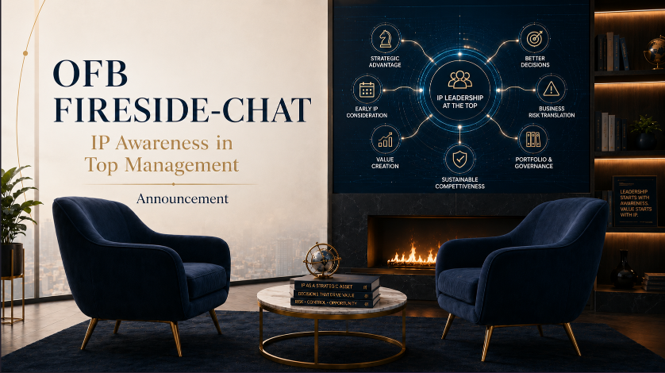
Many companies have more IP than their leadership teams actively see. They have patents, trademarks, designs, software, data, trade secrets, technical documentation, customer knowledge, market insights, contractual positions, platform access, standards knowledge, and operational routines that shape their competitive position. But in many boardrooms, IP still appears mainly as a legal topic, a cost item, a filing decision, or a risk that becomes visible only when there is a conflict.
That is why IP Awareness in Top Management will be the topic of an upcoming OFB Fireside Chat. The discussion will focus on a question that is becoming increasingly important for technology based companies: Does top management understand IP as a strategic leadership instrument, or only as a legal protection function?
This distinction matters. A company can have excellent patent attorneys, strong external counsel, capable R&D teams, and a professionally managed portfolio, while still missing the larger leadership question. What role does IP play in value creation? Where does IP influence market entry, financing, cooperation, pricing power, M&A, product architecture, platform strategy, freedom to operate, and long term competitiveness? Where does the company depend on assets it cannot easily see in its financial statements, but could lose through bad timing, weak contracts, poor documentation, or late decisions?
IP awareness at top management level is not about turning executives into IP lawyers. It is about making sure that business decisions are not made as if IP were only a downstream legal task.
IP is not only protection after innovation
A common misunderstanding is that IP becomes relevant once the technical solution is finished. Something has been invented, a product has been designed, a brand has been selected, software has been created, or a cooperation has produced results. Then someone asks whether protection is possible. In this logic, IP arrives after the decisive business choices have already been made.
That is often too late. IP does not only protect outcomes. It shapes options. It determines whether a company can enter a market safely, whether a product can be scaled, whether a platform position is defensible, whether a cooperation creates dependency, whether data can be used, whether technology can be licensed, whether investors understand the value of the business, and whether a competitor can copy the strategic core without copying the visible product.
For top management, the central IP question is therefore not simply: Can we protect this? The more important question is: What role does this asset play in our business model, and what happens if we do not control it?
This changes the conversation. IP is no longer an administrative layer around innovation. It becomes part of strategic choice. It helps leadership teams decide what should be protected, what should be kept secret, what should be shared, what should be licensed, what should be standardized, what should be monitored, and what should never be given away without a clear business reason.
The leadership translation problem
Many IP discussions fail at management level because they are presented in the wrong language. Technical teams speak about features, inventive steps, embodiments, source code, system architectures, data flows, process details, or engineering improvements. Legal teams speak about rights, claims, validity, infringement, contracts, confidentiality, ownership, and procedural risk. Top management, however, needs to understand decisions in terms of business exposure, value creation, strategic control, market access, investment risk, negotiation power, and future optionality.
The challenge is not that management is uninterested. The challenge is that IP risk is often not translated into business risk. A freedom to operate issue is not just a legal concern. It may delay a product launch, limit a market entry, reduce valuation, create negotiation pressure, or force a redesign. A weak ownership position in a joint development project is not just a contractual imperfection. It may prevent commercialization, block licensing, or create dependency on a partner. Poor trade secret handling is not just a compliance weakness. It may destroy the only protection available for a process, data model, algorithm, manufacturing method, or customer specific solution.
Top management does not need more IP detail for its own sake. It needs better IP meaning. It needs to know which decisions require attention now, which risks can be accepted, which assets justify investment, which dependencies need governance, and which opportunities are lost if IP is considered too late.
Where IP must be present early
There are certain corporate decisions where IP awareness should be present from the beginning, not added as a final review. M&A is one of them. A target may look attractive because of revenue, technology, talent, market access, or customer relationships. But if ownership is unclear, key know how is not transferable, software includes problematic third party components, data use is restricted, patents are weak, or trade secrets are poorly documented, the business case changes.
Product launches are another example. A launch decision is not only about readiness, pricing, marketing, and sales. It also involves freedom to operate, brand clearance, design protection, software licensing, data rights, regulatory interfaces, and the risk that the product teaches competitors how to copy the value layer behind it.
Cooperations, financing rounds, market entry decisions, platform strategies, standardization activities, procurement choices, outsourcing models, and AI implementation all raise similar questions. Who owns what? Who may use what? Who controls access? What must remain confidential? What can be published? What can be patented? What must be contractually secured? What happens if the relationship ends? What happens if the market grows faster than expected?
These questions are not side issues. They shape whether a business decision can create durable value.
IP metrics that matter to leadership
Another central topic for the OFB Fireside Chat will be the question of IP metrics. Many companies report numbers that are easy to count but not always useful for management. Patent filings, granted patents, renewal costs, opposition numbers, invention disclosures, or trademark registrations can all be relevant. But they do not automatically explain whether IP supports the company’s strategic position.
Top management needs metrics that connect IP to business decisions. Which product lines are protected and where are the gaps? Which strategic markets carry the highest freedom to operate exposure? Which patents support pricing power, licensing options, exclusion, negotiation leverage, or investor confidence? Which technologies depend mainly on trade secrets rather than formal rights? Which cooperation projects create ownership uncertainty? Which business units generate valuable knowledge but have weak documentation or reporting?
Useful IP metrics should not create a decorative dashboard. They should create better conversations. They should help leadership teams allocate budgets, prioritize portfolios, assess risk, select markets, structure transactions, evaluate partnerships, and understand where intangible value is accumulating.
From IP awareness to leadership culture
IP awareness in top management cannot depend on occasional presentations or crisis meetings. It must become part of leadership culture. That means IP appears in reporting structures, budget planning, innovation steering, portfolio reviews, strategic planning, M&A processes, product governance, data governance, and cooperation management. It also means that IP is not owned by one department alone.
The IP function can provide expertise, structure, analysis, and decision support. But leadership must create the conditions in which IP becomes relevant early enough to matter. R&D must know when to involve IP. Business development must understand when market opportunities have IP implications. Finance must see why intangible assets require investment before revenue is visible. Legal must connect contracts to strategic control. HR must understand that employee mobility, onboarding, offboarding, and incentive systems can all affect knowledge protection.
When this works, IP awareness becomes a practical capability. It helps companies ask better questions before they commit resources. It creates a common language between technical, legal, financial, and commercial perspectives. It also prevents IP from being reduced to the narrow question of whether a patent application should be filed.
Why this OFB Fireside Chat matters
The upcoming OFB Fireside Chat will address IP Awareness in Top Management as a leadership issue, not as an abstract educational topic. The focus will be on how companies can make IP visible where strategic decisions are made. How can IP risks be translated into business risks? Which IP indicators are truly relevant for executives, boards, and advisory bodies? How can IP be integrated into reporting, budgeting, innovation processes, and strategic decision making? How can leadership teams move beyond the vague statement that they protect their inventions and build a more precise understanding of how IP supports the business?
These questions matter because many companies are already intangible asset companies without managing themselves that way. Their value increasingly depends on knowledge, software, data, brands, designs, customer access, technical integration, ecosystem positions, and market trust. Yet the leadership systems around these assets often remain fragmented.
IP Awareness in Top Management is a way to close that gap. It helps companies see IP not as an isolated legal layer, but as a management language for control, value, risk, and strategic options. It brings IP into the room where the most consequential choices are made.
Further reading and contact
For readers who would like to explore the topic in more depth, the related dIPlex Deep Dive IP Awareness in Top Management: Turning IP into a Leadership System provides a structured perspective on how to making sure that leadership decisions are not made as if intellectual property were only a downstream legal function:
The Deep Dive complements the upcoming OFB Fireside Chat by looking on why IP should not be treated only as a legal protection function, but as a strategic leadership issue that affects value creation, business risk, market entry, M&A, cooperation, financing, platform strategy, reporting, budgeting and innovation governance.
For questions regarding the Open Foresight Board or the upcoming OFB Fireside Chat, please contact:
Theo Grünewald
Secretary of the CEIPI IP Business Academy’s Open Foresight Board
theo.gruenewald@ipbaportal.com
More details on the upcoming OFB Fireside Chat will follow soon.