
IP Decision Case: Portfolio Strategy for Immersive Digital Twins in Robotics Training with Andreas Berger

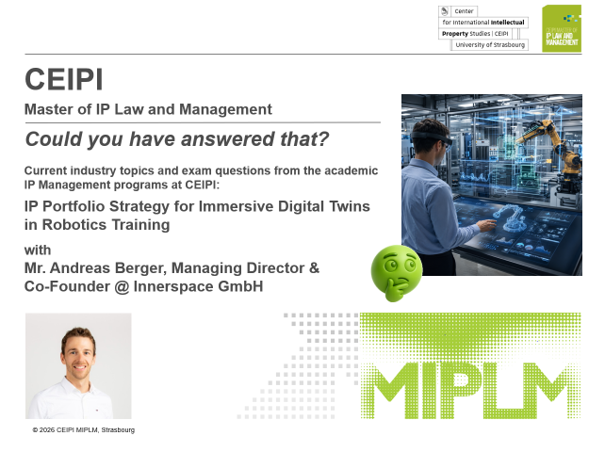
Immersive digital twins are no longer only about visualizing machines or creating virtual training environments. They are increasingly becoming a strategic layer around robotics and autonomous industrial systems. In complex mechatronic environments, value is not created by one robot, one simulation model or one software module alone.
It emerges from the way machine behaviour, operator decisions, safety-critical procedures, human-machine interaction, training analytics and workflow integration are combined into a learning environment that can influence real-world performance before deployment.
This creates a strategic IP challenge for software companies building digital twin platforms for robotics training. Such platforms may become valuable because they make complex operating situations repeatable, measurable and improvable. They can help customers train human operators, validate safety-critical procedures, simulate machine responses, assess decision quality and improve operational readiness without relying only on physical testing.
Yet the same digital architecture that enables scalability, customer adaptation, data-driven feedback and integration into industrial workflows can also expose the scenario logic, simulation structures, training models, user-performance analytics and validation routines that make the platform defensible. In such environments, the decisive IP question is often not whether one software feature can be protected, but where strategic control over the learning architecture should sit.
The Andreas Berger case highlights exactly this tension in the context of immersive digital twins for robotics training, where the company’s product is not the robot itself, but the digital layer that makes robotics systems easier to understand, train, validate and improve.
This is closely connected to the shift described in the CEIPI IP Business Academy analysis “The Robotics Strategy Gap”. The article shows that robotics companies are no longer developing isolated machines, but autonomous systems connected to sensors, AI models, control software, operational data, simulation environments, cloud infrastructure and human workflows. It argues that robotics is becoming one strategic control environment in which IP must move beyond isolated patents, software rights or trade secrets and become a decision system for embodied intelligence.
Here you find the findings of this study: “The Robotics Strategy Gap: What Autonomous Systems Companies Need, and What IP Advice Still Often Fails to Integrate”.
Against this background, the CEIPI IP Business Academy integrates practice-based questions from industry into its teaching. These questions help students understand IP not only as a legal protection tool, but as a management instrument for strategic decision making in emerging technology systems. In robotics and autonomous systems, this means looking beyond the physical machine and asking where the value-bearing layers of a connected, adaptive and data-driven system actually lie.
We are therefore pleased to include this industry case study with Andreas Berger, who brings a practitioner perspective to the question of portfolio strategy for immersive digital twins in robotics training.
His practical question focuses on a central issue for robotics software companies: how to structure IP protection when the most valuable knowledge may sit in simulation logic, scenario generation, behavioural models, training feedback loops, safety validation routines, customer-specific workflows, data architecture and the continuous improvement of virtual training environments.
The case shows why robotics software requires a hybrid IP management approach that connects patents, trade secrets, contracts, data governance, customer access rules and product architecture into one coherent portfolio strategy. It also shows why IP strategy must be considered before the market becomes crowded. Once larger automation and software providers enter the field, it may be too late to capture the decisive control points of the digital training layer.
Decision Context
A European software company has developed an immersive digital twin platform for training human operators in complex mechatronic and semi-autonomous environments. The platform is used to simulate machine behaviour, operator decisions, safety-critical procedures and human-machine interaction before deployment in the physical world.
The company’s product is not a robot. Its value lies in the digital layer around robotics: simulation models, scenario logic, user-performance feedback, training analytics, workflow integration and the continuous improvement of virtual training environments based on operational learning.
The company is entering a growth phase. Industrial customers increasingly ask whether the platform can be adapted to robotics, autonomous production cells and safety-critical operator training. At the same time, larger software and automation providers are moving into simulation-based training. They have stronger sales channels, broader patent portfolios and the ability to bundle training software with existing automation platforms.
The company must decide how to structure its IP portfolio before the market becomes crowded.
The Decision
Management must decide whether to build an assertive IP portfolio around the core control points of the digital twin training platform or rely primarily on speed, customer intimacy, trade secrets and product execution.
An assertive strategy would mean identifying patentable system features early, filing selectively around simulation logic, training feedback loops, human-machine interaction models and validation workflows, and preparing the portfolio for future enforcement or negotiation.
A more defensive strategy would keep critical know-how confidential, avoid disclosure of technical architecture, protect customer-specific workflows contractually and use patents only where they support funding, partnerships or defensive positioning.
The decision is not whether to “patent or not patent”. The real decision is where the company wants strategic control to sit: in enforceable rights, hidden know-how, customer integration, data access, or a deliberately combined portfolio model.
Why This Decision Is Difficult
The trade-off is structural.
Patents can make the company’s position visible, explainable and defensible. They may help in investor discussions, partnership negotiations and competitive disputes. They can also create leverage if a larger competitor copies the observable behaviour of the platform or approaches the same customers with a similar robotics training solution.
But patents require disclosure. In a software-driven training platform, some of the most valuable assets may be difficult to claim broadly but easy to learn from once disclosed. Competitors may design around published claims while still adopting the underlying product logic. An enforcement-oriented portfolio also requires resources, discipline and a level of organizational maturity that many growing software companies do not yet have.
Trade secrets avoid premature disclosure but create a different weakness. They are powerful only if access, documentation, employee knowledge, customer deployments and development processes are managed consistently. If the market starts to standardize around visible product features, a secrecy-only strategy may leave the company with limited leverage against imitation.
The decision also affects future business models. A platform sold as software-as-a-service, a customized enterprise solution, a licensing model for robotics OEMs or a certification infrastructure for operators may each require a different IP architecture.
Practitioner Perspective
From a practitioner perspective inspired by Andreas Berger, the starting point would not be legal classification. It would be product reality.
The key question is which parts of the platform actually create customer value. Is it the realism of the simulation? Is it the data foundation and architecture that links the complex machinery behaviour, related processes and human-machine interaction? Is it the ability to transform the data foundation into structured learning scenarios? Is it the ability to assess decisions, provide feedback, and improve behaviour over time? Or is it the integration into customer workflows, qualification and validation processes, and training systems that turns complex robotics environments into scalable products?
This perspective changes the portfolio discussion. The company should not begin with the abstract question of what can be patented. It should begin with the business question of what must remain under strategic control if the market scales.
For an immersive digital twin training platform, the relevant control points may start with the underlying data architecture: how real-world operations are structured, represented, connected and reused across training scenarios. Building on this foundation, control points may include scenario-generation engines, behavioural models, feedback systems, safety validation routines, customer-specific configuration methods and the learning loop between training sessions and product improvement.
The practitioner challenge is to translate these product control points into an IP architecture that management can actually use.
Implication for IP Management Education
This case shows why IP management education must move beyond isolated filing decisions.
In robotics and autonomous systems, value is rarely located in one technical component. It emerges from interaction: software with machines, users with simulations, data with feedback loops, and training environments with operational performance. The IP portfolio must therefore be designed around system control, not around invention descriptions alone.
For IP managers, the learning is that portfolio strategy and enforcement readiness must be considered before the competitive conflict becomes visible. Once the market is crowded, it may be too late to capture the decisive control points.
The educational message is clear: IP strategy in robotics software is not a legal afterthought. It is a management discipline for deciding which parts of an emerging business model should be disclosed, protected, kept secret, documented, licensed or defended.
Andreas Berger
 Andreas Berger is Managing Director and Co-Founder of Innerspace GmbH in Innsbruck, Austria. In this role, he has played a central part in shaping the company’s development since 2017, moving from software engineering into customer service, operations and product leadership. His work focuses on building high-quality products that respond to customer needs and market trends, supported by a strong emphasis on team culture, agile principles, entrepreneurship and product management.
Before founding Innerspace, Andreas worked as a self-employed software engineer, developing customized web-based applications with JavaScript frameworks and gaining experience in project management, customer collaboration, software development, data and machine learning tools such as TensorFlow and Python libraries. Earlier roles at INViiON GmbH and IDM Energiesysteme GmbH connected his software expertise with mechatronic engineering, prototype development, test bench automation and R&D. He holds a Master’s degree in Web Communication & Information Systems from Fachhochschul-Studiengänge Kufstein Tirol and a Bachelor’s degree in Mechatronics, Robotics and Automation Engineering from Management Center Innsbruck.