Protecting Quantum Innovation Across the Stack: Edd Cavanna and Daniel Speed on Finding the Right IP Control Points

Quantum innovation rarely appears as one clearly defined invention. It often combines hardware, control systems, software, mathematical methods, protocols and enabling technologies. The central question is therefore not simply whether something can be patented. It is where the commercially relevant contribution lies and how it should be translated into a coherent protection architecture.
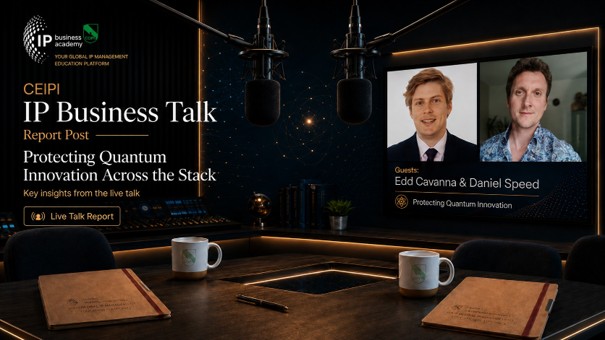
In the CEIPI IP Business Talk, Edd Cavanna and Daniel Speed from Mathys & Squire showed that quantum IP begins before drafting: with identifying technical and economic leverage and deciding how patents, secrecy and contracts can preserve control.
The invention must first be identified
One of the clearest messages was that inventors do not always know what the invention is. Researchers may present an entire quantum system and assume that protection can simply be placed around it. But the relevant invention may not be the most visible or scientifically impressive feature. It may be a control mechanism, calibration process, cooling solution, manufacturing step, error-mitigation method or interface that makes the overall system usable.
Cavanna described the necessary process as “invention mining”. It requires a detailed exchange with inventors rather than the passive receipt of an invention disclosure. The adviser must ask what changed, why it matters, which alternatives exist and which feature creates an advantage that competitors would find difficult to reproduce.
IP should therefore not enter the process only after someone internally declares that an invention has been completed. Regular interaction between R&D and IP advisers is needed to uncover protectable developments before publication, demonstration or collaboration makes protection more difficult.
A patentable idea is not automatically a valuable patent
The talk repeatedly returned to the distinction between obtaining a patent and obtaining a patent that supports the business.
A narrowly framed application may protect a technical detail that no competitor needs while leaving the decisive value-creating feature exposed. The right question is not only, “Can we obtain a patent?” but also, “What should this patent enable us to do?” The answer depends on strategy. Licensing, blocking competitors, platform control and component supply may each require a different focus.
Cavanna stressed that patent advisers need to understand the intended business model. Without this context, they may draft sophisticated applications but still miss the commercial control point. He also described the patent attorney as a storyteller: someone who structures the technical reality into a convincing account of the problem, solution and contribution. That story must work for an examiner and may later need to work for a judge, investor or licensing partner.
Quantum software requires technical framing
The distinction between scientific insight and technical contribution becomes particularly difficult in quantum algorithms and software. Quantum inventions may be expressed through optimisation procedures, matrices, vectors or Hamiltonians. The work can appear abstract even where it controls a physical system or improves the operation of a quantum device.
The challenge is not to hide the mathematics, but to show how it connects to a technical problem, implementation or effect. Does the method reduce noise, improve the use of hardware resources, enable more reliable control or increase the efficiency of a simulation or measurement process? These connections must be explicit during drafting. An application that presents only abstract computational steps may later struggle to demonstrate technical character.
Jurisdictional differences add another layer. An international filing strategy may require different emphasis while preserving the same technical and commercial logic. Speed’s contribution highlighted why mathematical understanding matters. The task is not merely to follow the equations, but to identify where the method becomes technically meaningful and how that contribution can be generalised without losing credibility.
Timing is part of the IP strategy
Quantum companies often operate under intense disclosure pressure. Academic papers, conferences, funding applications, investor discussions and customer demonstrations can all create deadlines that compete with the patent process.
Cavanna noted that this field demands flexibility from patent advisers. They must understand complex material quickly, communicate directly with inventors and prepare strategic filings before disclosure. Priority filings and staged strategies can create room for development, but the company must decide deliberately what must be secured before publication.
Companies should therefore establish trigger points for IP review, such as an upcoming publication, a prototype, a customer trial, a funding round, a joint-development project or a major change in the technical roadmap. The trigger should not depend on whether R&D believes it has produced a “finished invention”.
Protecting across the stack means choosing where to control
Quantum systems are built from interdependent layers, including processors, photonics, cryogenics, control electronics, compilers, protocols, error correction, algorithms and application-specific implementations.
Few companies will own every layer. The strategic question is where they need control and where they can rely on access, licensing or collaboration. Leverage may arise from an essential component, a hardware-independent algorithm or an interface connecting users to multiple systems.
The most valuable patent may consequently not cover the headline invention. It may protect the feature that makes the system stable, scalable, interoperable or commercially usable. The discussion used the example of laser technology, where enabling technologies such as cooling could become more decisive than the original concept. The same logic applies to quantum systems: control may sit in the “bolts” that make the architecture work.
Patents can also be collaboration assets. A strong position in one layer may attract partners, support joint ventures or improve negotiating power. The portfolio should therefore reflect the company’s intended role in the ecosystem.
Collaboration must define foreground and background IP
Quantum industrialisation depends heavily on cooperation between universities, start-ups, technology companies and application partners. This makes contractual clarity essential.
Before a project begins, the parties should identify their background IP: patents, software, data, processes, know-how and trade secrets. They must then decide what happens to foreground IP created during the project. Who owns it? Who controls filing and enforcement? Which licences are granted? Do they continue after the cooperation ends? Can the results be used in other fields?
These questions may appear defensive, but agreements matter most when relationships change. A company should not discover after a failed collaboration that it has lost control of core technology or later improvements. Patents may also leave essential calibration routines, process parameters or internal protocols as protected know-how.
Patents and trade secrets require a conscious choice
As quantum technology moves towards commercial deployment, companies must decide what to publish and what to keep secret. Trade-secret protection may be attractive where a method operates inside a closed platform and cannot easily be reverse-engineered. Patents offer a visible and transferable right that can support investment, licensing and collaboration, but they require disclosure.
This creates a real risk. An application may be published without ultimately producing a strong enforceable patent. The company may then lose both exclusivity and secrecy.
The choice should consider detectability, confidentiality, disclosure to partners and the commercial value of an enforceable right. There is no universal answer. The important point is to make the decision before publication or collaboration removes it.
From patent filing to system control
The talk made clear that quantum IP cannot be reduced to patent drafting. The real task is to identify where technical and economic control can be created. This requires interaction with R&D, business-model understanding, jurisdiction-sensitive drafting, deliberate disclosure and contractual control.
The strongest quantum portfolio may not be the largest. It may be the one that protects the few features on which others must depend. Quantum inventions do not arrive already packaged for protection. They must be found, framed and connected to commercial purpose. Only then can IP become a genuine control layer within the emerging quantum ecosystem.
Those interested in the background regarding quantum technology and IP can find the IPBA Connect Industry Focus “Quantum Technology and the Structural Lag of IP Decision-Making” here.
Edd Cavanna
 Edd Cavanna is a Partner and Patent Attorney at Mathys & Squire LLP. His practice covers physics, engineering, electronics, software and energy, including patent drafting, portfolio strategy, freedom to operate, licensing and joint development.
Before entering patent practice, he studied physics and mathematics and completed a PhD in Experimental Condensed Matter Physics at the University of Cambridge. His scientific background includes quantum information and experimental superconductivity.
Daniel Speed
 Daniel Speed is a Trainee Patent Attorney at Mathys & Squire LLP. Before entering the profession, he worked in research and teaching at the University of Bristol.
He holds an MMath in Mathematics from Cardiff University and a PhD in Theoretical and Mathematical Physics from the University of Bristol. His background gives him particular insight into quantum information, mathematical methods and software-related quantum inventions.
Mathys & Squire’s Quantum Communication
Mathys & Squire quantum practice group communicates its quantum expertise through the idea of a protection architecture rather than presenting quantum as one homogeneous technology field. Its public materials distinguish between quantum protocols, quantum hardware and systems, and quantum-enabling technologies, with references ranging from phase estimation, decoherence modelling and circuit benchmarking to photonic integrated circuits, quantum memories, cryogenics and microwave electronics. This detailed taxonomy helps potential clients locate their innovation within a recognisable protection landscape and understand whether the relevant contribution lies in an algorithm, component, manufacturing process, control system or enabling infrastructure.
The firm’s communication also makes the legal complexity of protection part of its positioning. Mathys & Squire highlights that quantum inventions—particularly those involving software, mathematical methods and algorithms—cannot necessarily be protected through a uniform filing logic across the United Kingdom, Europe and the United States. Its implied message is that effective quantum IP requires both technical differentiation across the stack and claims adapted to the patentability standards of different jurisdictions. This protection-architecture perspective gives founders, research organisations and in-house IP teams a vocabulary for addressing questions of patent scope, portfolio coherence and international filing strategy.