Meta Withdraws Muse due to privacy expectations 🎯 IP Management Pulse #65


Subscribe for compact, in-depth IP intelligence: trends, cases, and research curated by the team of the IP Business Academy and the IPBA Connect Platform. Get practical playbooks for positioning, LinkedIn, and business development. Learn from leading experts in the context of business models and R&D. Join the IPBA Connect community and turn IP knowledge into results — with dIPlex, live formats, IPBA Connect, and white papers as your launchpad.
Here you can find the latest issues in the archive and also subscribe. A fresh read with all important IP Management content will be sent to the subscribers every second Thursday at 7:00 (CET), so that they can start the day informed.
The next newsletter will cover the following topics:
Meta Withdraws Its Muse Image Feature
Meta discontinued its Muse Image function only days after launch. The feature allowed images to be generated using content from public Instagram accounts and was reportedly activated automatically, prompting criticism from users and SAG-AFTRA over consent and the risk of non-consensual digital replicas. Meta acknowledged that the implementation had failed to meet privacy expectations.
New Financing Support for IP-Rich Businesses
The British Business Bank has reserved up to £500 million of the current ENABLE Guarantee capacity for funding IP-rich smaller businesses during the following 12 months. The measure is intended to improve financing availability and pricing while strengthening lenders’ ability to evaluate businesses whose value depends substantially on intangible assets.
Satya Nadella’s Reverse Information Paradox
Microsoft CEO Satya Nadella recently warned that companies may effectively pay for AI twice: financially for access and strategically through the knowledge transferred while making the systems useful. Reactions from AI leaders showed broad agreement that AI-generated learning is valuable, although some argued that existing enterprise safeguards already limit data retention and model training.
The UPC and Life Sciences Portfolio Strategy
A recent analysis following the BIO International Convention in San Diego argues that the UPC is increasingly helping determine the price of life-sciences IP assets. A portfolio with credible cross-border enforcement potential may support a valuation premium, while weak patent validity prospects can reduce transactional value.
OFB Fireside Chat: Know-how Management
AI makes systematic know-how management more important, not less. Companies must preserve the tacit knowledge of experienced employees and make it usable for future teams and digital systems.
The Fireside Chat will address knowledge transfer, documentation, confidentiality, AI training and the organisational processes needed to retain technical expertise without losing context and professional judgement.
OFB Fireside Chat: Unitary Patent and Unified Patent Court
The Unified Patent Court is becoming a permanent element of European patent strategy. Companies must consider its impact not only in litigation, but also in portfolio management, licensing and valuation.
The Fireside Chat will explore UPC readiness, central revocation risks, opt-out decisions, evidence preparation and the identification of patents that provide real commercial leverage across Europe.
OFB Fireside Chat: IP Awareness in Top Management
IP increasingly influences financing, investment, competitive positioning and corporate value. Management therefore needs more than legal reports: it needs a clear understanding of IP’s contribution to business objectives and strategic risk.
The Fireside Chat will focus on board-level IP communication, portfolio value, investor readiness and how IP teams can translate legal assets into relevant management information.
OFB Fireside Chat: Data Protection and Privacy
AI and data-driven business models increase the importance of privacy-by-design. Data protection can no longer be treated only as a compliance review shortly before product launch.
The Fireside Chat will address AI training data, consent, platform governance, contractual safeguards and the interaction between privacy, intellectual property, innovation and user trust.
Why Good Work No Longer Speaks Clearly Enough on Its Own

Excellent work remains the foundation of credibility, but it no longer communicates its value automatically. In increasingly competitive and technology-driven IP markets, clients need to understand not only what an expert does, but when their judgement matters and what business decisions it supports. Generic service descriptions and credentials rarely create differentiation. Effective communication therefore makes expertise recognisable before a mandate begins by linking specialist knowledge to concrete client situations, risks and opportunities. The goal is not louder self-promotion, but clearer relevance. IP experts who articulate their perspective, strategic contribution and problem-solving value help clients understand whom to trust and why.
Controlled Openness Needs an IP Management System: Applying DIN 77006 and ISO 56005 in GreenTech with Dr. Jörn Plettig
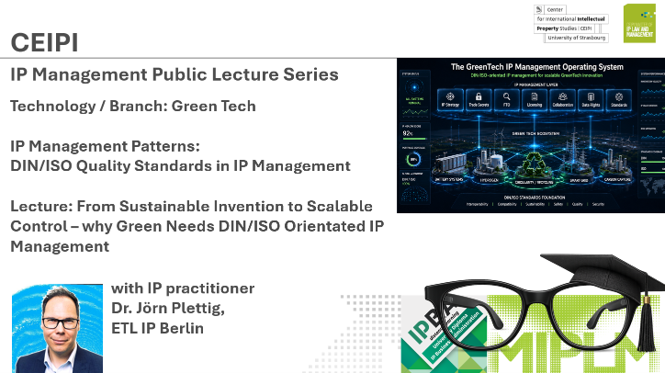
GreenTech innovation depends not only on sustainable technologies, but on managing the intellectual property distributed across patents, trade secrets, data, software, contracts and partnerships. DIN 77006 and ISO 56005 help companies embed IP into innovation management through defined responsibilities, documented processes, risk controls and continuous improvement. This supports controlled openness: sharing enough knowledge to collaborate, finance and scale while retaining ownership of commercially critical assets. For GreenTech companies, professional IP governance strengthens due diligence, investor confidence, freedom-to-operate planning and partner negotiations. It turns isolated inventions into scalable, defensible systems that combine openness, protection and competitive control across complex industrial ecosystems.
Open Source at the Wheel: IP Strategy for Software Defined Vehicles
Software-defined vehicles require a hybrid IP strategy combining open-source foundations with proprietary differentiation. Companies must manage licences, software provenance, supply-chain transparency, cybersecurity, patents, trade secrets and contribution policies. Effective IP management becomes part of software architecture, helping firms benefit from shared platforms while retaining control over interfaces, data and customer relationships.