
Authority Bridge: How IP Subject Matter Experts Can Reach Relevant Audiences Beyond the IP Bubble

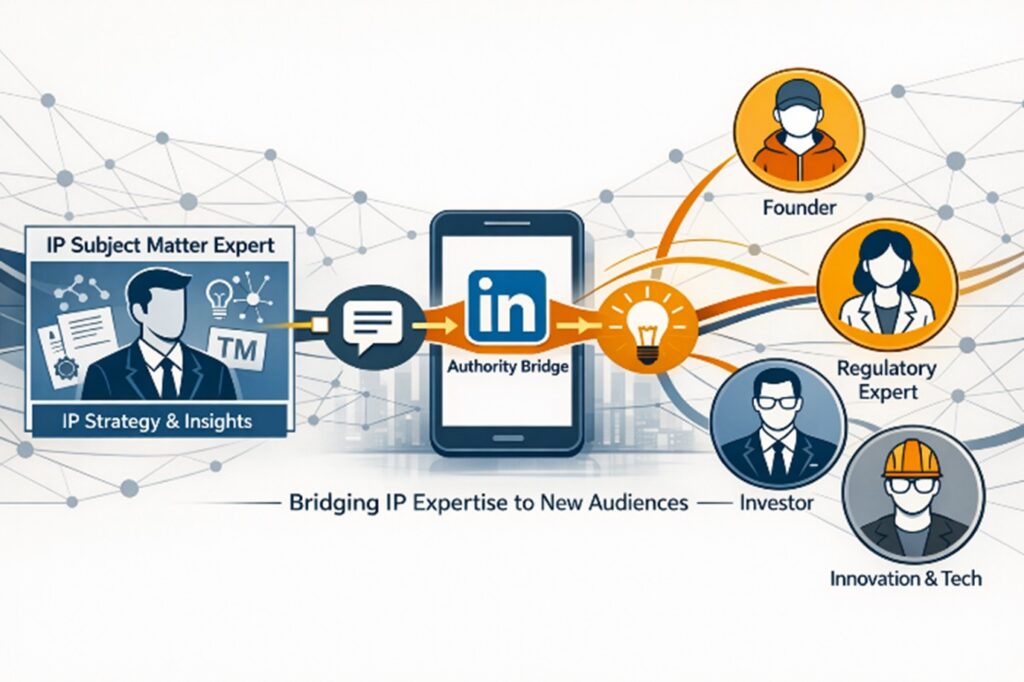
Authority Bridge is a service that places the insights of IP Subject Matter Experts into relevant influencer conversations already followed by their target audiences. The core problem is that IP often stays trapped inside its own professional bubble and reaches founders, investors, regulatory experts, or innovation teams too late. The solution is to add thoughtful, context-aware comments that connect the influencer’s topic with a relevant IP perspective and resource. This creates visibility, trust, and relevance through contribution rather than promotion.
The Problem: IP Expertise Often Circulates Inside Its Own Professional Circle
Here is an explainer video about the Authority Bridge.
One of the recurring frustrations in intellectual property communication is that strong expertise too often remains trapped inside a familiar professional loop. Patent attorneys speak to patent attorneys. IP strategists speak to other IP strategists. People who already understand the value of intellectual property keep explaining it to one another, while the audiences who most need that perspective never meaningfully encounter it. The result is not a lack of knowledge. It is a lack of distribution.
 This matters because most commercially relevant IP questions do not begin inside the IP profession. They begin elsewhere. They begin in software development, product management, venture capital, regulatory affairs, innovation teams, brand strategy, organizational design, or scale-up execution. By the time an issue becomes explicitly “an IP matter,” it is often already late in the process. The strategic moment was earlier, when a founder was shaping a business model, when a MedTech team was interpreting standards, when an operations leader was normalizing process debt, or when an investor was assessing defensibility.
 The examples you shared make this visible. In one post, a regulatory expert discusses how a single word such as “patient” can alter the standards scope for veterinary devices. The reply does not drag the discussion away from regulation. Instead, it adds an IP perspective by pointing out that small wording shifts can also redefine claim scope and protection strategy, then connects that idea to a digital IP lexicon 🧭dIPlex resource on digital transformation in MedTech. In another MedTech discussion, the comment links software compliance thinking with patentable software elements in medical devices. In the German examples, a debate about “projectification” is connected to Max Feucker’s work on IP Process Management, and a post about organizational debt is translated into a question about hidden debt inside innovation and IP-related processes.
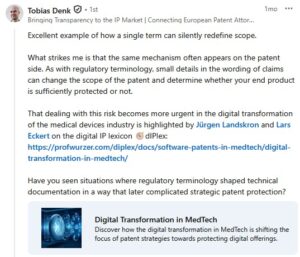
Here you can find this discussion
That is the core problem Authority Bridge addresses. The issue is not that IP Subject Matter Experts have nothing to say. The issue is that their knowledge is often published in the wrong place, in the wrong conversational frame, or at the wrong moment.
The Solution Model: Authority Is Built by Bridging Into Existing Conversations
Authority Bridge is a service model built on a simple insight: expertise gains traction faster when it enters a conversation that the target audience already considers relevant. Instead of waiting for non-IP audiences to come to an IP blog, glossary, letter, or profile page, Authority Bridge places the right idea into the right third-party conversation through a thoughtful, context-sensitive comment.
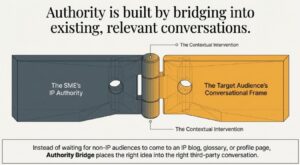 This is not classic influencer marketing. The goal is not borrowed fame. It is borrowed relevance. The external post creates an active context. The comment adds a disciplined layer of interpretation from an IP Subject Matter Expert. And the linked asset, whether a digital IP lexicon 🧭dIPlex entry, an 🔎IP management glossary page, an 📑IP management letter, or another 🔗IPBA Connect platform resource, gives the reader somewhere meaningful to go next. In that sense, Authority Bridge is not a traffic hack. It is a structured method for contextual market entry.
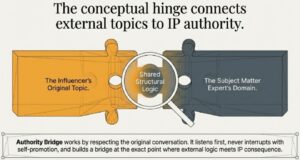
The model works because it respects the original conversation. It does not interrupt with self-promotion. It does not paste a generic sales message below a popular post. It listens first. Then it identifies a conceptual hinge between the influencer’s topic and the Subject Matter Expert’s area of authority. That hinge is where the bridge is built.
A good Authority Bridge comment usually does three things at once. First, it validates or sharpens the original point. Second, it reframes part of the discussion through the lens of IP, process design, standards logic, market defensibility, or another relevant specialist angle. Third, it offers a content asset that deepens the point without making the comment feel like an advertisement. The result is that the Subject Matter Expert appears not as an intruder, but as someone who belongs in that discussion.
Examples and Their Logic: How the Bridge Is Built in Practice
The MedTech examples show the model particularly well. In Beat Keller’s post, the topic is standards language and regulatory scope in veterinary devices. The reply does not suddenly start talking about patent law in isolation. It stays faithful to the original concern: small terms can silently expand or narrow scope. From there, it makes a parallel move into patent claim wording and strategic protection, then points readers to a resource on digital transformation in MedTech. That is a strong Authority Bridge move because the bridge is built on a shared structural logic: terminology defines scope.
The second MedTech example follows the same pattern from a different angle. Kiran Kumar Prabu’s post frames 2026 medical device standards as an integrated compliance challenge. The comment responds by introducing a publication from Jürgen Landskron and Lars Eckert on patentable software elements in medical devices and then asks whether patent thinking is being integrated into compliance workflows. Again, the move is subtle. It does not replace the conversation. It extends it. Regulatory and quality professionals are invited to see IP not as a downstream legal task, but as something that may belong inside the same operating logic. Here you can follow this discussion.
The German examples show that the same service works beyond legal or regulatory topics. Sascha Friesike’s post asks whether too many things are being turned into projects. The reply connects that discussion to Max Feucker’s approach to IP Process Management and asks whether projectification is mainly an organizational or cultural problem. That is important because it introduces IP expertise into a broader management debate without forcing the conversation into legal terminology. It makes IP process logic legible to an audience that may care about operations, leadership, and innovation systems more than patents as such. Here you can follow this discussion (in German).
The same happens in the post on organizational debt. The original topic is structural friction inside organizations. The response connects that idea to “the most important IP processes” and asks whether such debt is also visible in innovation processes. Here the bridge is not built around law at all. It is built around managerial consequences. That is exactly why it works. Many non-IP audiences are open to the logic of friction, hidden debt, and system design long before they are open to a direct conversation about IP strategy. Here you can follow this discussion (in German).
The Potential for the IP Community: From Insular Expertise to Shared Strategic Language
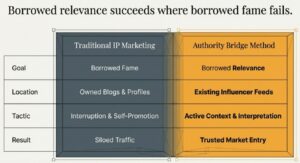 The larger potential of Authority Bridge for the IP community is significant. It offers a way out of insularity without requiring intellectual property professionals to dilute their expertise. In fact, it rewards the opposite. To build a good bridge, the Subject Matter Expert has to understand both their own domain and the external conversation well enough to connect them with precision. That makes the method intellectually demanding, but strategically powerful.
For IP Subject Matter Experts, this creates visibility where visibility actually matters: in the attention streams of founders, engineers, regulatory teams, investors, innovation leaders, and other decision-makers who may never search for IP content directly. For the wider market, it changes how IP is encountered. Instead of appearing as a specialist add-on after the “real” business discussion, IP shows up as part of the business discussion itself.
 That has cultural consequences for the profession. It can help reposition IP from a siloed function to a language of strategic interpretation. It can also create better entry points for trust. People rarely begin trusting a specialist because they saw a self-description. They begin trusting a specialist when they see that person make another conversation smarter.
In that sense, Authority Bridge is more than a commenting tactic. It is a distribution model for relevance. It helps IP Subject Matter Experts leave the comfort of the IP bubble without losing intellectual seriousness. And it gives the broader IP community a practical method for meeting other professional worlds where they already are, in the middle of the conversations that shape decisions before those decisions harden into missed opportunities.