Designing Around as a Growth Engine: How Nicos Raftis Builds Digital Visibility and Systematic Business Development on IPBA Connect


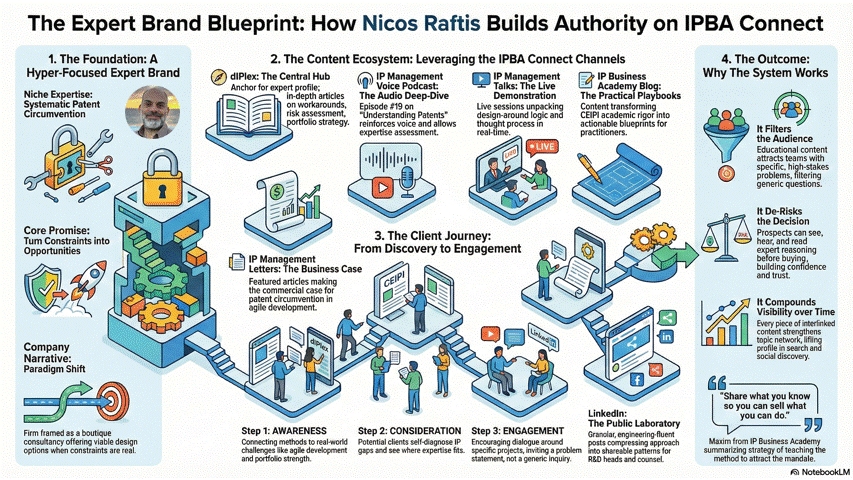
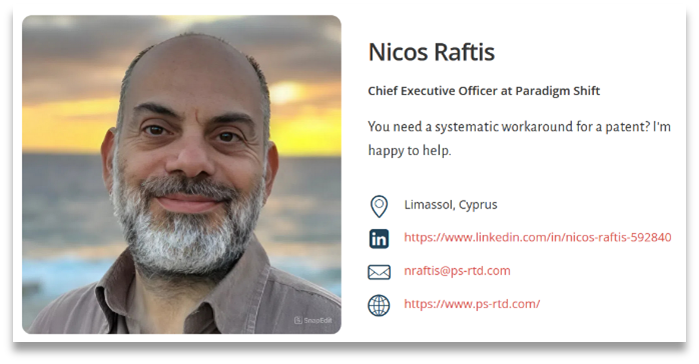
In the middle of most complex development projects sits a simple commercial truth: teams need options. When a competitor’s patent blocks a promising concept, progress stalls, budgets bleed, and a launch window narrows. Nicos Raftis has built his practice precisely for those moments. As an IP Subject Matter Expert on the IP Business Academy and 🔗IPBA Connect, he focuses on systematic patent circumvention—turning constraints into legal, technically robust alternatives that keep products moving and portfolios strengthening. His work shows how expert branding, digital visibility, and a repeatable client journey can convert specialized know-how into qualified conversations and mandates.
______________________________________________________________
 “The opportunity to use various channels as a subject matter expert for the targeted creation of patent circumvention solutions has helped me to raise awareness for my focus topics in the relevant circles. Active support in publishing content makes it easy for me to share my knowledge with others. In this way, I have been able to generate interest among potential clients and establish valuable business contacts.” Nicos Raftis, CEO at Paradigm Shift.
Personal Branding / Expert Branding: Name, Narrative, Niche
 Strong expert brands are specific. Nicos’ positioning is not “general IP advice” but a crisp promise: inventing around patents with clarity of function and structure. On the 🧭dIPlex hub that anchors his expert profile, he curates a tightly connected set of explainer pieces—how to find workarounds, how to leverage drawings in R&D, how to assess infringement risks under uncertainty, and how to use the process to build a strategic portfolio. This cluster communicates a unique, teachable method and signals to R&D leaders exactly where he creates value.
The expert story is reinforced by his firm’s public narrative. Paradigm Shift frames itself as a boutique technology consultancy trusted when “constraints are real,” with capabilities across conceptual design, inventing around, and prototype-driven development. The message is coherent: come with a tough patent problem; leave with viable design options and a clearer path to market.
Digital Visibility / Positioning: From Deep Dives to Applied Playbooks
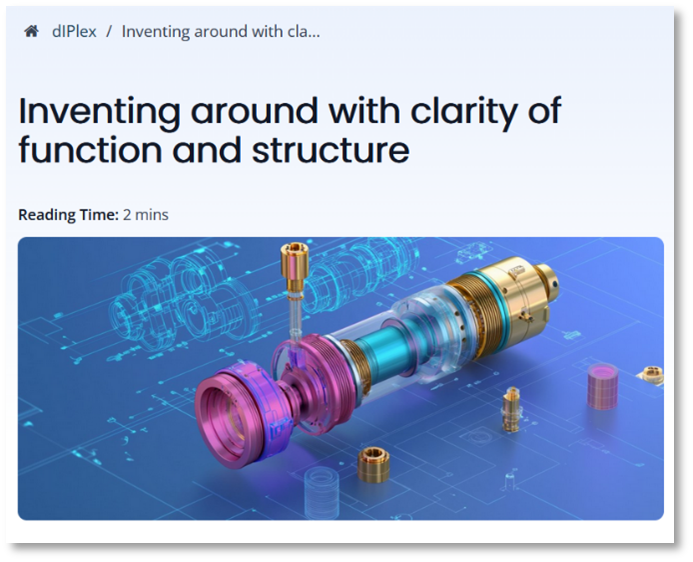 Visibility without context is noise. Nicos uses 🧭dIPlex to stage depth and progression: short, structured entries introduce core ideas (e.g., reading figures for function and structure), while longer pieces address live project dilemmas such as acting when independent claims look threatening but are still under examination. The result is “applied literacy”—content that helps teams think through FTO scenarios and make decisions under time pressure. Here you find Nicos 🧭dIPlex page inventing around with clarity of function and structure.
Crucially, the portfolio lens is never far away. One article explains how the same inventing-around process that avoids others’ claims can proactively seed a company’s own defensive and offensive filings—a message that resonates with executives who want fewer dead ends and more strategic IP assets.
Digital Marketing: Content That Teaches First, Converts Second
 On 🔗IPBA Connect, expert marketing is pedagogical: show how a method works in the real world, then invite the right teams to apply it. The IP Business Academy’s framework for systematic growth by IP experts emphasizes solving the innovation market gap—connecting users of the IP system with experts who provide context-aware solutions. Nicos’ content mirrors that blueprint: practical articles, lectures tied to CEIPI programs, and public interviews—all designed to educate decision-makers while signalling a specialized service proposition.
His feature 📑IP Management Letter on “IP in Product Development” makes the commercial case explicit: agile teams need a way to secure legal exclusivity as they iterate, and systematic patent circumvention provides a structured path to legal certainty and product differentiation. That narrative is marketing by teaching—relevant, specific, and actionable for product leaders.
LinkedIn: Proof of Thinking, in Public
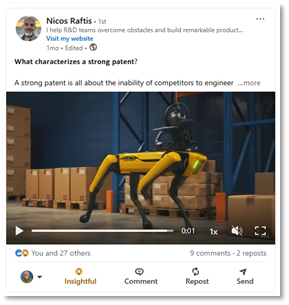 LinkedIn is Nicos’ laboratory for ideas and for trust. He posts granular, engineering-fluent takes on how claims describe protection but not operation, why early patent analysis uncovers performance headroom, and how to turn patent barriers into design prompts. These posts compress his approach into shareable patterns, and they create surface area for conversations with R&D heads, corporate counsel, and outside counsel. Here you find the LinkedIn profile by Nicos Raftis.
The platform connection loops back to IPBA assets. Episode #19 of the 🎧IP Management Voice podcast centers on “Understanding Patents”—context, visualization, and the strategic value of reading what’s claimed and what’s mechanically implied. Shared across channels, this reinforces his voice and makes it easy for prospects to assess fit in 20 minutes.
Thought Leadership: “Share what you know so you can sell what you can do”
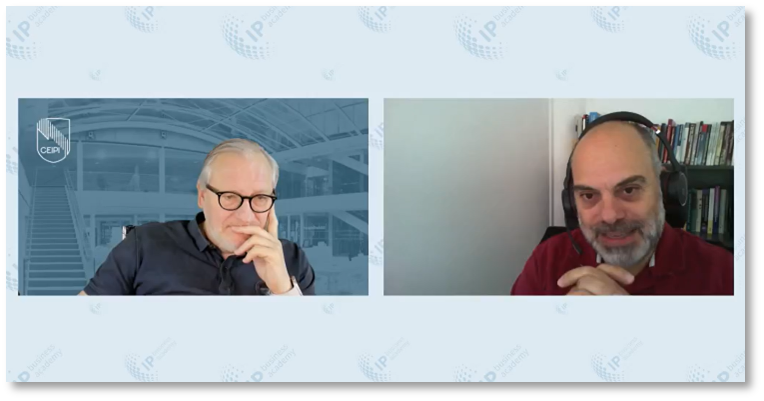 Nicos’ output exemplifies the Academy’s maxim: teach the method to attract the mandate. In addition to the podcast, a recorded 🖥️IP Business Talks session on designing around an avoiding patent infringement shows him unpacking design-around logic live—an effective format for demonstrating judgment under realistic constraints. When teaching moments are archived and interlinked (🧭dIPlex → 🎧podcast → 🖥️talk), they create a durable body of proof that shortens the time from first contact to scoped engagement.
Systematic Business Development: From Discovery to Qualified Conversation
The Academy’s model is explicit about business development: experts build a ladder of assets that move a prospect from awareness to consideration to engagement. In Nicos’ case, the ladder looks like this:
- Awareness: Blog posts and letters on the Academy and 🧭dIPlex that connect patent circumvention to agile product development and portfolio strength.
- Consideration: The CEIPI associated teaching materials and case-based articles in the 📑IP Management Letters and posts on the 📝IB Business Academy Blog — e.g., mapping product development stages to matching IP activities—help teams self-diagnose gaps and see where inventing-around expertise plugs in.
- Engagement: Live interviews (🖥️IP Business Talk), seminars (e.g., value-driven innovation), and targeted LinkedIn threads encourage dialogue around specific projects and constraints. Each touchpoint invites a problem statement, not a generic “contact us.”
Because every asset anchors to the same method, prospects encounter a coherent journey: understand the approach, recognize its fit, and then discuss an application to their own blocked path or portfolio objective.
Client Journey and Conversion: Designing for Moments That Matter
Conversion in expert services hinges on two inflection points: (1) the moment an internal team realizes their path is legally blocked, and (2) the moment leadership seeks a win that both avoids a competitor’s claim and expands their own moat. Nicos’ content anticipates both. The “uncertainty” article addresses real project timing—freezing design, locking tools, keeping launch dates—and establishes a calm, structured way to choose under risk. The portfolio article reframes design-around as an asset creator, not merely a defensive maneuver. These two pieces speak to both engineering urgency and executive strategy, which is why they convert.
Differentiation: Firm Brand vs. Expert Brand
A recurring pattern on 🔗IPBA Connect is the distinction between a law firm brand and an expert brand. Law firm brands commonly communicate institutional breadth and legal assurance. Expert brands communicate a personal method and a specific problem they can solve quickly. Nicos’ practice sits at the intersection: he collaborates with counsel yet owns a unique method that starts upstream—before a claim chart becomes a cease-and-desist. By operating as a named expert with a visible, teachable process, he complements firm work while remaining unmistakably distinct in scope and value.
Linked Learning Loops with CEIPI: Authority Meets Application
Teaching contributions to CEIPI IP Business Academy programs strengthen positioning. One letter presents a structured view of IP integration in product development, while other Academy posts transform classroom rigor into practitioner playbooks. Critically, these are not abstract lectures; they are blueprints executives can run tomorrow—mapping development phases, matching IP actions, and clarifying where inventing around removes blockers without jeopardizing timelines.
What “Good” Looks Like on the Page
Look closely at the architecture of Nicos’ pages and posts and you’ll see a few reliable patterns of effective digital marketing for experts:
- Clarity of audience: R&D leaders and technology executives under time and legal pressure.
- Concrete promises: From “systematic workaround” to “portfolio leverage,” the outcomes are explicit.
- Actionable depth: Articles show how to reason from figures to functions, how to treat dependent claims as decision signals, and how to stage portfolio moves.
- Interlinked formats: Short reads, long reads, a podcast episode, and a live talk connect in one narrative—easy to sample, easy to trust.
Why This Works: From Visibility to Mandates
Digital visibility that teaches a specialist method does three jobs at once. First, it filters. Teams with generic questions self-select out; teams with concrete constraints lean in. Second, it de-risks the expert choice for buyers: leaders can see the reasoning before they buy the service. Third, it compounds: every new case, post, or session plugs into the same topic network, lifting the entire surface of search and social discovery on IPBA Connect.
The Academy’s “systematic growth” perspective makes the commercial mechanism explicit: experts who consistently produce context-aware content aligned to real problems create a persistent channel between innovation users and specialist services. In that sense, Nicos’ digital presence is both storefront and studio—an always-on place where a niche capability is demonstrated, refined, and applied.
LinkedIn as an Extension of Method
Finally, LinkedIn brings the voice and timing of real projects into the feed. Posts that unpack how to reconstruct inner logic beyond claims, or how to use patents at the conceptual stage to spot performance headroom, reveal a discipline of thinking—not just a service list. Executives and engineers can “overhear” that thinking and respond when a current task mirrors the scenario in the post. That is conversion by relevance, not pressure.
Conclusion:
Nicos Raftis shows how an IP Subject Matter Expert can turn a narrow, high-stakes capability—systematic patent circumvention—into a modern, reference-rich expert brand on 🔗IPBA Connect. The combination of 🧭dIPlex pages, CEIPI-connected teaching, the 🎧IP Management Voice episode on understanding patents, and a steady stream of LinkedIn micro-insights builds a complete journey from discovery to decision. For product leaders and counsel who need options fast—and want those options to compound into a stronger portfolio—this is what expert marketing and systematic business development look like when they actually help teams ship.