
From Signals to Strategy: Three Key IP Management Trends Emerging from the Open Foresight Board


Corporate IP management is currently navigating a period of accelerated transformation. Technological advances, organizational pressure, and shifting business expectations are redefining what IP functions are expected to deliver — and how they create value inside companies.
Within the CEIPI IP Business Academy’s Open Foresight Program, practitioners from industry regularly reflect on these developments in a structured and systematic way. The objective is not prediction, but orientation: identifying meaningful signals early and translating them into actionable understanding for corporate practice and education.
As part of this process, members of the Open Foresight Board (OFB) recently participated in an exploratory trend study on the future of corporate IP management. In this article, we highlight three particularly visible signals from the study — not as a full ranking, but as an illustrative snapshot of what experienced corporate IP professionals currently perceive as most relevant.
1 . AI Is Becoming an Operational Reality for IP Functions
Artificial intelligence clearly stands out as a defining force in current IP practice.
What is notable is not simply its relevance — but the shift in perception: AI is no longer treated as a speculative future topic. Many organizations already experience it as part of everyday operations. The strongest focus lies on practical applications such as:
- prior-art searches,
- patent analysis and classification,
- drafting support,
- workflow acceleration.
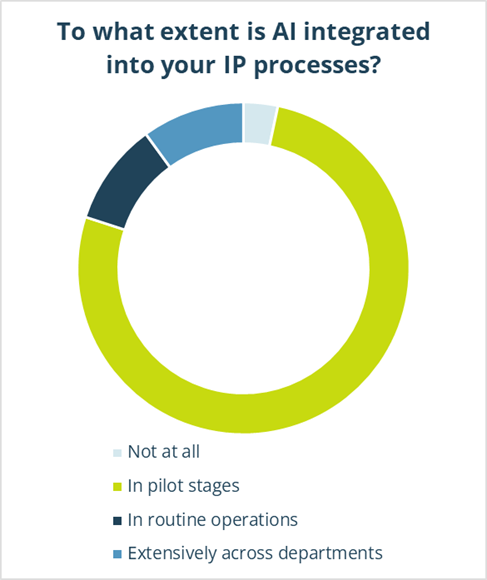 Beyond efficiency gains, respondents mainly frame AI as a practical shift in how IP work is executed rather than as a purely technological change. The open responses show a strong emphasis on operational support: speeding up research work, reducing manual workload, and automating back-office portfolio activities. AI is therefore less described as a standalone innovation and more as a layer that runs across existing IP workflows.
At the same time, many participants highlight a clear boundary between routine and complex work. While repetitive tasks such as classification, search preparation, or initial analysis are increasingly seen as suitable for AI support, strategic judgment and high-complexity decisions are still considered human domains. Several responses implicitly point toward a changing skills profile within IP teams — moving from manual execution toward interpretation, validation, and strategic decision-making.
An interesting observation emerging from the qualitative responses is that the conversation around AI is surprisingly pragmatic. Rather than abstract debates about disruption, practitioners describe incremental integration: experimentation, workload relief, and gradual adaptation of working models. This suggests that, in corporate IP practice, AI is currently experienced less as a revolutionary break and more as an operational accelerator that subtly reshapes how expertise is applied.
2 . Executive IP Awareness Emerges as a Strategic Bottleneck — and Opportunity
The second signal is organizational rather than technological: IP awareness at top management level.
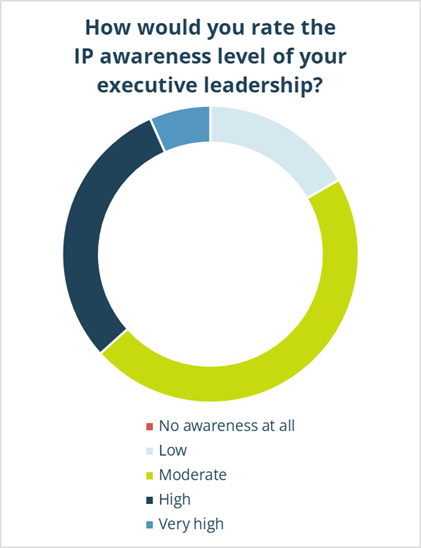 Across responses, participants consistently emphasize that the effectiveness of IP strategies depends heavily on executive understanding and engagement. Even sophisticated IP work risks remaining underleveraged if it is disconnected from leadership priorities.
Interestingly, the challenge appears less about awareness in principle and more about translation:
- IP topics are often perceived as complex.
- Executive agendas compete for attention.
- Strategic relevance is not always communicated in business language.
Where organizations report progress, recurring patterns appear:
- integrating IP discussions into existing decision processes,
- using concrete business cases instead of abstract IP concepts,
- maintaining continuous dialogue rather than one-time awareness initiatives.
The implication is clear: future IP leadership increasingly requires communication and narrative competence — connecting legal and technical expertise with strategic business framing.
3 . Automation Is Becoming a Necessity — Not a Vision Project
Automation of IP workflows forms a third strong signal.
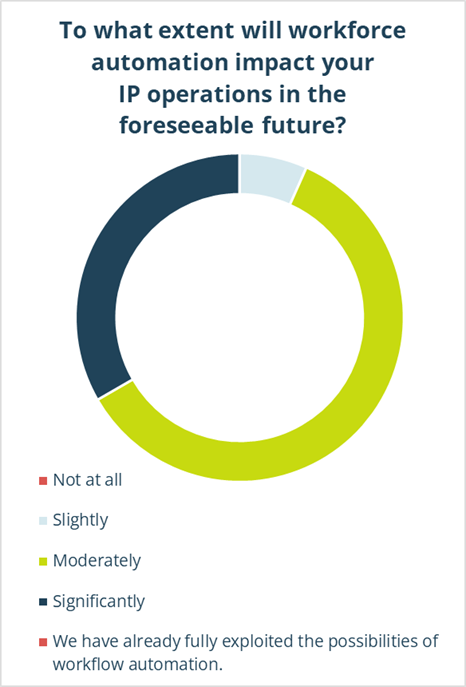 Notably, respondents rarely describe automation as a visionary transformation. Instead, it is seen as a pragmatic response to operational realities:
- increasing portfolio complexity,
- growing workload,
- limited human resources.
Automation is closely linked to AI adoption but carries a slightly different emphasis: scalability and operational resilience.
Typical areas mentioned include:
- administrative workflows,
- monitoring and reporting,
- portfolio analytics,
- routine management activities.
Many respondents expect a gradual shift in required skill profiles — from manual execution toward interpretation, coordination, and strategic decision-making. In this sense, automation does not replace expertise; it reallocates where expertise is most valuable.
Reading the Bigger Picture: What These Signals Have in Common
Taken together, these signals reveal an important underlying pattern.
Relevance in corporate IP management is increasingly driven by:
- immediate operational pressure,
- organizational maturity,
- exposure to uncertainty and risk,
rather than by abstract future visions.
In practice, this means IP functions are evolving from primarily protective roles toward continuous organizational sense-making — connecting technology, strategy, and business decision processes.
These insights emerge within the framework of the Open Foresight Program, an initiative designed to strengthen foresight capabilities across the IP community rather than to produce fixed forecasts.
The program brings together practitioners and experts to:
- identify emerging developments and weak signals,
- prioritize topics relevant for IP management,
- translate foresight into education, training, and practical guidance.
As outlined in the Open Foresight Program overview, the approach is intentionally collaborative and iterative. It combines expert input, continuous monitoring, and structured reflection to improve the collective ability to anticipate and interpret change.
The Open Foresight Board plays a central role in this process by contributing real-world corporate perspectives — ensuring that insights remain grounded in operational reality rather than abstract theory.
👉 Learn more about the program here: https://ipbusinessacademy.org/open-foresight-program/program-overview
Looking Ahead
The three trends outlined here are not exclusive or final. They simply represent a strong intersection where practitioner perspectives currently converge.
The broader lesson might be this:
IP management is entering a phase where technology, organization, and strategy are no longer separate layers — they are becoming deeply interdependent.
And the organizations that build foresight capabilities early will likely be better positioned to navigate that complexity.