What Makes Digital Marketing for IP Law Firms Work: Hoffmann Eitle, Marks & Clerk and the Logic of Visible IP Authority

Digital marketing for IP law firms works best when recognition does not stand alone. An award, a ranking or a landmark case can create attention, but attention becomes commercially relevant only when it confirms something the market can already recognise: a clear field of expertise, a credible pattern of work, and a visible position in the client’s decision environment.
This is why Hoffmann Eitle and Marks & Clerk are useful examples. Both firms have recently been recognised for work with strong European patent relevance. Hoffmann Eitle received several Managing IP EMEA Awards 2026, including recognition connected to Europe Impact Case of the Year and Europe Cross-Border Patent Litigation Team of the Year categories. Marks & Clerk received an Impact Case of the Year award for its work on G2/24. The marketing lesson is not simply that both firms won awards. The more interesting point is that both show how patent expertise becomes visible when it is connected to cases that shape how the market understands risk, procedure and strategic choice.
Hoffmann Eitle: Turning European patent complexity into litigation authority
Hoffmann Eitle is a strong example of a firm whose digital visibility can be built around European patent depth. The firm is not only associated with prosecution strength, but also with increasingly visible litigation and cross-border patent work. That combination matters because European patent disputes are rarely isolated legal events anymore. They often sit between technical substance, procedural timing, commercial pressure and strategic geography.
The Managing IP EMEA Awards 2026 make this visibility concentrated. Hoffmann Eitle received recognition connected to matters such as G1/23, Fujifilm v Kodak, Astellas Xtandi and Moderna Biontech/Pfizer. These are not random reputation signals. They point to work in legally and commercially significant patent disputes across Europe, where legal reasoning, procedural positioning and market consequences meet in ways clients can understand as strategically relevant.
This matters because European patent litigation has become harder to explain to clients in simple national terms. The rise of the Unified Patent Court, the continuing relevance of EPO proceedings, national litigation, cross-border coordination and portfolio-level enforcement choices all interact. Clients are not only asking whether a patent is strong. They are asking where to act, when to act, how much risk to take and how one decision affects the wider European position.
That is where the digital marketing opportunity lies. For a firm like Hoffmann Eitle, the message is not merely “we litigate patents.” A stronger message is that the firm operates where European patent decisions become strategically consequential. The awards support this message because they relate to matters that sit at the intersection of legal development, procedural complexity and commercial stakes.
JUVE Patent’s Germany 2025 coverage also reinforces this positioning. Hoffmann Eitle is described as combining a strong litigation team with one of Germany’s largest patent prosecution practices, while the firm also communicates strong rankings in litigation for patent attorneys and lawyers. From a digital marketing perspective, this creates a powerful architecture: prosecution depth gives technical credibility, litigation recognition gives dispute credibility, EPO and UPC relevance give European procedural credibility, and cross-border case work gives strategic credibility.
The key is that these signals should not remain separate. If they are connected, they tell one coherent story: Hoffmann Eitle can be positioned as a firm that helps clients navigate European patent value when technical, procedural and commercial questions converge. In digital marketing terms, this is not a story about being generally excellent. It is a story about becoming visible at exactly the point where clients need orientation.
Marks & Clerk: Turning impact cases into patent authority
Marks & Clerk represents a different but related model. The firm’s Managing IP recognition for G2/24 is a strong example of how an impact case can become more than a news item. G2/24 is not just a case reference. It is a signal that the firm has been involved in work that matters beyond a single client matter and affects how parts of the patent system are understood.
That is an important distinction in digital marketing for IP firms. Many firms publish case updates, but fewer firms manage to make case involvement part of a recognisable authority position. An impact case allows a firm to say, without overstating the point, that its work is not only part of legal practice, but part of how the law develops. This turns a legal event into a market signal.
This is especially relevant for patent attorney firms. Much of their value can be difficult for the market to see, because drafting, prosecution, oppositions, technical argumentation and procedural strategy often happen behind the scenes. Clients may experience the result, but the market does not always see the thinking that produced it. An impact case changes that by making invisible technical and procedural expertise visible through a public legal event.
Marks & Clerk’s broader award environment also supports this logic. The firm was shortlisted for several Managing IP EMEA Awards 2026 categories, including UPC Firm of the Year and Patent Disputes Firm of the Year in England, as well as individual recognitions and prosecution recognition in Scotland. This creates a useful marketing bridge. Marks & Clerk can be seen not only as a firm with patent prosecution scale and technical breadth, but as a firm whose work also connects to disputes, UPC relevance and legal developments with wider market impact.
The digital lesson is clear: technical patent expertise becomes more commercially visible when it is anchored in moments where the law moves. For clients, such moments are not abstract. They affect strategy, timing, procedural choices, risk assessment and confidence in enforcement or defence. For the firm, they create an opportunity to connect technical depth with the client’s need for guidance in a changing patent environment.
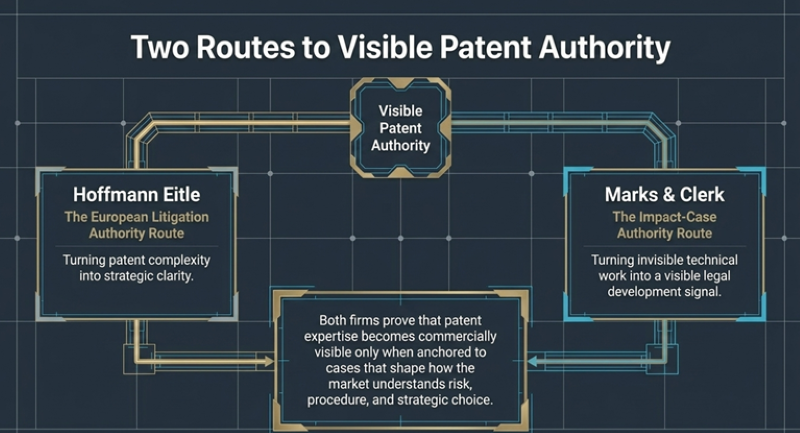
Two routes to visible patent authority
Hoffmann Eitle and Marks & Clerk show the same principle through two different routes. Hoffmann Eitle shows the European litigation authority route. Its recognition is connected to complex cross-border disputes, impact cases and a strong German litigation profile. The marketing logic is built around the ability to handle patent complexity across technical, procedural and commercial layers.
Marks & Clerk shows the impact-case authority route. Its recognition around G2/24 shows how a patent attorney firm can turn participation in a legally significant development into a broader authority signal. The marketing logic is built around making technical and procedural contribution visible through cases that shape market understanding. Both routes are valuable because they solve the same problem: patent expertise is often difficult to evaluate before a client relationship begins.
Prospective clients may not be able to judge the quality of claim drafting, opposition strategy, procedural choices or litigation coordination in detail. They need signals that translate expertise into confidence. Awards and rankings can help, but only if they are embedded in a clear positioning story. Without that story, recognition remains a short-lived reputation signal. With that story, it becomes part of a decision architecture.
The award is not the message
The common mistake is to treat awards as standalone announcements. A firm wins an award, posts the news, receives attention for a few days, and then the signal disappears into the archive. That is not enough if the goal is to make the firm easier to understand, remember and choose.
The stronger approach is to ask what the award confirms. Does it confirm a litigation identity, a sector position, a prosecution strength, a cross-border capability, a role in shaping legal development or a connection to client problems that are becoming more urgent? This question changes the function of the award. It is no longer only a badge of honour. It becomes evidence within a broader positioning system.
For Hoffmann Eitle, the Managing IP awards can confirm a European patent litigation and cross-border strategy narrative. For Marks & Clerk, the G2/24 recognition can confirm an impact-case narrative around technical patent expertise and legal development. In both cases, the award should connect to practice pages, case commentary, partner profiles, client problem statements, industry relevance and repeated insights. Only then does recognition become a reason to be chosen.
What IP law firms can learn from this
The most important lesson is that digital marketing for IP law firms should not start with communication. It should start with the question of market recognition. What should the market remember this firm for? If the answer is too broad, the marketing becomes generic. If the answer is too narrow, the firm may hide important strengths. The right answer often lies in connecting a real competence pattern with a client decision problem.
Hoffmann Eitle and Marks & Clerk both show how this can work. One firm can be read as a European patent complexity case: prosecution depth, litigation strength, EPO relevance, UPC relevance and cross-border work can form one authority architecture. The other firm can be read as an impact-case visibility case: technical patent work becomes more visible when it is linked to legal developments that matter beyond the individual file.
Both examples show that strong digital marketing does not invent expertise. It organises it. It takes elements that already exist, such as awards, cases, rankings, people, technical fields and procedural experience, and connects them in a way that helps the market understand why the firm matters. That is the difference between content production and market positioning.
From expertise to choice
For IP law firms, the commercial challenge is rarely a complete lack of expertise. The more common challenge is that expertise remains fragmented in the market’s perception. A ranking here, an award there, a case note, a partner profile, a practice page and a conference appearance may all be true and valuable. But if the elements are not connected, they do not create a strong reason to choose the firm.
Hoffmann Eitle and Marks & Clerk show how recognition can become more powerful when it is treated as part of a positioning system. The real marketing value lies not in saying that a firm has been recognised. It lies in showing what that recognition reveals about the firm’s role in the patent market and why that role matters for the next client decision.
Digital marketing for IP law firms works when it turns expertise into a visible choice architecture. Hoffmann Eitle shows how European patent complexity can become litigation authority. Marks & Clerk shows how an impact case can make technical patent expertise visible. Together, they show why the strongest IP marketing does not simply report success, but explains why that success matters to the next client decision.