Industrial IoT in Motion: Why Smart Manufacturing Turns IP into a System Question

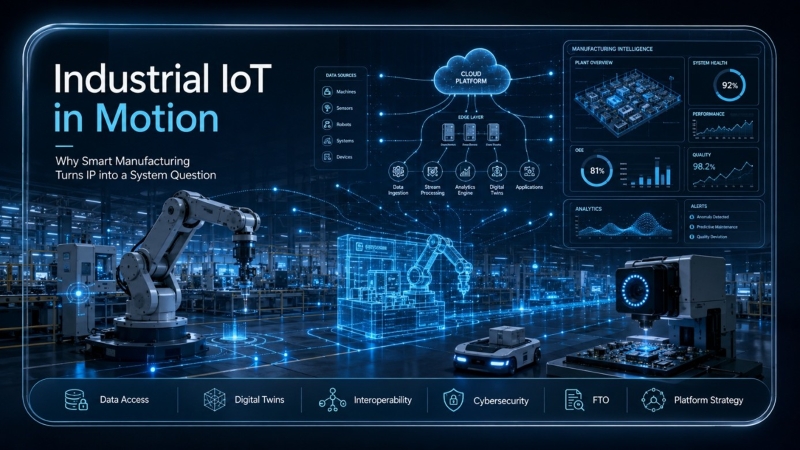
Industrial IoT and Smart Manufacturing are no longer only about connecting machines, sensors and production systems. They are changing how industrial value is created, monitored, optimized and protected. The IP question is therefore no longer limited to whether a specific device, algorithm or technical feature can be protected. It is becoming a system question: who controls the relevant data, software, interfaces, models, standards, operating knowledge and commercial options in a connected production environment?
This topic matters because it shows how IP is moving from a narrow legal protection function into a strategic decision system for control, collaboration, market access, risk management and competitive positioning.
Connected production has become a practical reality
Industrial IoT used to be discussed as a future layer of the factory. Today, it is increasingly part of ordinary industrial decision making. Machines collect data. Sensors monitor performance. Production lines are optimized through software. Digital twins simulate physical assets. Predictive maintenance turns operational data into service decisions. Connectivity links products, customers, suppliers, platforms and service providers.
This is why Industrial IoT cannot be treated as a narrow patent topic. It brings together hardware, software, data, communication protocols, artificial intelligence, cybersecurity, engineering know-how and commercial service models. In many cases, the economically relevant innovation is not located in one component, but in the interaction between several layers.
Justus Kreuels, Patent Attorney and European Patent Attorney at Kreuels Henrichs Pannen, captures this development in his article “Internet of Things – patent law aspects” when he writes: “With the rapid developments in the field of IoT, the number of patent applications for computer-implemented inventions is continuously increasing.”
That observation matters beyond filing statistics. It shows that IoT innovation increasingly moves into the area of computer-implemented inventions, where patentability, technical contribution, software architecture and system integration must be assessed together. For industrial companies, this creates a practical challenge: the visible product may be a machine, device or sensor, but the protectable and commercially decisive contribution may sit in data processing, control logic, connectivity, system behaviour or the way the machine interacts with a wider production environment.
IoT turns individual technologies into industrial systems
The Internet of Things is not one technology. It is a bundling mechanism. Sensors, software, communication modules, processors, cloud systems, edge computing, user interfaces and analytics are combined in physical objects and industrial processes. Kreuels describes this structural character of IoT when he notes that “The Internet of Things is implementing a large number of technologies, some of which are patent-protected, in everyday objects.”
In Smart Manufacturing, the same logic applies with higher strategic intensity. A connected machine may include patent protected sensor systems, embedded control methods, industrial communication protocols, predictive algorithms, user dashboards, service interfaces and cybersecurity features. At the same time, the machine may depend on third party standards, supplier software, cloud infrastructure and data access rights.
For IP management, this changes the unit of analysis. The relevant question is not only whether one invention is new and inventive. The more strategic question is how the whole system can be operated without losing freedom to act, differentiation and bargaining power.
A company may hold patents on a sensor arrangement, but depend on external connectivity standards. It may operate a powerful predictive maintenance model, but lack clear rights to use customer generated machine data. It may design a proprietary platform, but need interoperability to enter the market. It may rely on trade secrets for model training, but face disclosure demands from customers, regulators or partners. These are not isolated legal questions. They are business architecture questions with IP consequences.
Digital twins make industrial knowledge actionable
Digital twins show particularly clearly why Smart Manufacturing turns IP into a system question. They connect physical assets with virtual models and real time data flows. This makes them more than engineering tools. They become instruments for simulation, prediction, lifecycle management, service design and operational decision making.
Darena Slavova, UK and European Patent Attorney at Mewburn Ellis, describes the practical relevance of digital twins in ship design and maintenance. She writes that “digital twins enable maritime stakeholders to test scenarios, predict failures, and make smarter, data-driven decisions.”
Although the maritime example is sector specific, the underlying logic is directly relevant for Smart Manufacturing. A digital twin of a production asset can help companies test configurations, anticipate failures, optimize energy use, improve quality, support maintenance and generate evidence for compliance or performance claims. The value lies not only in the virtual model itself, but in the continuous relationship between physical system, live data, analytics and decision making.
This creates a new IP management challenge. The protected contribution may lie in sensor integration, data processing, simulation methods, predictive algorithms, model updating, control feedback or the specific way in which the digital twin supports industrial decisions. Slavova therefore points out that “From sensor integration techniques and predictive algorithms to simulation methods and data processing systems, many aspects of digital twin systems are patentable.”
That statement is important because it moves the discussion beyond a simplistic view of software. Digital twins are not merely abstract models. They can be embedded in technical systems, generate technical effects and support real world industrial operations. The strategic IP question is how to protect the parts of the digital twin architecture that create defensible value, while still enabling integration, collaboration and scaling across customers and industrial partners.
Computer implemented technologies create new patent and portfolio questions
Computer implemented technologies are becoming central to physical industries. This is not limited to classic manufacturing. Agriculture, maritime operations, energy systems, logistics and medical technology all show the same structural pattern: physical assets are monitored through sensors, represented in digital models, optimized through AI and embedded in service ecosystems.
Chris Bird and Dean Bradley of FPA Patent Attorneys illustrate this in their article “Pixel perfect pastures: Patents in computer-implemented agriculture.” They describe how digital twins, IoT sensors and AI are being combined in agricultural applications. Their observation that “Digital twins integrated with distributed IoT sensors and powered by AI and machine learning models are emerging as powerful tools” is highly relevant for Industrial IoT as well.
The sector may differ, but the IP problem is similar. Computer implemented innovation becomes patent relevant when it produces tangible technical effects, improves physical processes or enables new system functionality. The question is not whether a computer is involved. The question is whether the computer implemented solution changes the way a technical system works or creates a concrete industrial advantage.
This has direct consequences for portfolio architecture. A company developing Industrial IoT solutions may need to protect multiple layers: physical sensor arrangements, control methods, data processing pipelines, digital twin simulation methods, AI assisted prediction, edge computing architecture, communication interfaces and service workflows. Some elements may be suited for patent protection. Others may be better protected as trade secrets. Some may need to be contractually controlled. Others may have to remain open to support interoperability or standard adoption.
Regulation is changing the IP context of connected products
The strategic urgency is reinforced by regulation. The EU Data Act is applicable from 12 September 2025 and gives users of connected products, including businesses, rights to access data produced through the use of smart objects, machines and devices. For Industrial IoT, this is a fundamental shift. Machine data, performance data and operational data can no longer be treated as a purely internal resource by default.
This affects IP management in several ways. Companies must decide which data they can exclusively control, which data must be made accessible, which data should be protected through trade secrets, which data should support service models and which data can be shared without weakening competitive position. The economic value of a connected machine may depend less on hardware ownership and more on data access, data quality, analytics capability and contractual architecture.
Cybersecurity is becoming similarly important. The EU Cyber Resilience Act introduces mandatory cybersecurity requirements for manufacturers of products with digital elements. These obligations cover planning, design, development and maintenance across the product lifecycle. For Smart Manufacturing, cybersecurity therefore becomes part of product architecture, market access and trust.
This is not merely a compliance issue. Security related design decisions can influence patent strategy, software architecture, update obligations, disclosure practices, supplier contracts and customer confidence. A connected product that cannot be securely maintained may become commercially fragile even if the technical invention itself is strong.
Why fragmented advice is no longer enough
Industrial IoT exposes a gap in traditional advisory models. Patent advice may focus on claim drafting and filing strategy. IT advice may focus on infrastructure. Data advice may focus on access and contractual rights. Cybersecurity advice may focus on compliance. Business teams may focus on service models and customer adoption. Each perspective is necessary, but none is sufficient on its own.
The strategic problem is that Industrial IoT decisions are interdependent. A decision to open an interface can support market adoption but reduce exclusivity. A decision to keep an algorithm secret may protect know-how but limit enforceability. A decision to rely on a standard can enable scale but create licensing and freedom-to-operate issues. A decision to collect machine data can unlock service revenues but trigger access obligations and customer negotiation. A decision to build a digital twin can create strong differentiation but also require careful ownership and data governance across the lifecycle.
This is where IP management becomes decision architecture. It helps companies identify where value is created, where control is needed, where openness is useful, where legal risk becomes strategic risk and where early choices determine future bargaining power.
The role of IP experts in Smart Manufacturing
IP experts are needed not only to explain legal rules, but to translate between technical systems, business models and strategic choices. In Industrial IoT, they must help companies ask better questions earlier.
Where does the innovation actually sit: in the device, the software, the data model, the interface, the service process or the system behaviour? Which rights are needed for market entry? Which assets are critical for investment readiness? Which standards create dependency? Which third party rights may affect freedom to operate? Which data positions must be secured before the business model scales? Which elements should be patented, licensed, kept secret, published, standardized or contractually controlled?
This is also why Industrial IoT matters for different actors in different ways. Startups need to show investors that their technical solution is not only innovative, but defensible and scalable. Established manufacturers need to avoid becoming hardware suppliers in ecosystems controlled by platforms, data owners or software providers. In-house IP teams need to coordinate with R&D, IT, product management, cybersecurity, legal, sales and business development. Patent attorneys need to understand not only technical patentability, but also the commercial context in which the protected system will operate. Standardization bodies, regulators and public institutions shape the environment in which interoperability, access and competition are negotiated.
Strategic implications
Industrial IoT and Smart Manufacturing are no longer peripheral topics for IP management. They are part of the infrastructure of modern industrial competition. Connected production changes where value sits, how control is exercised and when IP decisions must be made.
First, Industrial IoT shifts IP from product protection to system positioning. The relevant advantage may lie in the relationship between machine, data, software, model and service.
Second, digital twins turn industrial knowledge into actionable decision systems. Their IP relevance depends on how sensors, models, analytics and technical effects interact.
Third, computer implemented technologies require careful patent strategy because the boundary between abstract software and technical contribution remains strategically important.
Fourth, data regulation and cybersecurity regulation are changing the conditions under which connected products can be commercialized, maintained and scaled.
Fifth, companies that treat Industrial IoT as a set of separate legal, technical or compliance issues risk missing the strategic picture. Companies that address it as an integrated IP management question can build better freedom to act, stronger negotiation positions and more resilient industrial business models.
The core conclusion is simple: Smart Manufacturing turns IP into a system question because the factory itself is becoming a connected, data dependent and software shaped environment. In that environment, IP strategy must follow the architecture of value creation, not only the boundaries of individual inventions.