
IP Management Control Systems in Quantum Technology: CEIPI MIPLM 2025/26 Modul 5


The lecture on Management Control Systems in the CEIPI Master of Intellectual Property Law and Management addresses a central problem of modern corporate management: how can organizations make intangible assets visible, measurable, and manageable without reducing them to simplistic numbers? This question becomes especially relevant when intellectual property is not merely a legal instrument, but part of the strategic architecture of innovation.
In traditional industrial settings, management control systems were largely built around tangible assets, production efficiency, costs, margins, liquidity, and return on invested capital. These indicators still matter. Yet they do not fully explain how companies create value in technology fields where knowledge, data, ecosystems, standards, and exclusive positions shape future competitiveness. Quantum technology is a particularly powerful example of this shift. It is scientifically demanding, commercially uncertain, and strategically important long before mass markets fully emerge.
The uploaded case on KPIs for quantum technology shows why classical R&D indicators are not enough. Counting patents, prototypes, publications, or short-term milestones may create an impression of progress, but it does not necessarily show whether an organization is building the capabilities required to create future value. In quantum technology, the more relevant question is often not “What has already been delivered?” but “How well is the organization preparing itself for future opportunity spaces?”
Here you can find the 🔬Research Nugget 📑IP Management Letter “How Metrics can Transform IP from a Cost Centre to a Strategic Asset”.
Management Control as Target-Oriented Management
The lecture begins with a general understanding of management control systems. Controlling is presented as business-management support through information, planning, and control. Its purpose is not simply to collect data, but to enable target-oriented management. In other words, controlling should help organizations understand where they stand, where they want to go, and what must be adjusted to get there.
This is important because companies operate under increasing complexity. Markets become more dynamic, technologies more sophisticated, competition more intense, and decision-making less transparent. Management control systems respond to this by maintaining the organization’s capacity to act, adapt, anticipate, and coordinate. They translate uncertainty into structured management attention.
The lecture distinguishes between strategic and operative management. Operative management is concerned with short- and medium-term efficiency, profit, liquidity, and internal processes. Strategic management is concerned with long-term profit potentials, environmental orientation, qualitative judgement, and the question of whether the organization is doing the right things. This distinction is essential for IP management because intellectual property often contributes less to immediate operational performance and more to future strategic potential.

Structure of Management Control and Corporate Management
A patent portfolio may not immediately increase revenue. A trade secret may not appear as a financial asset on the balance sheet. A carefully built exclusivity position may only become decisive years later when a market matures. For this reason, IP controlling must be much more than cost reporting. It must connect IP activity to strategic intent.
Here you can find the 🔎IP Management Glossary entry on IP Process Controlling.
Why Intangible Assets Need Their Own Control Logic
The lecture makes clear that today’s business models differ significantly from traditional industrial models. In an industrial sellers’ market, success was often linked to cost-efficient production, tangible assets, and margins. In today’s buyers’ markets, success increasingly depends on customer value, innovation power, adaptability, and the ability to partner.
This shift changes the role of controlling. If intangible assets are central to value creation, then management control systems must be able to recognize them. Intellectual property is one of the most important forms of such intangible assets, but it is also one of the hardest to control. It is legal, technical, strategic, and economic at the same time.
IP controlling therefore has to create transparency where traditional accounting systems remain blind. It must show which IP activities support the business model, where resources should be allocated, which exclusivity positions matter, and whether the portfolio is aligned with future value creation. The lecture identifies transparency, resource allocation, control, and optimization as central benefits of IP controlling.
However, IP controlling also has clear limitations. IP is technically complex, which means that controllers often cannot assess the substance of rights without expert input. IP costs are difficult to influence once rights are created, because renewal fees and procedural costs follow external structures. IP rights are also legally fixed once filed, which limits the possibility of later adjustment. Finally, the economic benefit of individual rights is difficult to prove, because causal links between IP and market success are often indirect.
These limitations are not weaknesses of IP controlling. They define its specific character. IP controlling cannot simply copy the instruments of financial controlling. It must build its own logic around strategy, learning, portfolio orientation, and market impact.
The IP Controlling System: Strategy, Portfolio, and Exploitation
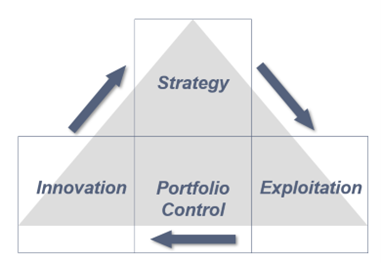
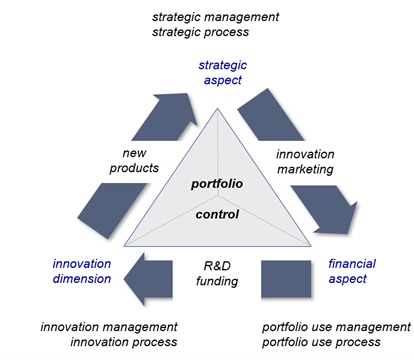 The lecture presents IP controlling as a system that connects three areas: strategy, portfolio control, and innovation exploitation. This is a useful structure because it prevents IP management from becoming isolated legal administration.
At the strategic level, IP controlling asks whether intellectual property supports the business strategy and patent strategy. It looks at market development, competitive background, opportunities, risks, and defined goals. At the portfolio level, it asks whether the company should invest, divest, slim down, or strengthen certain parts of the portfolio. At the exploitation level, it asks whether the portfolio is actually used to support innovation, market access, customer benefit, and economic value.
The lecture’s intellectual property value chain captures this process from R&D and innovation to protection, patent strategy, portfolio management, reporting, controlling, use, and sale. This value chain is important because it shows that IP controlling should not start only after patents have been granted. By then, many strategic options have already been fixed. Effective IP controlling has to accompany innovation early enough to influence what is protected, why it is protected, and how protection relates to the business model.
 This is especially relevant for quantum technology. In such a field, it is rarely sufficient to ask whether a technical invention can be patented. The deeper question is which future position the organization wants to occupy. Does it want to protect core hardware components, error correction methods, control systems, cryogenic interfaces, algorithms, sensing applications, manufacturing know-how, or integration knowledge? Each of these choices creates a different strategic option.
The IP Controlling Cockpit
One of the practical tools introduced in the lecture is the IP Controlling Cockpit. It integrates different controlling perspectives into one management framework. The first perspective is IP cost controlling. It creates transparency about official fees, attorney fees, translation costs, and renewal fees. This is necessary for budgeting, but it is only the starting point.
The second perspective is business model orientation. Here, IP rights are assigned to specific business model targets. The key question is whether the portfolio protects what actually matters for value creation and customer benefit. A portfolio may look impressive by number of rights, but still be strategically weak if those rights protect peripheral features rather than decisive value elements.
The third perspective is market impact. This asks whether IP contributes to observable economic effects such as price premiums, market share, competitive cost advantages, or defensible customer benefits. This is difficult to measure, but it is essential. IP only becomes economically meaningful when it supports a position that matters in the market.
For established technology fields, these three perspectives can often be applied with relatively concrete data. Products exist, customers are known, competitors are visible, and market prices can be compared. In quantum technology, the situation is different. Markets are still emerging, applications are not always fixed, and customer benefit may be speculative or indirect. Therefore, the cockpit must be adapted.
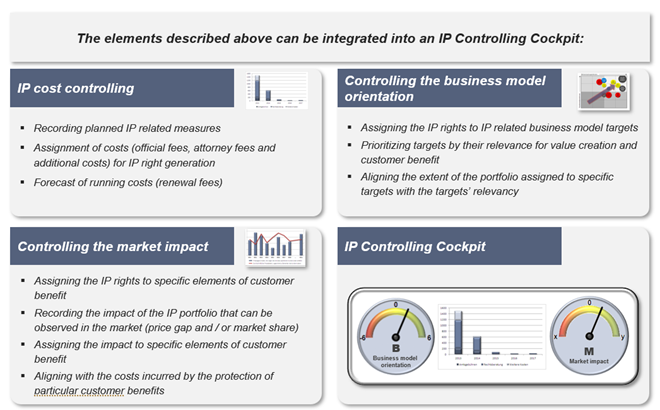
Example of an IP Controlling Cockpit
Why IP Controlling in Quantum Technology Must Be Different
IP controlling in quantum technology must be different from IP controlling in established technological fields because the object of control is fundamentally different. In an established field, companies often know the product architecture, the relevant customer needs, the main competitors, the standards, the cost structures, and the commercialization pathways. IP controlling can therefore focus on portfolio efficiency, market coverage, cost-benefit alignment, and competitive blocking positions.
Quantum technology does not offer this level of stability. It is characterized by deep technological uncertainty, long development horizons, interdisciplinary dependencies, and evolving ecosystems. The value of IP may lie less in protecting a current product and more in creating future strategic options.
This changes the meaning of performance. In a mature technology field, performance can often be measured by output: number of filings, claim coverage, licensing revenues, product protection, or enforcement success. In quantum technology, performance may consist in learning faster than competitors, securing access to critical knowledge networks, reducing technological uncertainty, building internal absorptive capacity, or shaping emerging standards.
The uploaded case expresses this clearly through the distinction between traditional R&D metrics and quantum innovation KPIs. Conventional indicators focus on relatively direct outputs such as patents, prototypes, milestones, or short-term R&D returns. In quantum technology, these indicators remain relevant but insufficient. KPIs must also capture capability formation, strategic positioning, experimental reliability, interdisciplinary collaboration, and preparedness for future opportunity spaces.
This means that IP controlling must become more forward-looking. It must not only ask whether a granted right currently creates value. It must ask whether the organization is building a defensible position in a field where value may materialize later. A patent in quantum technology may be valuable because it secures a technological pathway, strengthens the company’s role in a consortium, supports standardization influence, improves negotiation power, or signals competence to investors and partners.
IP controlling must also become more ecosystem-sensitive. In established fields, a company may control value through product protection and market exclusivity. In quantum technology, value often emerges through collaboration between universities, startups, corporates, suppliers, public research organizations, and standard-setting bodies. IP rights can enable cooperation, but they can also block it if managed too narrowly. The controlling system must therefore assess not only ownership, but also access, interoperability, freedom to operate, and partnership relevance.
Finally, IP controlling in quantum technology must treat uncertainty reduction as a legitimate performance outcome. If a project clarifies that a certain technological route is not viable, this may still be valuable. If patent analysis reveals that a specific subfield is too crowded, this can redirect investment before large resources are committed. If early IP mapping identifies an open white space around an application layer, this can shape future R&D strategy. In all these cases, IP controlling creates value not by proving past success, but by improving future decision quality.
KPIs for Quantum IP Management
A suitable KPI system for quantum IP management therefore has to combine classical IP indicators with strategic readiness indicators. Patent numbers, filing costs, renewal budgets, and portfolio coverage remain useful, but they must be interpreted carefully. A large number of patents does not automatically indicate a strong position. A small but well-targeted portfolio may be more valuable if it protects a critical interface, an enabling method, or an application-specific control point.
More important are indicators that show whether the organization is developing the capabilities needed for future value creation. These may include the maturity of quantum-related competencies, the quality of interdisciplinary cooperation, the reliability of experimental systems, the ability to translate scientific results into protectable inventions, and the strength of the organization’s position in relevant ecosystems.
IP-related KPIs may also measure whether patent activities are aligned with strategic options. For example, a company may ask whether its filings support future business models, whether trade secrets are used for process knowledge that should not be disclosed, whether freedom-to-operate risks are monitored continuously, and whether the portfolio reflects the organization’s intended role in the quantum value chain.
The essential point is that KPIs should not become a bureaucratic reporting layer. They must inform strategic governance. If indicators show that the company is filing patents without clear linkage to value creation, the portfolio strategy must change. If indicators show strong scientific progress but weak IP capture, invention harvesting must improve. If indicators show strong internal knowledge but weak ecosystem access, partnership strategy must be reconsidered.
Strategy Maps and Balanced Scorecards for Quantum IP
The lecture also introduces strategy maps and the balanced scorecard as tools for linking intangible assets to strategy. This is highly relevant for quantum technology because the value of IP cannot be understood in isolation.
A strategy map can show how learning and growth feed into internal processes, how these processes create customer value, and how customer value ultimately supports financial outcomes. For quantum IP management, this means that IP should be connected to capabilities, research processes, ecosystem participation, application development, and future business potential.
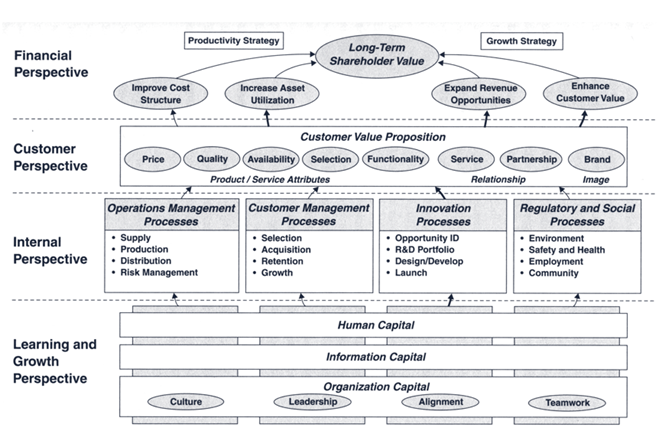
General structure of a strategy map.
Here you can find the 🔎IP Management Glossary entry on Strategy Maps.
The balanced scorecard can translate this into objectives, measures, targets, and initiatives. The financial perspective may focus on long-term value options rather than immediate returns. The customer perspective may focus on future use cases and problem relevance. The internal process perspective may focus on invention capture, IP landscaping, freedom-to-operate monitoring, and portfolio review. The learning and growth perspective may focus on quantum literacy, interdisciplinary competence, and collaboration routines.
Such a scorecard helps avoid a common mistake: treating IP as a legal afterthought. In quantum technology, IP must be embedded in the innovation system from the beginning. It should guide choices about collaboration, publication, secrecy, patenting, licensing, and market positioning.
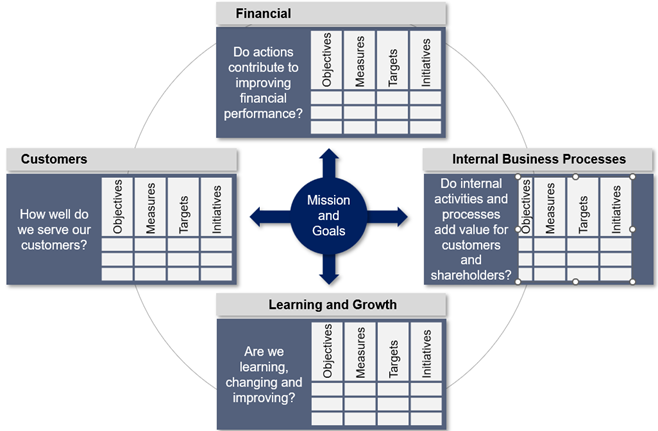
Example of a Balanced Scorecard (BSC) Structure.
Here you can find the 🔎IP Management Glossary entry on Balanced Scorecard (BSC).
Learnings from this lecture
The lecture on IP Management Control Systems shows that controlling is not merely about measurement. It is about enabling better management under complexity. For intellectual property, this means creating a system that links legal rights to strategy, value creation, portfolio structure, and market impact.
Quantum technology makes this challenge particularly visible. Because the field is uncertain, long-term, and ecosystem-based, IP controlling cannot rely on classical output indicators alone. It must measure readiness, learning, positioning, uncertainty reduction, and strategic option creation.
The central lesson is that IP controlling must evolve from a backward-looking reporting function into a forward-looking management system. In established technology fields, IP controlling may focus on optimizing existing portfolios. In quantum technology, it must help organizations build the foundations for future competitiveness.
This changes the role of IP itself. IP is no longer just a protective layer around finished products. It becomes a strategic instrument for shaping innovation pathways, securing future options, enabling collaboration, and positioning the organization in emerging value systems. In that sense, IP controlling in quantum technology is not about counting what already exists. It is about making the future manageable.