LinkedIn as Conversation Architecture: How IP Expertise Turns into Qualified Inquiries

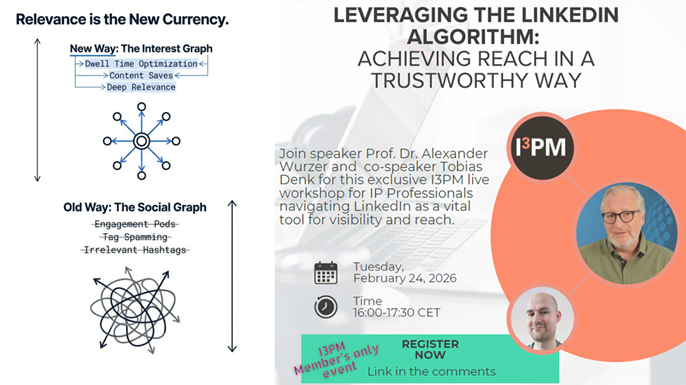
A recap of the I3PM training session on 24 February 2026, led by Prof. Dr. Alexander J. Wurzer and Dr. Tobias Denk.
Most LinkedIn frustrations sound like “I post, but nothing happens.” The I3PM session “Leveraging the LinkedIn Algorithm: Achieving Reach in a Trustworthy Way” offered a reset: reach is not the goal. The goal is a steady flow of conversations with the right people, created because your profile and your content make three things clear: who you help, what problem you solve, and what evidence supports your claim.
A core theme ran through the workshop: the algorithm rewards signals that improve user experience. If you design for clarity and usefulness, you can earn attention without compromising trust.
1 . The structural reality: a market gap for authority
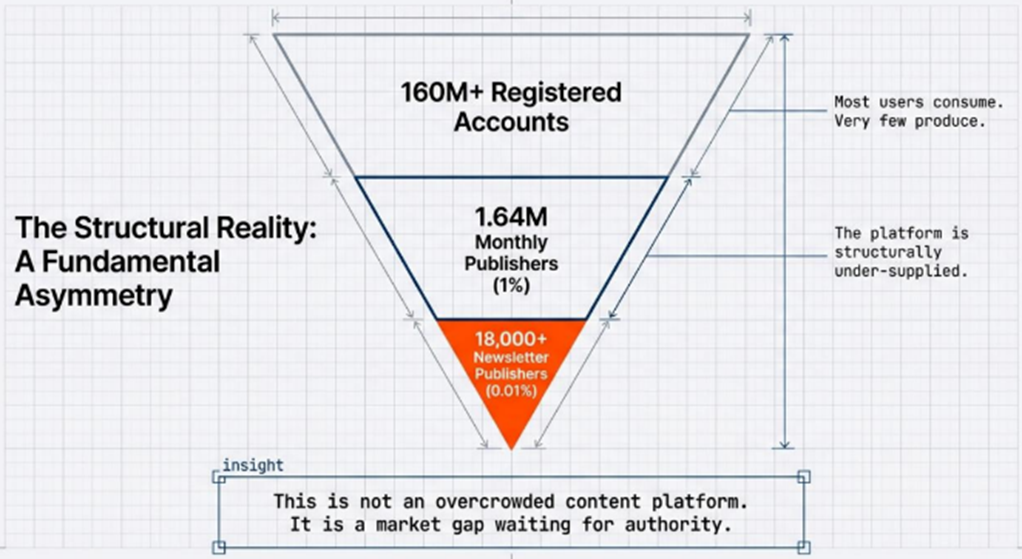 A slide early in the deck visualized a basic asymmetry: many registered accounts, but only a small minority publishes regularly, and an even smaller fraction publishes higher effort formats such as newsletters. The conclusion was optimistic: the platform is structurally under supplied with specialized, useful authority. If you publish for a clear audience, you are filling a gap rather than shouting in a crowd.
For IP professionals this is particularly relevant. Much of the work happens behind confidentiality, so “proof” must be translated into public signals: your thinking, your frameworks, and your ability to reduce risk for decision makers.
2 . LinkedIn as “conversation architecture”: order matters
The session framed LinkedIn success as a building with levels. At the bottom sit foundations (understanding profiles, posts, and basic mechanics). Higher levels cover communication design, positioning and narrative, then business goal alignment, and finally measurement and optimization. The warning was explicit: skipping foundations means you try to convert cold attention without a stable system.
This model explains why “better posts” alone often do not help. If your positioning is unclear, you may be seen, but not remembered, and visibility does not become inquiry.
3 . Profile first: from digital CV to landing page
One of the core contrasts was “digital CV” versus “conversion landing page.” A CV is backward looking and biographical. A landing page is forward looking and solution oriented. The deck attached a simple insight: your profile determines whether attention converts into meaningful interaction.
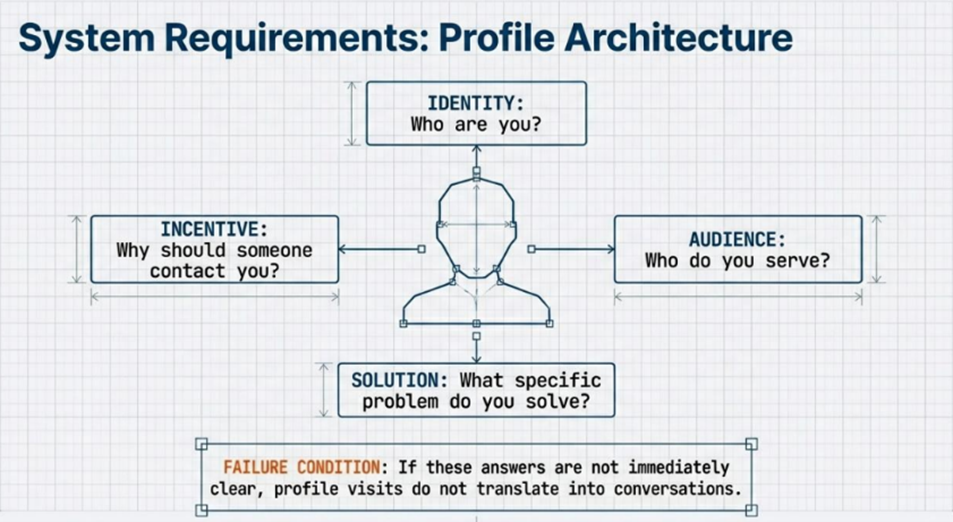 To make that concrete, the speakers used four profile questions (shown as system requirements):
1 . Identity: who are you.
2 . Audience: who do you serve.
3 . Incentive: why should someone contact you.
4. Solution: what specific problem do you solve.
Headline: value before qualification
Because the headline appears next to every post, it works like a constant positioning label. The session recommended moving beyond job titles and toward value statements that name audience and outcome, for example “Helping MedTech teams secure software enabled innovation across Europe” rather than only “European Patent Attorney.”
 About section: a structured narrative
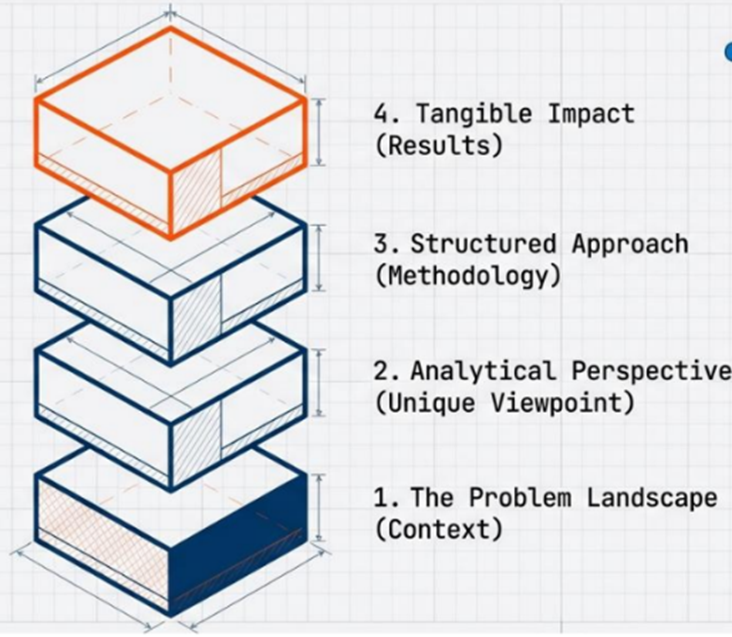
The “About” section was presented as a strategic narrative in four parts: context (the problem landscape), your viewpoint (what you see that others miss), your methodology (how you work), and your impact (results). The instruction was to avoid biography and instead answer the reader’s silent question: “What can this person do for me, and how will it work?”
Evidence: make your expertise verifiable
A separate slide framed the “Featured” section as visual proof. It turns a claim into verification by linking to case studies, frameworks, articles, talks, and other applied material. In short: reduce the effort needed to trust you.
Reduce cognitive friction through consistency
Visual and thematic consistency were treated as conversion levers. The deck connected consistency to familiarity, lower mental effort, and higher conversion, with a simple checklist: banner, profile image, terminology, and thematic focus.
4 . Findability: LinkedIn is a search environment
The deck also treated LinkedIn like a search engine. Findability is influenced by headline keywords, About section context, experience descriptions, and skills taxonomy. Generic wording dilutes positioning, specific problem oriented wording strengthens it.
A practical implication was emphasized in the discussion: after meeting you offline, people often search your name, and your LinkedIn profile becomes the first impression that decides whether they explore further.
5 . The operating system: routine beats inspiration
 Professional LinkedIn use needs operational infrastructure: a simple workflow, content templates, link management, and a way to track outcomes. Without routine, usage becomes reactive consumption.
The deck offered “system diagnostics” to locate bottlenecks, such as high profile views but low inquiries, unclear specialization, or visibility without measurable outcomes. The underlying message: no algorithm optimization can compensate for a weak foundation.
6 . The algorithm lens: signals, not magic
On the algorithm side, the slides referenced monitoring work by AuthoredUp and analysis by Richard van der Blom based on a large dataset from late 2025. The summarized changes included lower overall reach, longer post visibility, stronger performance of carousels, higher value of reposts and saves, and reduced reach when links are placed directly inside posts.
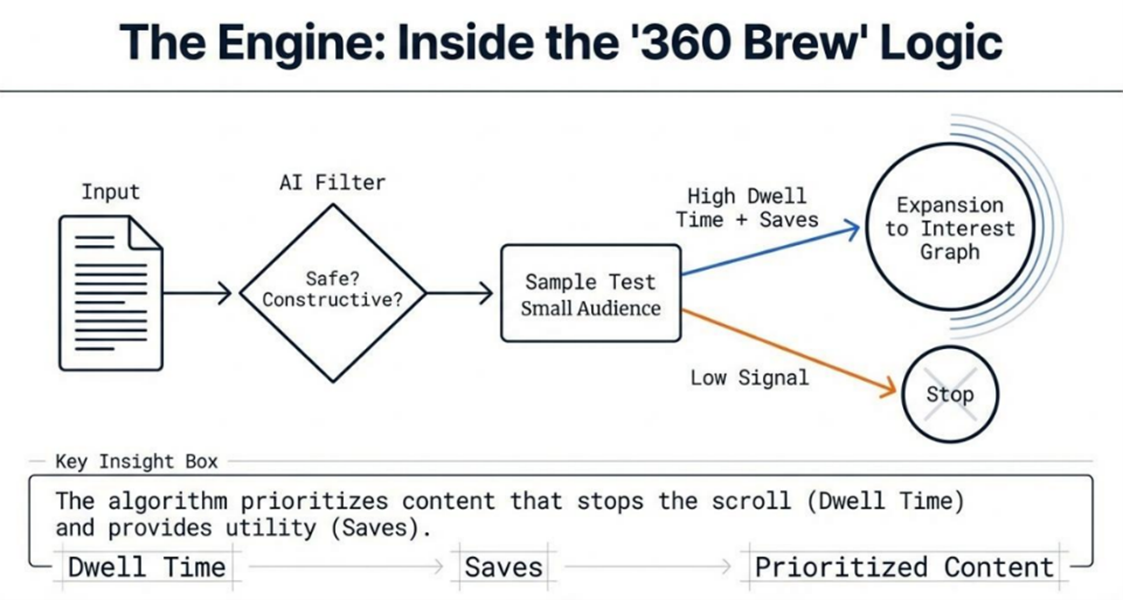 From the live discussion, one phrase landed strongly: the “social graph” is largely dead as the main distribution engine. Follower counts matter less than relevance signals. Specificity helps the algorithm match content with the right audience. Vagueness makes you harder to place.
A slide on feed optimization listed practical signals: relevance, early comments, saves, dwell time, and clicks. The session translated this into an editorial rule: aim for posts people want to save, because saving is a strong indication of value.
Timing and presence also mattered. Publishing and then disappearing wastes the early interaction window. The speakers argued that scheduling posts can reduce the most important part of social media: being present to respond and build conversations while momentum forms.
7 . What “trustworthy reach” looks like in practice
The session’s trust principle can be summarized in three choices. Respect time, reduce friction, and be helpful and specific. Niche content is not a limitation, it is the condition for repeatable usefulness and therefore for trust.
A short checklist to apply this week
1 . Rewrite your headline to name audience and outcome.
2 . Rebuild your About section with context, viewpoint, methodology, impact.
3 . Curate your Featured section so proof is one click away.
4 . Remove friction through visual and thematic consistency.
5 . Use a simple routine: post, respond, review analytics, repeat.
6 . Write posts that earn saves: frameworks, templates, examples.
7 . Stay present after publishing and turn early comments into conversations.
The most useful reframing from this I3PM session was that LinkedIn success is built, not hacked. Build clarity first, publish consistently, and let the algorithm measure the interest you have genuinely earned.