
The Positioning Shift: How IP Experts Become the Clear Choice

The Positioning Shift: From Expert to Choice
Summary of the Independent by Design IP Expert Support Live Session (24 February 2026)
Most IP experts do not have a competence problem. They have a translation problem. The session opened with a pattern you and your team see repeatedly: outstanding technical work, yet an unclear market perception. The consequence is frustratingly familiar. The right clients do not reach out, not because the expert is not good enough, but because the outside world cannot quickly understand why this particular expert is the safest choice for a specific situation.

_____________________
“I loved the forum provided for like-minded people exploring how to better provide the value that we each individually have developed over the courses of our respective careers. As AI continues to ‘infiltrate’ society, I find meaning and joy in these types of human interactions.”
Edward Caja, Intellectual Property Counsel
That gap matters more than ever because buying decisions increasingly start before the first conversation. Prospects build an opinion based on digital signals. LinkedIn, articles, talks, comments, search results, and online mentions form a picture long before a potential client sends a message or requests a meeting. In the session, this was framed as the phenomenon of digital judgement. It is not primarily about being visible. It is about perceived fit: whether someone feels you are credible, relevant, and the right choice for their problem.
A short quote used on the slides captures the point: “Your brand is what other people say about you when you’re not in the room”, often attributed to Jeff Bezos. The practical takeaway is not to obsess over personal branding as aesthetics, but to treat digital perception as a decision environment that can be shaped intentionally.
Why expertise alone does not convert
A central idea of the session was that technical expertise is largely invisible until after engagement. Clients cannot truly evaluate depth, judgement, and execution quality until they have worked with you. In early stages, they rely on proxies. The slides named three of them: reputation, clarity, and fit. This is why the positioning shift is not about claiming more expertise. It is about making the right kind of cues easy to grasp for non-specialists, under time pressure, in a complex market.
This also explains a common mismatch between how experts present themselves and how clients choose. Experts tend to value completeness and focus on the how. Clients value safety and look for coherence, consistency, and confidence. If you do not provide simple cues that reduce perceived risk, decision makers fall back to substitutes like price, brand size, or familiarity. In other words, the market does not reward the most comprehensive profile. It rewards the most legible relevance.
The layer model behind a strong online presence
To structure the problem, the session used a layered model for designing an online presence. At the foundation sit the technical basics: profile setup, keywords, and the “nuts and bolts”. Above that are platform mechanisms and algorithms, then communication design, then positioning and narrative, and finally communication strategy plus measurement and optimisation. The key message was that consistency across layers creates a coherent image that supports conversion over time.
This is an important reframing for many IP experts. Positioning is not “just the headline on LinkedIn”. It is a system that coordinates signals across multiple touchpoints so that the same promise becomes recognisable in different formats and contexts.
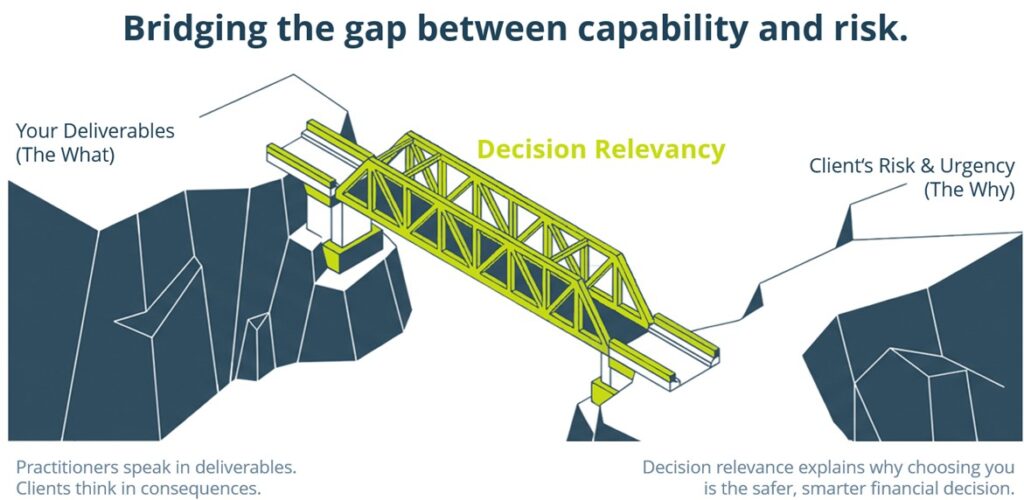
From deliverables to decision relevance
A practical bridge presented in the session was the move from deliverables to business consequences. Practitioners naturally speak in deliverables: filings, audits, opinions, clearance, portfolio work. Clients think in consequences: exposure, timing, bargaining power, surprises, costs, enforceability, and certainty. Positioning becomes stronger when an expert can translate the deliverable into what changes for the client, and why that matters now. The slides called this decision relevance, “bridging the gap between capability and risk”.
A simple translation table on the slides illustrated the concept. “Patent filing” becomes “protecting options, timing, and bargaining power”. “IP audit” becomes “reducing exposure, rework, and surprise escalations”. The deliverable stays the same, but it becomes legible to non-specialists because it is expressed in the client’s language of risk and consequence.
This also explains why long lists of generic services often weaken positioning. A list may be accurate, but it forces the prospect to do the translation work. The session argued that prospects do not want to invest high search costs. They want a quick, reliable match between their problem and your competence.
Stop selling solutions. Start guiding decisions.
Another turning point in the session was the distinction between selling solutions and guiding decisions. Many clients are not choosing between two experts. They are choosing between competing priorities. They weigh trade-offs such as speed versus certainty, scope versus cost, and coverage versus enforceability. When you help them see those trade-offs clearly, you become a guide rather than a vendor. That guidance itself becomes part of the value, because it reduces uncertainty and improves the quality of the decision.

_____________________
“The live session “The Positioning Shift – From Expert to Choice” was a compelling and highly relevant example, how IP experts are supported by IPBA in the transformation from selling detailed solutions to guiding clients’ decisions. Excellent examples were given how to build a strong online presence, adapted to the respective focus fields to attract clients attention. I can strongly recommend to grasp the next opportunity to watch this live session.”
Udo Gennari, Business Upper Austria.
This framing is especially relevant in IP because symptoms are often ambiguous. A client may sense risk but not know the underlying problem, the sequence of steps, or the reasonable next decision boundary. The session repeatedly returned to the idea that clients buy clarity and safety, not tasks in isolation.
Examples of clear positioning in practice
The session used several concrete examples of experts who communicate in a way that quickly creates fit. Two early illustrations showed how consistent education signals expertise: posts and profile elements that repeatedly connect a niche topic with client relevant meaning. The point was not imitation of style, but repetition of a clear message until the market learns what you stand for.
 _____________________
“The session “The Positioning Shift: From Expert to Choice” provided valuable insights on the way IP experts should position themselves towards future clients. Instead of focusing on your own capacities and expertise, Prof. Wurzer very clearly and convincingly explained to focus on the clients’ problems instead. Also IP experts should refrain from using difficult language, but speak business consequences.”
Laurens Kamp, Rightlane B.V.
A related insight came from the “sell twice” idea referenced in the live discussion: IP experts often need to establish why IP matters and then why they are the right person once IP matters. That reinforces the need to combine the what with the why in every visible signal, especially in the profile header and early content formats.
Positioning under confidentiality: show patterns, not cases
A frequent objection for IP professionals is confidentiality. If you cannot discuss clients or outcomes, how can you prove anything? The session answered this directly: confidentiality does not prevent positioning, it changes what you show. Instead of specific case details, you make recurring patterns visible. Examples named on the slides included ownership clean up, inventor coordination, and licensing readiness. Patterns demonstrate experience and judgement without exposing sensitive information.
 _____________________
“The session showed me what matters when positioning as an IP expert. It is clearly demonstrated how the platform provides a safe environment and tools for building a profile with a signature step by step.”
Georg Schmitz, Huber & Schüssler Patentanwälte
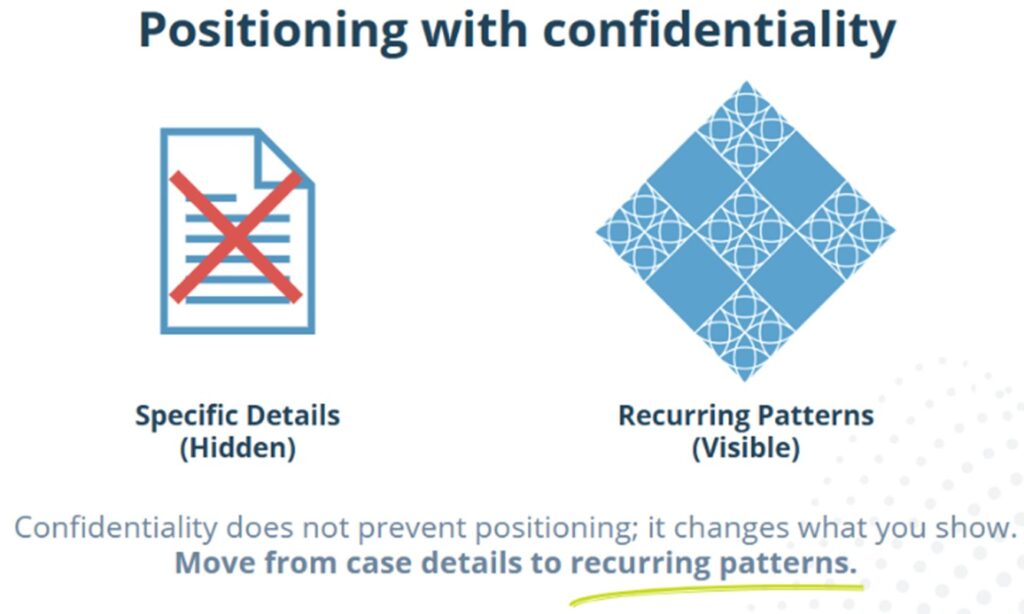 This is a powerful relief for many experts. It means you can publish without breaking confidentiality by teaching the typical decision situations you repeatedly see and the boundary conditions that make outcomes succeed or fail. In a complex market, pattern clarity is often more helpful than case storytelling anyway.
Your process is a sharable asset
Beyond patterns, the session highlighted process as a trust asset. Clear stages, governance gates, checkpoints, and decision boundaries create confidence without revealing confidential material. Many clients fear ambiguity more than they fear fees. When you state how collaboration works, what inputs are needed, what happens when, and where decisions must be made, you reduce uncertainty and increase perceived control.
In practical terms, process clarity becomes another signal of fit. It tells a prospect, “This person has done this before, and there is a safe path through the complexity.”
Signals across the customer journey
Positioning becomes real through signalling across a client journey, not through a single post. The slides mapped four stages: awareness, consideration, decision, and engagement. Each stage has a different job. Awareness is emotional and creates recognition and trust. Consideration is more rational and help oriented, using formats like checklists, webinars, and white papers. Decision is where proof assets matter: project descriptions, testimonials, cost benefit ratios, and consultative conversations. Engagement focuses on relationship building, retention, and continuing value after the purchase decision.
This is where many experts unintentionally break consistency. They post occasionally on LinkedIn but have no supporting assets for consideration. Or they have expertise but no proof format that reduces perceived risk at the decision stage. Or they deliver excellent work but underestimate post engagement communication, even though long term relationships often produce repeat work and referrals. The session made the case that each stage needs a tailored format mix, aligned with the same underlying positioning.
The slides also framed downloads as signals: white papers and checklists are not only helpful, they reveal information needs and create additional interaction points while reducing friction for the client. Case studies were positioned as particularly useful when introducing new offerings or tools, because they reduce uncertainty and support buying decisions.
Demand appears when clarity meets risk
One slide summarised the commercial logic in a single sentence: demand appears when clarity meets risk. People buy when they feel a specific problem is understood and can be restored safely. In that framing, demand is not about how much the expert knows, but about how well the client understands what changes if they choose that expert. It is a crisp definition of the positioning shift, and it explains why “more content” is not the goal. Clearer signals are the goal.
The support ecosystem at IPBA Connect
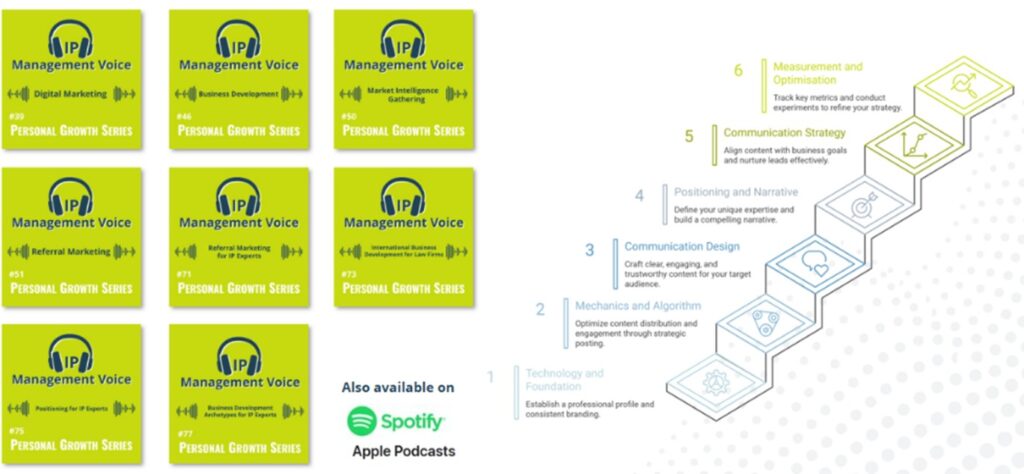 The session closed by mapping the positioning topic into the wider Independent by Design IP Expert Support system. The presentation referenced resources that cover multiple layers: the newsletter, live sessions, upcoming masterclasses, tools and guides, a resource hub, and podcast episodes aimed at online marketing and business development for IP experts. Specific examples included a “Smart on LinkedIn” guide, client persona development material, an online marketing strategy configurator, and video courses such as referral marketing for IP experts. The announced roadmap also included additional live sessions on outcome offers, proof assets, and operational freedom, plus a masterclass positioned as a small group workshop to craft a positioning statement, content pillars, an offer ladder, and a short term proof plan.
The shift from “expert” to “choice” is not a change in competence. It is a change in legibility. When your digital signals consistently translate deliverables into consequences, show patterns instead of cases, and guide decisions instead of listing services, clients can finally recognise fit quickly, and that recognition is often the beginning of trust.